
Internet · Canada
CRTC Internet Code in Plain English: Contracts, Notices, and Your Switching Rights
Most people meet the Internet Code when a bill is already wrong. The Code is older than that fight. It has been in effect since 31 January 2020, and it is the reason a large Canadian ISP is supposed to show you the price during a promo, the price after, and the date the promo ends, before you need a complaint. This is a plain-English map of the parts households actually use, plus the 2026 fee decisions that people keep gluing onto the wrong product. It is not legal advice, and it is not a CCTS outcome.
Disclosure: Education only. No affiliate offer belongs on a rights page. Saving Optimizer does not file complaints and has no ISP partnership.
Key takeaways
- The simplified Code (read 21 Sep 2026) binds named large facilities-based ISPs. TekSavvy, Oxio, and Fizz are not on that list. CCTS membership is a separate check.
- You should get a permanent contract and a Critical Information Summary that includes during-and-after promo prices, the end date, the trial, and how to reach the CCTS.
- A new 90-day email before a long promo expires was added in CRTC 2026-67 and is enforced from 13 Apr 2027. Do not skip your own calendar in 2026.
- Usage alerts hit at 75 percent, 90 percent, and 100 percent of a cap. Unlimited plans are not supposed to generate overage, unless a fair-use limit was disclosed.
- Trial: 15 days, or 30 if you self-identify as a person with a disability, when an ETF applies. Activation fees without a technician are a 2026-43 issue. Internet ETFs are not banned. Complain to the ISP, then the CCTS.
Who the Internet Code covers (and which small ISPs may differ)
The simplified Code says it applies to large facilities-based Internet service providers, namely Bell Canada, Cogeco Connexion, Eastlink, Northwestel, Rogers, SaskTel, TELUS, Videotron, and Xplore. It applies to retail fixed internet for individual customers, in every province and territory, standalone or in a bundle, bought in person, online, or by phone. Mobile data is the Wireless Code, not this one. That split is why a 2026 “cancellation fees are banned” headline keeps landing on the wrong bill. The ETF guide is the longer version.
The Code applies in full to new, renewed, and amended contracts. For contracts that already existed when it started, some sections (including parts of the contract-content and cancellation machinery) were carved out. If you have had the same untouched agreement since before 2020, do not assume every sentence below is retroactive. Ask which version you are on.
Wholesale retailers are the gap readers care about. TekSavvy and Oxio buy access to those networks. Fizz is a Videotron flanker with its own retail terms. The Code’s list does not name them. Some consumer protections in their contracts are similar because the market copied the Code, or because a given company is in the CCTS. Similar is not “the Code applies in full.” Read the retailer. If you need the 15-day trial or the 45-day mismatch cancel, confirm it is in your contract rather than assuming Ottawa put it there.
Clear contract and critical information summary requirements
Before you consent, the offer has to include the key terms, in plain language, including on a phone call or at the door. Prices for promos, discounts, and bundles have to be clear, and the provider has to say whether tax is included. When you agree, you get a contract. In person, that is immediate. At a distance, the Code sets a short delivery window (the simplified text: within the timelines in section B, including a next-business-day style rule for electronic copies in the distance-sale branch). If they miss the window, or the permanent copy conflicts with what you agreed, you may cancel within 45 calendar days of the start without an ETF or other penalty.
The contract is supposed to include, among other items: services and any limit that could trigger overage, the minimum monthly charge during and after a time-limited discount, when that discount ends, the commitment period, early cancellation terms if any, and the trial period with its time and usage limits.
The Critical Information Summary rides with the permanent contract. It has to summarize the key terms, describe the standard trial and the longer trial for customers who self-identify with a disability, describe limits on anything sold as unlimited, and explain how to complain, including the CCTS. You can ask for another copy later, including an accessible format, at no charge. If you do not have this document, ask for it before you argue about a credit. The fight is easier with the page they were required to give you.
Price change and promotional offer notice rules
During the commitment period, the provider must not change key terms without the account holder’s informed, express consent. You can refuse. The exception is a change that clearly benefits you, such as more usage or speed for the same price. A promo that ends on the date in the contract is not, by itself, a mid-term change. It is the second price they were supposed to disclose on day one. If the base rate moves and nobody asked you, that is the clause to quote.
After the commitment, they may change a key term if they give at least 60 calendar days’ notice explaining the change, when it takes effect, and that you can request an updated contract at no charge.
CRTC 2026-67 (Gatineau, 13 Apr 2026) amends the notice rules. Two pieces matter:
- The existing “at least 90 days before a fixed term ends” notice is updated so it goes by the method you selected, and the provider keeps a copy. It still has to say whether the contract will extend.
- New: if a time-limited discount or promo lasts more than three months and will expire before the initial commitment ends, the provider must notify you 90 days before that expiry, by your chosen channel, and keep a copy. The notice includes the expiry date.
The decision says these amendments take effect on 13 Apr 2027, with quarterly progress reports until providers implement them. A simplified Code page may already show the new sentences. Enforcement timing is the decision, not the formatting of the webpage. Between now and April 2027, treat a missing 90-day promo email as a reason to keep your own reminder, not as an automatic Code breach. A missing during-and-after price in the original contract is a different, older obligation.
Short promos (three months or less) are outside that new 90-day rule even after 2027. So are discounts that end exactly when the commitment ends; those lean on the end-of-term notice. Month-to-month resellers with a 12-month credit and no commitment period may never owe you this email. The seven-day framework does not wait for it.
Usage notifications and bill shock protections
If you have a usage cap, the provider must notify you at least once at 75 percent of the limit, again at 90 percent, and again at 100 percent, inside that billing cycle. If they charge overage, they must offer free tools to monitor it, and plain-language examples of what common activities use. When you actually incur overage, they must point you at those tools, at usage examples, and at other plans, once per cycle, unless you opt out.
Unlimited means they must not bill overage for that service, and must not cap it unless the fair-use or acceptable-use policy explains the limit. Read that policy before you run a backup that would have been fine on a capped plan and is “unacceptable” on an unlimited one. The Code also says they cannot charge for a device or service you did not expressly buy. A pod, a insurance-style device plan, or a TV add-on that appeared without a yes is the sentence to use.
Trial period basics for qualifying services
The trial exists when a new customer is subject to an early cancellation fee. It starts the day service begins. Minimum 15 calendar days. Minimum 30 if you self-identify as a person with a disability. Standard usage allowance is half of whatever the contract calls the monthly usage, including however they define half of unlimited. The disability trial’s usage floor is at least double the standard trial’s cap. You can cancel without the ETF if you stayed under that usage and returned equipment in near-new condition, packaging included if they say so.
This is not a 60-day satisfaction guarantee. Oxio’s 60-day policy is Oxio’s. The Code trial is shorter, and it only attaches when an ETF exists. If you are month-to-month with no ETF, you do not need the trial in order to leave. If you are on day 16 of a term and over the usage cap, you are past it. Self-identifying for the 30-day trial is your step to take at signup, not after a dispute starts.
How the Code interacts with 2026 activation/modification fee bans
CRTC Telecom Regulatory Policy 2026-43, in force 12 Jun 2026, restricts fees whose point is to penalize activating or changing internet or wireless service, and it changes the Wireless Code so a mobile ETF is not charged when the provider did not subsidize a phone. The CCTS explainer dated 2 Sep 2026 is the household translation: new-account and no-technician install or plan-change fees are generally not allowed; a technician who actually comes to the home can still be a reasonable charge; optional products you chose, reconnection after non-payment, equipment you do not return, and a contracted internet fixed-term ETF can still appear.
The Internet Code’s own ETF rule was not repealed. For fixed-term internet, an ETF has to be set out in the contract, can apply only for the lesser of 24 months and the term, and has to decline to $0 by the end of that period. Month-to-month internet should not have one. Notice of Consultation work in 2026, including CRTC 2026-155, has kept pressure on fees that got renamed rather than removed. If a “setup” charge survived 12 Jun 2026 under a new label, say so in the complaint and cite 2026-43. Do not cite it to erase a declining term ETF that the contract actually discloses.
Connecting Families does not waive a retail ETF. ISED has said leaving a promo or contract to join can still leave an amount owing. The Code and the $10 or $20 program are different instruments.
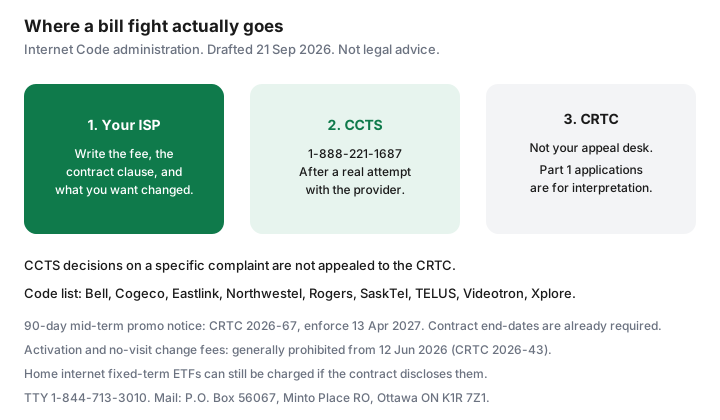
Where to complain: provider, then CCTS, then CRTC pathway
- Provider, in writing. Name the charge, the date, the contract clause or the missing summary, and the fix you want (credit, corrected rate, cancelled ETF). Keep the reply. Pay the parts of the bill you do not dispute so a shutdown is not the story.
- CCTS if the reply is no, or silence after a real chance to answer. Phone 1-888-221-1687, TTY 1-844-713-3010, web form at ccts-cprst.ca, mail P.O. Box 56067, Minto Place RO, Ottawa, ON K1R 7Z1. The Code says you try the provider first. CCTS can interpret the Code for your complaint. It will not invent a lower rate because a forum had one.
- CRTC is not the appeal of that decision. The Code says CCTS outcomes on a complaint are not appealed to the Commission. Providers who want a general interpretation can file a Part 1 application. Your next step after an unsatisfactory CCTS result is whatever remedy CCTS gave you, not a parallel CRTC case you sketch from a blog.
Switching rights, in practice, are the trial, the 45-day mismatch window, the rule that an ETF must shrink, the ban on no-visit activation fees, and your freedom to take a month-to-month plan or an independent once the numbers work. None of them are a coupon. Use the address quotes first so the complaint is about a fee, not about a price you simply dislike.
Sources & date stamps
- CRTC, The Internet Code, simplified — crtc.gc.ca/eng/internet/codesimpl.htm. Application list, contract and summary contents, 45-day cancel, 60-day post-commitment notice, usage alerts at 75/90/100 percent, trial period, unlimited-use rule, CCTS path. Read 21 Sep 2026.
- CRTC, The Internet Code: Protecting your rights — crtc.gc.ca/eng/internet/code.htm. Short public version of clear prices, 45 days, 15-day trial, ETF horizon.
- Telecom Regulatory Policy CRTC 2026-67 (13 Apr 2026) — promo-expiry and end-of-term notice amendments; in force 13 Apr 2027.
- Telecom Regulatory Policy CRTC 2026-43 (in force 12 Jun 2026) and CCTS, “New rules: What fees can internet and wireless phone providers charge?” (2 Sep 2026).
- CRTC Notice of Consultation 2026-155 — referenced as ongoing renamed-fee scrutiny. Re-read the file before you quote a result; this draft does not treat it as a final ban beyond 2026-43.
- CCTS internet help — ccts-cprst.ca/for-consumers/how-we-can-help/internet/.
Frequently asked questions
Does the Internet Code apply to TekSavvy, Oxio, or Fizz?
The simplified Code, read 21 Sep 2026, lists large facilities-based providers: Bell Canada, Cogeco, Eastlink, Northwestel, Rogers, SaskTel, TELUS, Videotron, and Xplore. Smaller retailers are not on that list. They can still be CCTS members. Read their terms, and check CCTS participation before you assume a Code clause is yours.
When does the 90-day promo warning start?
Telecom Regulatory Policy CRTC 2026-67 was issued 13 Apr 2026. It requires a 90-day notice when a time-limited discount longer than three months ends before the commitment period does. The Commission said the amendments are enforced from 13 Apr 2027. On 21 Sep 2026, do not wait for an email the rule does not yet require. The contract should already show the end date.
Can I be charged for going over an unlimited plan?
The Code says a provider must not charge overage for a service purchased as unlimited, and must not limit that use unless the limits are in the fair-use policy. Read the fair-use policy. Unlimited is not a blank cheque if the policy names a consequence.
What is the trial period?
When a new customer would owe an early cancellation fee, the trial is at least 15 days from the day service starts, or 30 days if you self-identify as a person with a disability. Usage during the standard trial is half the monthly allowance in the contract (double that for the longer disability trial). You must return gear in near-new condition, with packaging if they require it.
Who do I call first?
The provider. Then the CCTS at 1-888-221-1687 if you are not satisfied. CCTS decisions on a complaint are not appealed to the CRTC. If a provider is unsure how the Code applies in general, the Code points them to a CRTC Part 1 application. You do not start at the CRTC.