
Transportation · Canada
How Canada’s EVAP EV rebate works in 2026 (what replaced iZEV)
If you are still searching “iZEV rebate,” you are reading a closed program. Transport Canada’s Electric Vehicle Affordability Program (EVAP) is the federal passenger incentive that launched 16 February 2026. It pays at the dealership, caps most transactions at a $50,000 final value (with a Canadian-made exception), and the dollar amount declines every few calendar years. Shoppers who treat it like 2022 iZEV — high MSRP luxury trims, mail-in cheques, “the delivery date is what counts” — miss the rebate or lock a smaller year.
This is a federal how-to with a high-level provincial map, not a model-by-model shopping list. For whether a new EV beats a used gas car after the rebate, use used vs new TCO and the ownership dashboard.
Disclosure: EV shopping/quote tools and home charger deals are offer types. Saving Optimizer may earn a commission if we later add partner links. We do not currently claim dealer or charger partnerships. Confirm eligibility on Transport Canada and provincial sites — not on an ad.
Key takeaways
- EVAP window: 16 Feb 2026–31 Mar 2031, or earlier if the $2.275B envelope is used. Remaining funds $2.131B as of 1 Jun 2026 (Transport Canada).
- 2026 amounts: up to $5,000 BEV/FCEV and $2,500 PHEV at participating dealers for new vehicles (leases ≥ 12 months).
- Most vehicles: final transaction value $50,000 or less. Canadian-made EVs: no that cap. FTA-country production rules apply; Chinese-built vehicles are widely excluded.
- The dealer’s eligibility-assessment date in the portal sets the year on the declining table — not when the truck unloads the car.
- Used EVs are not federal-eligible. Provincial stacks exist in some provinces and vanish in others; check remaining funding the week you buy.
EVAP vs old iZEV: what changed for buyers
iZEV used MSRP bands and ran until funding ran out (closed 31 Mar 2025 in common summaries). EVAP looks at what you actually pay on the eligible portion of the deal, not the brochure price of the trim. A loaded compact that crosses $50,000 on options can lose the rebate even if a stripper version of the same nameplate would have qualified. Conversely, an EV assembled in Canada can sit above $50,000 and still qualify — Transport Canada’s program pages repeat that exception.
Other practical shifts:
- Point-of-sale only. You do not file a federal form as a retail buyer.
- Amounts decline on a published calendar (see next section).
- Production must be in Canada or a country with a free-trade agreement with Canada.
- Car-sharing companies have a separate EVAP lane — not this household article.
Incentive amounts for BEV/FCEV vs PHEV in 2026
| Type | 2026 | 2027 | 2028 | 2029 | 2030–31 |
|---|---|---|---|---|---|
| BEV / FCEV | $5,000 | $4,000 | $3,000 | $3,000 | $2,000 |
| PHEV | $2,500 | $2,000 | $1,500 | $1,500 | $1,000 |
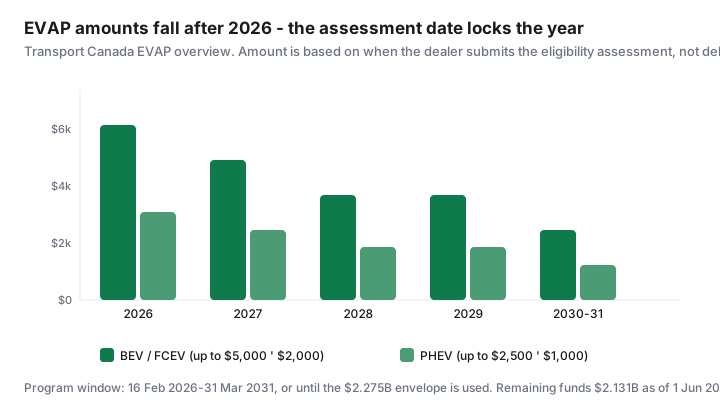
Worked example (labelled): a $48,000 final-transaction BEV purchased in October 2026 with the assessment submitted in 2026 = up to $5,000 off at the till (taxes still apply on the reduced price as the dealer invoices it). Same car if the dealer sits on the portal file until 2 Jan 2027 = $4,000 column. That $1,000 is a calendar problem, not a trim problem.
The $50,000 final transaction value rule — and Canadian-made exceptions
Transport Canada’s landing page: incentives for transactions with a final value of $50,000 or less, and no final transaction value limit on EVs made in Canada. Public Q&A and dealer explainers (reviewed 2026) commonly treat the $50,000 as including MSRP, options, packages, accessories, and dealer fees, and excluding taxes, PDI/freight, extended warranties, winter tires, luxury tax, and registration. Do not trust a forum screenshot. Ask the dealer to show the line they will send in the assessment.
The official vehicle list is a convenience, not a prison: if a vehicle is off the list but meets the rules and the $50,000 test (or is Canadian-made), the transaction can still qualify. If it is on the list but your loaded deal is $51,400, it may not. Chinese-built EVs have been excluded from federal eligibility in 2024–2026 policy — another reason to read the live list, not a U.S. IRA explainer.
Negotiation implication: it can be rational to drop a $1,800 option package to stay under $50,000 and keep a $5,000 incentive. It is not rational to add $2,000 of accessories “because rebate.” Used EVs do not get EVAP; a CPO bolt-on will not sneak in.
Point-of-sale process at participating dealers
- Confirm the dealer is enrolled. Non-participating roofs exist. If they cannot show the portal, walk.
- Agree a bill of sale that keeps you eligible (transaction value, new VIN, Canadian registration, driver’s licence).
- Dealer submits the eligibility assessment. Ask for the submission date in writing if you are near 31 December.
- Incentive is deducted on the invoice. You finance or pay the after-incentive amount (plus tax as invoiced).
- Register the vehicle in Canada. Exporting or flipping against program rules is how people get clawed back — read the Q&A if you are not keeping the car.
Households typically get one personal incentive per person for the life of the program in public summaries; businesses have a separate cap. If two adults each want a rebate, that is two files, two VINs, two sets of eligibility — not a loophole, just paperwork.
Lease length pro-rating basics
Leases must run at least 12 months. Transport Canada’s vehicle list publishes 2026 purchase/48-month lease at the full $5,000 BEV, then 36 / 24 / 12 month columns (examples on the list: $3,750 / $2,500 / $1,250 for a $5,000 BEV). A 12-month lease is not a cheap way to grab the full $5,000. If you will keep the car four years, buying or a 48-month lease is the column that matches the full amount. Exact factors live on the current list — copy the row for your VIN’s model year, do not invent a fraction.
Stacking with provincial programs (high-level map)
Federal and provincial programs are separate applications or dealer flows. Canada.ca says they can be combined where both exist. The 2026 map is thinner than 2022. Verify the provincial site the week you shop; this table is orientation, not a guarantee of remaining funds.
| Province / territory | Typical 2026 passenger stack with EVAP |
|---|---|
| Quebec | Roulez vert still paying a reduced amount (about $2,000 BEV in 2026 public guides) and scheduled to end 31 Dec 2026; used BEV and charger amounts may still exist. Stack on top of federal if eligible. |
| Prince Edward Island | Among the last generous Atlantic passenger rebates (public figures around $4,000 BEV / $2,000 PHEV). Tesla exclusions appear in some provincial rules. |
| Manitoba | MPI-linked rebates were extended in some 2026 budget copy and reported ended 31 Mar 2026 in others. Treat as verify today — do not budget $4,000 from a blog. |
| Ontario, Alberta, Saskatchewan | Federal EVAP only for the vehicle in standard 2026 round-ups. Charger utility programs may still exist separately. |
| British Columbia | CleanBC passenger rebate wound down in 2025; BC Hydro charger amounts may remain. Vehicle = federal. |
| NS, NB, NL, Yukon | Passenger rebates paused or ended 2025–2026 in public summaries. Federal only unless a new announcement appears. |
Home Level 2 chargers are a different envelope (utilities, some provincial top-ups). Price the charger as a home project, not as “part of EVAP.”
Verify funding remaining before you shop
Transport Canada publishes remaining EVAP funds on the program home page. As of 1 June 2026 they showed $2.131B of $2.275B. That is healthy relative to iZEV’s sudden pause — it is not a reason to ignore the meter in 2028. Dealers also run out of patience and portal access. Before you take a day off work:
- Open tc.canada.ca EVAP and note remaining funds and the vehicle list date.
- Open your provincial program page and note whether it is accepting applications.
- Ask the dealer, in email: enrolled in EVAP? Assessment submitted in which calendar year? Transaction value they will file?
- Re-run TCO with and without the $5,000. If the deal only works with a provincial stack that might be closed, it does not work.
EVAP is a discount on a car you should already want to own. It is not a reason to buy a $50,000 vehicle to “use the rebate” if car-share and transit would have been cheaper. The federal government is not paying your parking stall.
Sources & date stamps
- Transport Canada, Electric Vehicle Affordability Program home — 16 Feb 2026 start, $5,000 / $2,500, $50,000 rule, Canadian-made exception, $2.275B / $2.131B remaining as of 1 Jun 2026.
- Transport Canada, EVAP overview — declining yearly table; assessment-date rule; 12-month minimum lease; end date 31 Mar 2031.
- Transport Canada, EVAP vehicle list — lease pro-rating columns; list is indicative; Canadian-made cap exemption noted.
- Canada.ca electric vehicle incentives hub — federal vs provincial stacking at a high level.
- ThinkEV, “EV Incentives Canada 2026” (11 May 2026) — provincial thinning; treat as a map to official pages, not the official page.
Frequently asked questions
Is iZEV still available?
No. iZEV funding paused and the program closed in 2025. EVAP is the live federal passenger program, in effect 16 Feb 2026 through 31 Mar 2031 or until funds run out. Do not use old iZEV MSRP rules.
How much is the 2026 rebate?
Up to $5,000 for eligible battery-electric and fuel-cell vehicles and up to $2,500 for plug-in hybrids, applied at participating dealers. Amounts fall in later calendar years. Leases of 12 months or more are pro-rated.
What is the $50,000 rule?
Most vehicles must have a final transaction value of $50,000 or less — options and dealer fees count; taxes, freight/PDI, winter tires, and extended warranties are typically excluded per program explainers. Canadian-made EVs have no transaction-value cap. Confirm Transport Canada’s current definition on the bill of sale.
Do I apply myself?
No. The dealer submits an eligibility assessment through Transport Canada’s portal. The year of that submission, not delivery day, sets the incentive table. Ask the dealer to submit before year-end if you are shopping in December.
Can I stack provincial rebates?
Often yes where a provincial passenger rebate still exists. Quebec’s Roulez vert is reduced and scheduled to end 31 Dec 2026. PEI remains comparatively generous. Ontario, Alberta, Saskatchewan, and several others are federal-only. Verify the provincial site the week you shop — envelopes close.