
Transportation · Canada
How to calculate your real cost of owning a car in Canada (2026 framework)
Owners track the loan, or they track gas, and then they are shocked that the car “costs more than I thought.” Ratehub’s 2026 Canadian average is $1,373 a month in cash: principal, interest, fuel, maintenance, admin, parking, insurance. Statistics Canada still files transportation among the household’s largest spending chunks (Ratehub cites 15% of spending, behind shelter and food). Your number will not be $1,373. The framework is how you find yours — including provincial fees and the parking line that national averages either over- or under-state.
Once the dashboard exists, compare it to car-share, a fare cap, and used vs new. Insurance shopping is coverage first, not a banner premium.
Disclosure: Insurance quote tools and auto-loan comparison tools are offer types. Saving Optimizer may earn a commission if we later add partner links. We do not currently claim insurer or lender partnerships. This framework is not credit, tax, or insurance advice. CRA taxable-benefit rules on employer parking are high-level only.
Key takeaways
- Ratehub (29 Apr 2026): $1,373/month blended · $1,504 new · $1,343 used. Nine years: $139,716 / $152,292 / $120,420.
- Loan principal + interest is $714 of that average before the wheels move. A paid-off car is a different dashboard (~$659 on their non-loan lines, before you swap in real parking and insurance).
- Parking $200 and insurance $164 are placeholders. Condo stalls, street permits, and FSRA-shopped premiums will not match.
- Count opportunity cost of cash tied in the vehicle if you could sell it — especially against 19% card debt.
- Per-km only after the monthly stack is honest. A car that sits still costs hundreds.
Cash costs vs opportunity cost of capital
Cash costs leave a bank account this month: loan or lease, insurance, fuel, parking, maintenance, registration, tickets, car wash you actually buy. Opportunity cost is the equity in a paid-off car (or your down payment) that could retire 8% debt or sit in a high-interest savings account. Worked example (labelled): $12,000 equity in a hatchback. At 4% it is $480/year (~$40/month). Against a 19.99% card it is much more. Put $40–$80 on the dashboard as a grey line if you like; do not pretend it is $0 because no bill arrived.
Do not double-count: if you include monthly principal, you are already capturing cash that builds equity (and the asset is depreciating). If you paid cash, skip principal and instead track market-value decline plus opportunity cost.
Insurance, registration, and inspection by province
Ratehub’s insurance placeholder is $164/month ($143 in 2025 in their YoY table). Ontario urban theft ratings and Québec’s split public/private system will not match that. Quote the VIN; shop at renewal with a coverage sheet.
Registration and inspection are provincial nickels that add up:
- Ontario: licence plate renewal, DriveTest/licensing, emissions where applicable historically — check current MTO fees. Safety Standards Certificate on used transfers.
- B.C.: ICBC insurance is bundled with basic coverage in ways Ontario is not; optional add-ons are a second shop.
- Québec: SAAQ registration plus private damage insurance.
- Prairie and Atlantic: renewals and winter-readiness rules differ (Québec winter-tire mandate vs Ontario’s insurance discount).
Put last year’s registration and licence fees / 12 on the dashboard. If you cannot find them, $10/month (Ratehub’s admin line) is a floor, not a ceiling.
Parking: street, condo, and workplace
Ratehub uses $200/month. That is a modelling convenience. Replace it:
- Condo stall: what you pay (or what a neighbour rents comparable stalls for if it is “included” in fees — it still has a price).
- Street permit: City of Toronto residential permit rates vary by area; other cities have their own. Tickets are parking too.
- Workplace: if the stall would cost $250 on the open market, that is part of compensation. CRA can treat some employer-provided parking as a taxable benefit — high-level: do not assume “free at work” is free in tax. Ask payroll or a tax professional for your facts; this guide will not file your T4.
- GO lot reservation vs first-come: a “cheap train” with a $10 day lot × 20 days is $200 before the fare.
Households in Halifax with a driveway and households in downtown Toronto are not in the same sport. The dashboard exists so you stop using someone else’s $200.
Fuel or electricity + maintenance reserves
Ratehub gas line: $165/month in the main 2026 table, with a later note that mid-April 2026 national averages near $1.749/L implied ~$231/month during a price spike, and that Ottawa temporarily paused the federal gasoline excise (announced 14 Apr 2026, pause described as 20 Apr–7 Sep 2026 in their copy). Use your last three fill-ups × 12 / 12, not the news.
Electricity: home off-peak kWh × 0.15–0.20 as a crude Ontario sketch, or your actual hydro line. Public charging can look like gasoline in downtown condos without a stall.
Maintenance reserve: Ratehub $120/month on the 2026 average (up sharply YoY in their table). A new car under warranty can run lower; a salted 12-year vehicle needs a named envelope (tires, brakes, battery, rust). Winter tires are a biannual cash event — amortize them. CAA’s calculator is a second model to sanity-check make/model, not a replacement for statements.
Depreciation and interest if financed
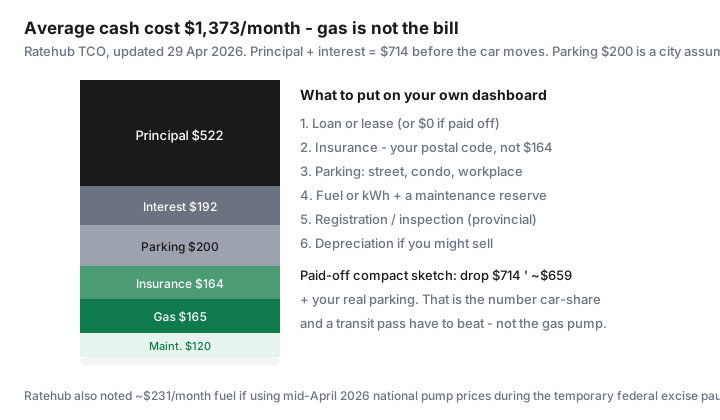
Interest is not optional on a loan: $192/month in the average. Shop the rate as hard as the car (used vs new warns about stretching amortization to decorate a payment). Depreciation: look up typical resale for your nameplate, or track Canadian Black Book style values once a year. If you plan to keep the car until it is scrap, depreciation becomes “I already paid it”; if you might sell in three years, it is a headline.
Per-km and per-month dashboards
| Line | Your $ / month | Ratehub 2026 avg |
|---|---|---|
| Loan / lease principal | $522 | |
| Interest | $192 | |
| Insurance | $164 | |
| Parking (all places) | $200 | |
| Fuel or electricity | $165 | |
| Maintenance + tires reserve | $120 | |
| Registration / admin | $10 | |
| Cash total | $1,373 | |
| Km this month | 1,200 (example) | |
| Cash per km | ≈ $1.14/km at 1,200 km |
If you drove 400 km, the same $1,373 is $3.43/km. That is how a “cheap” car becomes a luxury relative to GO at $8.16 for 40 km. Per-km is a diagnostic, not a reason to take a longer drive to “amortize insurance.” Insurance already happened.
Compare against transit + car-share alternatives
Build a rival month:
- Transit product: TTC cap up to $155.10 adult, or GO ladder on your pair, or Compass/OPUS locally. See getting around in Canada.
- Car-share: days you actually needed a hatchback × operator day rate + membership.
- Occasional rental or a relative’s car — price honestly, including the social cost if it is not actually available.
Worked sketch (labelled, Toronto): TTC cap $155 + Zipcar two days $156 + $9 membership ≈ $320 versus $1,373 financed ownership or ~$659 paid-off with $200 parking. If you need the car 16 days, the sketch flips; go back to break-even days.
The goal is not to win an argument about cars. It is to stop paying a second rent for motion you could have bought by the hour — or to keep the car with eyes open because shift work is real. Write the dashboard once a year, the week before insurance renews.
Sources & date stamps
- Ratehub, “What is the total cost of owning a car?”, updated 29 Apr 2026 — $1,373 blended monthly, new/used splits, nine-year totals, component table, fuel-spike note, StatsCan spending share.
- CAA Driving Costs Calculator — make/model cross-check (insurance assumptions documented on CAA club pages).
- FSRA auto insurance consumer page — shopping behaviour that changes the $164 line.
- TTC / GO fare pages — transit comparison products (see the TTC and GO fare articles).
Frequently asked questions
What does Ratehub say car ownership costs in 2026?
About $1,373 per month ($16,476/year) on their blended average, or $139,716 over nine years. New averages $1,504/month; used $1,343. Updated 29 Apr 2026. Gas can run higher than their $165 line if pump prices spike — they also cited ~$231 using mid-April 2026 national averages.
Should I include the money tied up in the car?
Yes if you could sell it. Opportunity cost is what that equity could earn in a boring Canadian account or against high-interest debt. It is not a cash bill, but ignoring it makes ownership look cheaper than it is.
Is parking really $200 a month?
That is Ratehub’s modelling assumption, not a law. Downtown Toronto or Vancouver garages can exceed it; a suburban driveway can be $0. Use your stall, permit, or workplace deduction.
How do I compare this to transit?
Put last month’s true car cash (loan, insurance, parking, fuel, reserve) beside last month’s transit, plus a realistic car-share or rental line for trips a bus cannot do. TTC’s 47-trip cap and GO’s loyalty ladder are the transit products to price in the GTHA.
Does this include depreciation?
Ratehub’s published monthly table is cash expenses (principal is a cash out the door; depreciation is partly inside principal if you are financing a wasting asset). Add a depreciation estimate if you bought cash or will sell. Do not double-count principal and market-value loss on the same dollars.