Technology · Canada
Buying a Phone Outright vs Carrier Financing in Canada: The 24-Month Rules and the Real Cost
A phone "for $0 down" is a loan sitting beside a plan. The monthly device payment looks smaller than the price on a store shelf. The number that matters, if you want to leave, is the balance the carrier still requires. Since December 2017 the phone itself is supposed to be unlocked. The Wireless Code still limits how an early cancellation fee, including that balance, can be stretched. This page puts those rules next to a made-up two-path comparison. It does not rank a retailer or a refurbished seller. Plan structures without a phone attached are on cheaper cell plans.
Disclosure: Retailer offer types and refurbished-device offer types are offer types. Saving Optimizer may earn a commission if a partner link is added later. No partnership is claimed. No retailer or refurbished seller is ranked. Education only.
Key takeaways
- From 1 December 2017, new devices must be provided unlocked, and a locked device is unlocked free on request. The Wireless Code says the same thing in section F.1.
- Telecom Decision CRTC 2021-98, 4 March 2021, says device financing tied to a wireless plan is under the Wireless Code, and the balance you must repay when you cancel is an early cancellation fee.
- That fee has to be reduced so it reaches $0 by the end of 24 months, or sooner if the contract is shorter. Financing longer than 24 months does not comply with sections G.1 and G.2.
- A 26 November 2025 staff letter asked questions about a Bell offer to rent a phone and then pay off the remaining balance over 12 months. It is an enquiry, not a ruling.
- Outright plus a bring-your-own-phone plan can cost more in month one and less later. The chart uses made-up inputs. Check real prices on the day you buy.
Why phones are sold unlocked since December 2017
The CRTC news release of 15 June 2017, checked 29 Sep 2026, says that as of 1 December 2017, individual and small-business wireless customers have the right to have cellphones and other mobile devices unlocked free of charge on request, and that all newly purchased devices must be provided unlocked from that day forward. The point of the change, in the release, was a market where you can take a competitive offer without a lock standing in the way.
The Wireless Code, simplified, checked 29 Sep 2026, states the rule as section F.1. Any device a provider gives you for wireless service must be provided unlocked. If a device is, or becomes, locked, that provider must unlock it, or give you the means to unlock it, on request, at no charge. You do not pay an unlock fee to use another carrier's SIM or an eSIM. Roaming on an unlocked phone is the roaming guide.
A Commission letter of 28 November 2025 to Bell, checked 29 Sep 2026, applies that rule to a specific practice. Bell had told the Commission it intended to sell locked phones, for up to 60 days, citing crime at points of sale. The letter says section F.1 requires the device to be provided unlocked, and that paragraph 306 of Telecom Regulatory Policy CRTC 2017-200 requires devices to be unlocked at or before the time of sale. The Commission denies a request to allow the practice temporarily, denies a request to open a proceeding to change the Code, and directs Bell to stop selling locked phones and to unlock, free of charge, phones still locked because of that practice, and to tell the affected customers. If a phone you bought is still locked, ask the provider to unlock it at no charge. This letter is about that practice. It is not a reason to assume every phone in a store is locked.
Device financing and the Wireless Code's 24-month limit on cancellation fees
Telecom Decision CRTC 2021-98, Ottawa, 4 March 2021, checked 29 Sep 2026, is the financing decision. The Commission says device financing plans fall under the Wireless Code because of the link between the financing and the wireless plan. It says the required repayment of the balance, when you cancel, constitutes an early cancellation fee. The full protections of the Code apply. Providers were directed to bring contracts and sales material into line with the early-cancellation rules as of one month after the decision.
The simplified Code, section G, is the arithmetic. If you cancel before the commitment period ends, the provider must not charge any fee or penalty other than the early cancellation fee, calculated under G.2 and G.3. A month that has partly elapsed counts as a full month elapsed. For a subsidized device on a fixed-term contract, the early cancellation fee must not exceed the value of the device subsidy. It must be reduced by an equal amount each month, for the lesser of 24 months or the number of months in the contract, so that the fee is reduced to $0 by the end of that period. Tab contracts use a minimum amount or a percentage each month, with the same 24-month outside limit. Indeterminate contracts use a maximum of 24 months. The subsidy is the retail price minus what you paid for the device when you agreed. Retail price is the lesser of the manufacturer's suggested retail price or the provider's no-contract price.
Decision 2021-98 then says the financing balance is that kind of fee. The Commission finds that device financing plans with terms longer than 24 months are not compliant with sections G.1 and G.2. It also says it would not, in that decision, make a specific finding of violation for past plans, because the record was disputed and the goal was compliance going forward. The rule you use when you read a contract today is the one in the decision: longer than 24 months does not comply. A 36-month device loan tied to the wireless plan is the pattern the decision rejected.
If no subsidized device is part of the contract, section G.3 says the provider must not charge an early cancellation fee. A bring-your-own-phone plan is the usual place that sentence matters. Read the contract. A "connection fee" or an "activation fee" is a different line. The Code defines an activation or modification fee. It does not, on the page checked for this guide, set a national dollar cap this article should quote. Check the contract.
What happens to your balance if you switch carriers
You can cancel by telling the provider. The simplified Code says cancellation takes effect the day the provider receives notice. The early cancellation fee, if one applies, is the remaining device balance, calculated as the Code and Decision 2021-98 describe, not a penalty stacked on top of that balance. Ask for the buyout figure in writing before you port the number. The new provider can start a port. This page does not quote how many hours a port takes. Check both providers, and do not cancel the old line in a way that strands the number until the new provider confirms it has moved.
A partly elapsed month counts as a full month when the fee is calculated. If you switch on day two of a billing cycle, ask how that rule changes the figure you were shown online. Keep the written number. If the figure does not match a straight-line decline toward $0 at month 24, ask the provider to show the calculation against section G.2.
Complaints go to the provider first. The Commission for Complaints for Telecom-television Services, ccts-cprst.ca, checked 29 Sep 2026, says its complaint service is free and that you give the provider a chance to fix the problem before you submit a complaint. Decision 2021-98 asked the CCTS to track device-financing complaints separately from other early-cancellation complaints. The CCTS is not the CRTC, and it is not a shortcut around the buyout figure. The Internet Code is a different code, for home internet. It is explained on the Internet Code in plain English. Do not quote Internet Code deadlines as if they were the phone trial period.
New rental and deferred-balance offers to read carefully
Financing is not the only way a $0-down offer can be written. A staff letter from Scott Hutton, Vice-President, Consumer, Analytics and Strategy, to Bell's counsel, dated 26 November 2025 and checked 29 Sep 2026, describes a Bell Mobility offer that lets a customer rent a device for the commitment and then pay off the remaining balance over 12 months. The letter says that, at first glance, the offer could be out of line with Wireless Code protections, and it points to Decision 2021-98. It says staff have been directed to enquire, because the protections are meant to let customers change providers every two years without a barrier. It says the hope is to resolve it without more formal action. It is a staff letter. It is not a Commission decision, and it is not a finding that the offer is unlawful. The accurate sentence is: the CRTC has asked questions about that rent-then-pay-off structure.
If you are shown a rent-then-own or deferred-balance offer, write down four things before you sign. What do you pay each month while you are "renting"? What is the remaining balance at the end, and over how many months is it then paid? Can you return the device instead, and in what condition? If you cancel in month six, what number is due that day? Compare that number with the 24-month decline the Code describes for an early cancellation fee. If the offer does not show a date on which the balance reaches $0 inside 24 months, ask the provider to explain it against Decision 2021-98. Check the carrier. This page does not say every rental offer in the market matches the one in the letter.
Outright purchase: retailer, manufacturer, refurbished
Buying the phone outright means you pay the seller, you own the device, and the plan you choose can be a bring-your-own-phone plan with no device subsidy. The seller might be a retailer, the manufacturer, or a refurbished seller. Offer types exist for retailers and for refurbished devices. An offer type is not a ranking, and this page does not name a "best" phone or a "best" store. Prices and open-box grades: check the retailer.
A refurbished phone still has to be unlocked if a carrier sold it to you as the wireless device, under the rule above. A private sale between two people is not that rule. Ask the seller to confirm it is unlocked, and check the manufacturer's page for remaining updates. A worn battery on a used phone is a repair cost, not a reason to finance a new one by default. That comparison is battery replacement versus a new phone.
Outright does not remove the plan. A cheaper line on a flanker brand or a prepaid balance can be the larger saving, once the phone is paid. Households comparing a mobile line with home internet should keep the bundle discount visible: mobile and home bundles and internet, TV, and phone bundles. A financed phone that locks you to one mobility brand can be the thing that makes a home bundle look unavoidable. If the device balance is the debt you are trying to clear, the payoff order belongs on a household debt payoff plan, as a bill with an end date, not as a mysterious "phone charge."
Cost comparison with made-up inputs
Example with made-up inputs. The phone's retail price in this sketch is $1,200. The bring-your-own-phone plan is $40 a month. The financed path is $0 down, $50 a month toward the phone for 24 months, and a $55 plan. After month 24 the device balance is $0 and the sketch assumes the $55 plan continues, because nobody switched it. None of these figures is a shelf price.
Outright cumulative cost is $1,200 plus $40 times the number of months. Financed cumulative cost is $105 times the number of months through month 24, then $55 a month after that. At month 18, outright is $1,920 and financed is $1,890. At month 19, outright is $1,960 and financed is $1,995. The lines cross between those months. At month 24, outright is $2,160 and financed is $2,520. At month 36, outright is $2,640 and financed is $3,180. Financing is ahead early because you did not pay $1,200 on day one. Outright is ahead after the cross, and the gap widens if the plan price never drops when the phone is paid off. If you do drop the plan to $40 after month 24, redo the arithmetic. The chart assumes you do not.
| Rule | What the CRTC text says |
|---|---|
| Financing tied to a plan | Decision 2021-98: device financing plans are under the Wireless Code. |
| Balance when you cancel | That balance is an early cancellation fee for purposes of the Code. |
| How fast the fee falls | Reduced so it reaches $0 by the end of 24 months, or the contract term if that is shorter. |
| Terms longer than 24 months | Not compliant with sections G.1 and G.2. The decision did not, in that document, assign a violation for past plans. |
| Rent, then pay the balance over 12 months | 26 Nov 2025 staff letter: the CRTC has asked questions. Not a ruling. |
| Unlocked | Provided unlocked since 1 Dec 2017. Unlock free on request if it is locked. |
| Month | Outright plus $40 plan | Financed plus $55 plan |
|---|---|---|
| 0 | $1,200 | $0 |
| 12 | $1,680 | $1,260 |
| 18 | $1,920 | $1,890 |
| 24 | $2,160 | $2,520 |
| 36 | $2,640 | $3,180 |
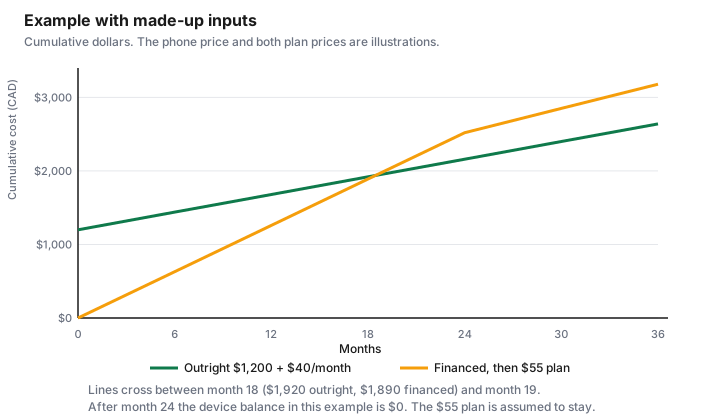
Use your own three numbers in the same shape: the outright price, the bring-your-own-phone monthly plan, and the financed device payment plus the plan that comes with it. Mark month 24, because that is when a compliant device balance should be $0. If the contract you are holding still shows a balance after month 24, that is the conversation with the provider, with Decision 2021-98 and section G.2 in front of you.
Sources & date stamps
- CRTC news release, 15 June 2017, checked 29 Sep 2026: from 1 Dec 2017, unlock free on request and new devices provided unlocked.
- Telecom Decision CRTC 2021-98, Ottawa, 4 Mar 2021, checked 29 Sep 2026: financing under the Wireless Code; balance on cancel is an early cancellation fee; terms longer than 24 months are not compliant with G.1 and G.2; no specific finding of violation for past plans in that decision.
- CRTC, The Wireless Code, simplified, checked 29 Sep 2026: section F.1 unlocking; section G early cancellation fee reduced to $0 within 24 months or the contract term if shorter; a partial month counts as a full month; cancellation effective when the provider receives notice; no early cancellation fee when there is no subsidized device.
- CRTC staff letter to Bell, 26 Nov 2025, checked 29 Sep 2026: rent for the commitment, then pay the remaining balance over 12 months; staff directed to enquire. Not a Commission decision.
- CRTC letter to Bell, 28 Nov 2025, checked 29 Sep 2026: locked phones for up to 60 days; direction to cease and to unlock free of charge.
- CCTS homepage, checked 29 Sep 2026: free complaint service after you give the provider a chance. Phone prices: check the retailer or carrier.
Frequently asked questions
Is it cheaper to buy a phone outright in Canada?
It can be, once you add the plan over the months you will keep the phone. Outright costs more on day one. Financing costs less each month and can cost more in total if the plan stays higher after the phone is paid off. The chart uses made-up inputs, so check the prices in front of you and include the balance you would owe if you left.
What happens to my phone balance if I switch carriers?
Telecom Decision CRTC 2021-98 says the balance you must repay when you cancel is an early cancellation fee under the Wireless Code. Ask for that figure in writing. It should decline to $0 by 24 months, or sooner if the contract is shorter. Cancellation takes effect the day the provider receives notice.
Can a phone financing plan be longer than 24 months?
Decision 2021-98 says device financing plans with terms longer than 24 months are not compliant with sections G.1 and G.2 of the Wireless Code. The early cancellation fee has to reach $0 inside that horizon. If a contract still shows a balance after month 24, ask the provider to explain it against that decision.
Are phones sold unlocked in Canada?
Yes, for devices a wireless provider supplies. From 1 December 2017, new devices must be provided unlocked, and an existing locked device is unlocked free on request. The Wireless Code states that in section F.1. A private sale is a separate conversation: ask the seller to confirm the phone is unlocked.
What are 'rent then pay off' phone offers?
A CRTC staff letter of 26 November 2025 describes a Bell offer to rent a device for the commitment and then pay the remaining balance over 12 months. Staff said it could conflict with the Wireless Code and directed an enquiry. The CRTC has asked questions, and the letter is not a ruling. Read any offer you are shown for the balance due if you cancel.