
Housing · Canada
Tenant insurance in Canada: how to compare coverage that actually protects renters
Renters treat tenant insurance as optional until the lease desk asks for a certificate — or until a dishwasher hose soaks the unit below. The cheap policy that fails the landlord’s $1 million or $2 million liability line is not a save. It is a rejected key pickup. The building policy does not buy your laptop, your bike, or additional living expenses if you cannot stay in the unit.
This page is Canadian shopping: meet the lease, inventory what you actually own, then compare deductibles and channels. It is not a ranking of Sonnet, TD Insurance, or any broker. Statistics Canada’s rent CPI for August 2026 (Daily, 14 Sep 2026) had national rent +2.8% year over year — mood music. Insurance is the small line that stops a $2,000 contents loss from becoming a credit-card event.
Disclosure: Insurance comparison tools and broker quote portals are offer types. Saving Optimizer may earn a commission if we later add partner links. We do not currently claim insurer or broker partnerships. We do not sell policies. This is comparison education, not insurance advice. Confirm wording with a licensed intermediary.
Key takeaways
- Match the lease’s liability number first — usually $1 million, often $2 million in managed buildings — then shop contents.
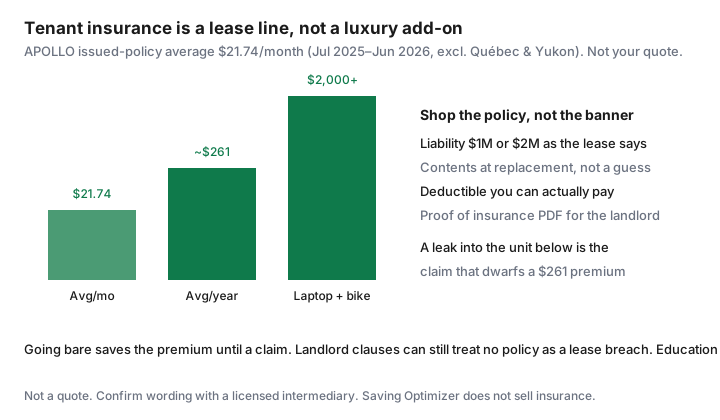
- APOLLO issued-policy average (Jul 2025–Jun 2026, excl. Québec & Yukon): $21.74/month (~$261/year). Your quote will differ.
- Inventory at replacement cost. A $20,000 contents limit on $35,000 of stuff is underinsurance, not a bargain.
- Deductible and multi-policy bundling move price. So does a claims-free discount you actually qualify for.
- Keep photos, serials, and the certificate PDF. A claim without a receipt is a negotiation you will lose hours to.
What tenant insurance typically covers (liability + contents)
A standard Canadian tenant (renter) policy is usually three piles:
- Personal liability. Injury to a guest, or damage you cause to others’ property — the classic “overflow into the downstairs neighbour.” This is the line landlords care about.
- Contents. Your stuff, usually at replacement cost if the policy says so. Special limits often apply to bikes, jewellery, and collectibles unless you schedule them.
- Additional living expenses (ALE). Hotel or extra rent if an insured peril makes the unit unlivable, up to the limit and the wording.
Water is the claim that surprises people. Sudden escape from a burst hose may be in. Gradual leak, sewer backup, and overland water often need endorsements or are excluded. Ask, in writing, what water events are in. The home-insurance water checklist is the same vocabulary with a bigger rebuild number.
Landlord minimum liability requirements to meet
No province we checked makes tenant insurance a public-law duty for every renter. Landlords still write it into leases, and Ontario’s standard residential lease has a place to say whether insurance is required. B.C. tenancy guidance treats insurance as a term to agree before you sign. Québec’s Civil Code does not invent a mandate; clause F or an added clause on the mandatory lease form often does. Federal emergency-preparedness copy says the same thing in one sentence: it may not be mandatory, but the landlord can require it.
Shopping order:
- Read the exact liability limit and any “proof within X days” line.
- Quote that limit. Do not buy $1 million because it was cheaper if the lease says $2 million.
- Ask the insurer or broker for a certificate or proof page you can email. Property managers want a PDF, not a login screenshot.
- Put a calendar reminder 30 days before renewal so the certificate does not expire mid-lease.
If you already moved in without a policy, buy one that matches the clause and send proof. Do not argue “the RTA doesn’t require it” at the front desk — that is a different conversation from the contract you signed. For illegal fees, use the Ontario tenant-fee sheet or the money-first rights hub. Insurance is not a junk fee; it is a risk transfer.
How to inventory belongings without over-insuring
Walk room by room with your phone. Photograph open closets, the bike, the instruments, the work laptop, and the serial-number stickers. Add a one-line spreadsheet: item, purchase year, replacement cost today (not what you paid in 2019). Sum it. That sum is the contents limit you quote — plus a 10–15% buffer for the stuff you forgot, not a 3× fantasy that inflates premium for furniture you would not replace.
Under-insuring to “save $4 a month” is how a kitchen fire becomes a half-payout. Over-insuring a $12,000 life as $60,000 is how you pay for a warehouse you do not own. Special items (engagement ring, $3,000 bike, camera kit) often need to be scheduled or they sit under a small sub-limit. Ask. Tenant or home policies also show up in e-bike conversations for the same reason.
Deductible and bundling levers that change price
A higher deductible lowers premium if you can write that cheque the week of a claim. A $1,000 deductible on a $21.74-average policy is a real lever; a $2,500 deductible you would put on a card is not. Bundling tenant with auto at the same company is a common discount — FSRA-style auto shopping still wants identical coverage when you compare, so do not let a bundle hide a worse auto deductible. Claims-free and alarm or monitored-building discounts exist; loyalty discounts exist too. Re-quote annually. A comparison tool or broker portal is an offer type, not a duty.
Comparing direct writers vs brokers (education, not recommendations)
| Direct writer | Broker | Aggregator / quote site | |
|---|---|---|---|
| Sells | One company’s tenant product | A panel of insurers | Leads and estimated ranks |
| Useful when | You already bundle auto there | You want someone to re-trade water wording | You need a first pass of who is in range |
| Blind spot | Cannot show a rival’s price | Panel may exclude a direct-only discounter | Coverage never matches until a human binds it |
Compare the same liability, contents, deductible, and water endorsements. A $16 quote that dropped sewer backup is not cheaper than a $24 quote that kept it. We do not name a winner. The auto version of this habit lives in broker vs direct auto shopping.
Claim documentation habits that save headaches
- Save the policy PDF, the certificate, and the declarations page in the same folder as the lease.
- Keep the inventory photos off-phone (cloud or a cheap drive) so a stolen phone does not take the evidence.
- After a leak or theft: photos first, then the landlord, then the insurer’s claim line. Do not throw out damaged goods until they say so.
- Write the claim number on a calendar. Follow up if silence lasts more than the timeline they stated.
A roommate house needs a conversation about whose policy responds. Often each tenant wants their own contents and liability — see roommate rent math. Do not assume one person’s $1 million covers everyone on the lease.
Sample annual cost vs risk of going bare
Labelled sketch: $261/year at the APOLLO average versus a $1,800 laptop, a $900 bike, $400 of winter coats, and a four-figure water invoice from downstairs. Going bare “saves” $261 until any one of those lands. It also risks a lease breach if the clause required proof. If cash is tight, lower contents to a documented inventory and raise the deductible before you drop liability below the lease.
Once you have a policy, keep the unit by negotiating the renewal with comps, not by skipping insurance to fund a $80 rent increase.
Sources & date stamps
- APOLLO Insurance, cost of tenant insurance in Canada — issued-policy average $21.74/month Jul 2025–Jun 2026, excluding Québec and Yukon (used 20 Sep 2026).
- Financial Consumer Agency of Canada / public emergency-preparedness copy — tenant insurance may be required by the landlord even if not a public-law mandate.
- TD Insurance and IBC-style consumer pages — liability, contents, ALE as the usual three piles (education, not a product pick).
- Ontario standard lease / B.C. tenancy guidance / Québec mandatory lease practice — insurance as a contract term (confirm current forms).
- Statistics Canada, CPI August 2026 (Daily, 14 Sep 2026) — national rent +2.8% year over year.
Frequently asked questions
Is tenant insurance mandatory in Canada?
No provincial statute we checked forces every renter to buy it. A landlord can still write a liability-and-contents clause into the lease. Once you sign, that clause is a contract term. Ontario’s standard lease can specify insurance; B.C. and Québec landlords commonly require it even though the Residential Tenancy Act and Civil Code do not invent a public mandate. Confirm your lease, not a forum.
How much does tenant insurance cost in Canada?
Issued-policy averages from APOLLO (July 2025–June 2026, excluding Québec and Yukon) sat at $21.74 a month nationally — about $261 a year. Consumer ranges of $15–$35/month are the usual conversation. Your postal code, contents limit, deductible, claims history, and $1 million vs $2 million liability will not match that average. Get written quotes.
What liability limit do landlords usually require?
One million dollars is the common floor. Many 2026 leases — especially condos and professionally managed buildings — ask for $2 million. Raising the limit is often a small premium step compared with a water claim into the unit below. Match the lease number, then keep the certificate PDF.
Does the landlord’s building policy cover my stuff?
No. The building policy is for the structure and the landlord’s liability. Your laptop, bike, clothes, and guest injuries in your unit sit on your tenant policy — or on you. Additional living expenses after a fire or flood are also a tenant-policy line.
Is this insurance advice?
No. It is comparison education. Saving Optimizer does not sell policies or rank insurers. Read the wording with a licensed intermediary in your province (FSRA-licensed in Ontario, AMF in Québec, and so on).