
Housing · Canada
Hidden first-year homeownership costs Canadians forget in the rent-vs-buy math
New owners budget the down payment and the mortgage, then run out of cash in month four: land transfer tax, a dead fridge, the first property-tax instalment that was not in escrow, and a condo special that was a rumour in the status certificate. The rent-vs-buy worksheet already said year-one cash often decides a stay under five years. This page is that cash, line by line.
Figures are date-stamped and labelled. Ontario’s first-time land-transfer refund maximum remains $4,000 (ontario.ca, updated 10 Feb 2026). It does not make Toronto cheap.
Disclosure: Home-insurance comparison tools and furniture-outlet deals are offer types. Saving Optimizer may earn a commission if we later add partner links. We do not currently claim insurer, retailer, lender, or broker partnerships. This is not mortgage, tax, insurance, or legal advice.
Key takeaways
- Closing costs sit beside the down payment: land transfer tax, legal, title insurance, inspection, adjustments.
- Ontario first-time LTT refund: up to $4,000 (full relief on the first $368,000 of consideration). Toronto has a separate municipal rebate — verify on toronto.ca.
- Immediate repairs, overlapping rent, utility deposits, and the first tax instalment are how chequing accounts die.
- Condo/strata special assessments and insurance deductibles belong on year one even if the listing said “low fees.”
- A boring monthly maintenance reserve (freehold sketch: on the order of 1% of value / 12, then adjust) moves the break-even by years if you skip it.
Closing costs checklist beyond the down payment
CMHC’s consumer home-buying pages treat closing costs as their own pile. Typical Canadian conversation is a few percent of the purchase price, wildly sensitive to land transfer tax. Budget, then get your lawyer’s estimate:
- Provincial land transfer / property transfer tax; municipal land transfer tax in Toronto; Québec mutation (welcome) tax.
- Legal fees and disbursements, title insurance, status-certificate or estoppel fees.
- Home inspection, condo document review, appraisal if the lender wants one.
- Property-tax and utility adjustments on the statement of adjustments.
- Default-insurance premium if you are high-ratio — usually added to the mortgage, still real (see stress-test / insured nuances).
Ontario first-time refund: beginning 1 Jan 2017, qualifying purchasers pay no provincial LTT on the first $368,000 and a maximum refund of $4,000 above that. Claim at registration or within 18 months. Toronto’s municipal rebate is a separate program with its own cap — verify before you treat $8,475 as a law of physics. B.C. and other provinces have first-time thresholds that change; read the current provincial page.
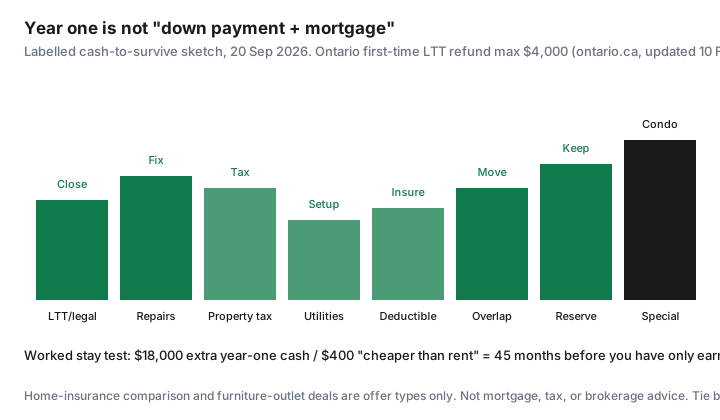
Immediate repairs, appliances, and moving overlap
Inspections find the roof. They do not buy the roof. Used appliances fail the week after closing because the seller’s last act was not a tune-up. Price: a reserve for the inspection’s “soon” items, plus a fridge/washer number if anything is “as is.” Moving overlap is the forgotten double shelter month — you still have last month’s rent sitting somewhere and a closing date that does not match the lease end. Use DIY vs movers including condo elevator certificates of insurance.
Property tax instalments and utility setup deposits
If the lender does not escrow tax, the city’s instalment calendar will. A $6,000 annual bill is $1,500-shaped surprises, not $500/month vibes. New hydro/gas/water accounts can want a deposit, especially if you have no history at that utility. Internet installation is a week-three problem if you work from home. None of this is in the mortgage payment screenshot.
Condo/strata special assessments and insurance deductibles
Read the status certificate / Form B like it can invoice you. Special assessments for envelopes, elevators, and parkades show up in year one more often than listing copy admits. Unit insurance deductibles on water and sewer backup are four-figure events. Comparison-shop home or condo insurance — coverage first, brand second. We do not rank insurers.
Maintenance reserves: a practical monthly set-aside rule
Freehold folk rule of thumb: about 1% of value per year, divided by 12, then adjust down for a new build and up for 1970s brick. A $700,000 house sketch is ~$580/month you do not spend on furniture. Condos: the fee is not the reserve — the reserve is for inside-the-unit and the special you have not met. Skip this line and a water heater becomes a credit card.
How these costs move your break-even by years
Labelled stay test from the rent-vs-buy page, made uglier: $18,000 extra year-one cash that was not in the “rent vs mortgage” meme. If owning is $400/month cheaper on the monthly stacks, break-even on that cash alone is 45 months — before sell costs, before a special, before you count the FHSA or HBP repayment that starts later. Under five years, renting can still be the conservative money move even if you passed the stress test.
Budget template for the first 12 months after closing
| Month 0–1 (close) | Months 2–6 | Months 7–12 |
|---|---|---|
| Down payment already spent | First tax instalment / escrow true-up | Second tax instalment |
| LTT / legal / title / inspection | Appliance or roof “soon” item | Maintenance reserve still happening |
| Move + overlap rent | Insurance deductible if something breaks | Condo special or freehold surprise |
| Utility deposits + first bills | Furniture you actually need (offer-type outlets) | HBP/FHSA paperwork filed? |
If the spreadsheet only balances when overtime is permanent, you do not have a housing plan. You have a hope. Qualification is the lender’s question. Year-one cash is yours.
Sources & date stamps
- CMHC, consumer home-buying pages — closing-cost framing (used 20 Sep 2026).
- Ontario.ca, Land transfer tax refunds for first-time homebuyers — maximum $4,000; $368,000 full-relief threshold; 18-month claim window (updated 10 Feb 2026).
- CRA FHSA and Home Buyers’ Plan pages — wrappers, not monthly stacks.
- Saving Optimizer, Rent vs buy city stacks — stay-horizon and $18,000 / $400 sketch reused here as year-one cash.
Frequently asked questions
What hidden costs do Canadian first-time buyers forget?
Land transfer tax and legal fees, inspection and moving overlap, property-tax instalments, utility deposits, immediate repairs and appliances, condo special assessments, insurance deductibles, and a maintenance reserve. The down payment and mortgage payment are not the year-one budget.
How much is the Ontario first-time land transfer tax refund?
Up to $4,000 for qualifying purchases on or after 1 January 2017, which fully covers provincial tax on the first $368,000 of consideration (ontario.ca, updated 10 Feb 2026). Toronto’s municipal rebate is separate. Confirm eligibility — including the spouse rules — before you spend the refund in your head.
How do these costs change rent-vs-buy math?
They are mostly cash in year one. Divide that cash by the monthly “owning is cheaper” gap. If $18,000 extra cash needs $400/month of stack advantage, you need 45 months before you have only earned the cash back — before selling costs. Short stays often still favour renting.
Should I drain the FHSA and HBP to cover year one?
Use those wrappers for the down payment if you qualify, but keep a cash reserve for closing and repairs. HBP has a repayment calendar. Emptying every registered account into a thin-reserve condo is how year one becomes a credit card.
Is this mortgage or tax advice?
No. It is a household cash checklist. Home-insurance comparison and furniture outlets are affiliate types only. A lawyer, licensed mortgage professional, or tax advisor should review your numbers before you waive conditions.