
Housing · Canada
Canada’s mortgage stress test explained for buyers: how it caps your purchase price
Buyers browse listings at the payment that fits their paycheque, then write an offer the stress test will not fund. The deposit cheque is what burns. Canada’s minimum qualifying rate is not a slogan — it is the payment a federally regulated lender must underwrite on a new uninsured mortgage. As of OSFI’s public MQR page (verified 20 Sep 2026), that rate is the greater of the contract rate plus 2% or 5.25%.
This page is buyer-facing shelter math. It is not a rate quote, not a pre-approval, and not the same rule as an uninsured straight switch at renewal (OSFI, 21 Nov 2024).
Disclosure: Mortgage rate and qualification tools are offer types. Saving Optimizer may earn a commission if we later add partner links. We do not currently claim lender or broker partnerships. This is comparison education, not brokerage, credit, or legal advice. Confirm OSFI, insurer, and lender rules for your file.
Key takeaways
- OSFI MQR for uninsured originations: greater of contract + 2% or 5.25% (verified 20 Sep 2026). Lenders still apply Guideline B-20 judgment.
- You shop the contract payment. You qualify at the higher payment. That gap caps the offer you can write.
- Insured (high-ratio) files sit under federal housing-insurance rules that also use a stress test — confirm with the insurer and lender, not a forum screenshot.
- Bigger down payment, a cleaner debt load, and a different term change the cap. Browsing $80,000 above the cap does not.
- Straight-switch MQR relief is a renewal rule. A purchase is an origination.
What the qualifying rate is trying to do
OSFI’s MQR is a buffer and a floor. The 2% buffer asks whether you can still make the payment if rates or household costs move. The 5.25% floor catches files whose contract rate is already cheap. A 4.50% five-year fixed is underwritten at 6.50%. A 3.00% rate is still underwritten at 5.25%, not 5.00%. OSFI reviews the floor and buffer at least annually and no longer promises a December announcement if nothing changes.
The test is about capacity, not the payment that will leave your account on the first of the month. That is why a listing “estimated payment” on a brokerage banner is not your approval.
How stress testing changes the home you can afford
Lenders also look at gross debt service and total debt service — the mortgage-plus-taxes-plus-heat (and condo fees) share of income, and that plus other debts. Public CMHC/lender conversation still sits in the high-30s / mid-40s for many insured files. Confirm the current limits on your letter. The stress test inflates the numerator: the same house needs more income, or a smaller loan, to clear the ratio at 6.50% than at 4.50%.
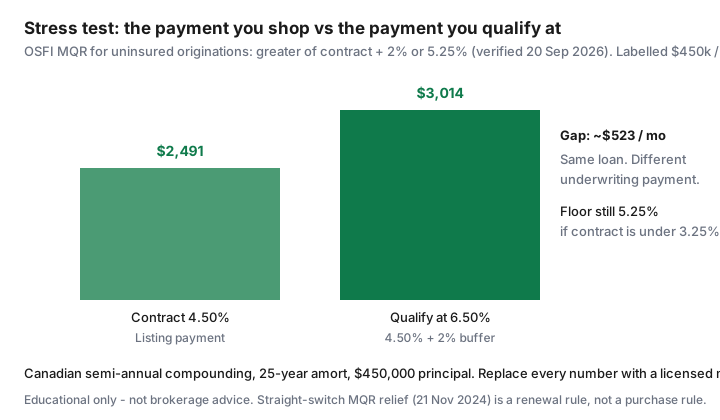
Worked sketch (labelled): $450,000 loan, 25 years. The qualifying payment is about $523 a month higher than the contract payment. That is the money that is not available for a “we can stretch” listing. If your ratios were already tight at $2,491, they fail at $3,014. The house did not get more expensive. The underwriting payment did.
House-hunt like a lender: filter the MLS or realtor feed by a maximum purchase price your worksheet survived at the qualifying rate, not by the payment you wish you had. Failed offers still cost appraisal, legal retainers, and inspection cash — see first-year ownership costs.
Insured vs uninsured nuances at a high level
Uninsured (typically 20%+ down, or a purchase above the insurable price cap): federally regulated lenders apply OSFI’s MQR on a new origination. Credit unions and some provincially regulated lenders can look different — ask, do not assume OSFI’s page is their policy.
Insured / high-ratio (usually under 20% down, subject to price caps and insurer rules): default insurance from CMHC, Sagen, or Canada Guaranty is required. Those files are also stress-tested; the public conversation uses the same greater-of contract+2% or 5.25% shape. Premiums are a percentage of the loan by loan-to-value — a 5% down file pays a higher published premium than a 10% or 15% file. Verify the current CMHC table before you treat a 5% listing as “the same house, smaller cheque.” Premiums are usually added to the mortgage, so they grow the balance you qualify.
A purchase above the federal insurable price ceiling is not an insured 5% story. That is a 20% down conversation. Do not paste 2019 CMHC rules onto a 2026 offer.
Strategies households use: bigger down payment, different term, debt clean-up
- More down payment. Smaller loan, smaller qualifying payment, sometimes a jump off a high insurance-premium tier, and at 20% you leave the insured box. An FHSA or Home Buyers’ Plan can change the cash wrapper. They do not waive the MQR.
- Different term or product. A lower contract rate can still sit on the 5.25% floor. A shorter term with a higher contract rate can raise both the payment you shop and the +2% qualify rate. This is a licensed-professional choice, not a blog dare.
- Debt clean-up. Car loans, cards, and HELOC minimums eat TDS. Paying a $350 car loan beats hunting a $20,000 cheaper condo if the condo fees then eat the gap (see reserve-fund flags).
- Longer amortisation. Spreads the payment. Insured amort rules and 30-year surcharge conversations change. Confirm what your insurer will actually book.
Renewal vs purchase: where rules differ
On 21 November 2024, OSFI stopped prescribing the MQR for an uninsured straight switch at renewal between federally regulated institutions when you do not increase the loan amount or remaining amortisation. That is why a 2026 renewal shop can feel easier than your 2021 purchase. It does not apply to a new purchase, a cash-out, an amort reset, or an insured switch. If you are buying, you are in origination-land. If you already own, use the 120-day renewal calendar.
Common myths that waste house-hunting time
- “The bank said I can afford $X payment, so I can offer $X × 12 × a magic number.” They meant a qualifying payment and a max price on a letter with conditions.
- “Variable will be stress-tested at the floor only.” The MQR is still the greater of contract+2% or 5.25%.
- “My credit union ignores OSFI, so the listing is fine.” Maybe. Get it in writing on that property.
- “Renewal relief means I can buy now and switch later without a test.” Buying is the test. Later is a different file.
- “Condo fees do not count.” They do in the debt-service stack.
Worksheet: payment at contract rate vs qualifying rate
| Line | Contract 4.50% | Qualify 6.50% |
|---|---|---|
| Monthly P+I | ~$2,491 | ~$3,014 |
| Gap | About $523 / month — this is the stretch that is not approved | |
| Property tax + heat + condo | Add the same dollars to both columns; ratios still use the higher P+I | |
| Max purchase | What the listing site implies | What the letter will survive — use this filter |
Write the qualifying payment on a sticky note on your phone before you book a second showing. The expensive habit is falling in love $80,000 above the cap and then “just seeing.”
Sources & date stamps
- OSFI, Minimum qualifying rate for uninsured mortgages — greater of contract + 2% or 5.25% (page used 20 Sep 2026).
- OSFI, Backgrounder: Minimum Qualifying Rate — uninsured straight-switch MQR prescription change, 21 Nov 2024 (renewals, not purchases).
- OSFI Guideline B-20 — sound underwriting; lenders can still decline a file that “passes the math.”
- CMHC consumer home-buying pages — insurance and down-payment structure; verify current premium tables on cmhc-schl.gc.ca before you rely on a tier.
Frequently asked questions
What is Canada’s mortgage stress test for a buyer in 2026?
For a new uninsured mortgage at a federally regulated lender, OSFI’s minimum qualifying rate is the greater of the contract rate plus 2% or 5.25% (verified 20 Sep 2026). You are approved on that higher payment, not the listing payment. Insured files use a federal housing-insurance stress test with the same public shape — confirm with the insurer and lender.
Does a bigger down payment help me pass?
Usually. A smaller loan means a smaller qualifying payment and can drop you into a cheaper default-insurance premium tier, or off insurance entirely at 20% down. FHSA and HBP can change where the cash comes from. They do not cancel the MQR.
Is the stress test the same when I renew?
Not always. As of 21 November 2024, OSFI no longer prescribes the MQR for an uninsured straight switch at renewal between federally regulated lenders if you do not increase the loan or remaining amortisation. A purchase is an origination. Insured, cash-out, and amort-extending files are different.
Can I just use a credit union to skip the test?
Some provincially regulated lenders are not OSFI FRFIs. That is not a promise they will skip a stress test or approve your listing. Get a written pre-approval on a comparable price, then shop the house.
Is this mortgage advice?
No. It is a household worksheet so you stop writing failed offers. A licensed mortgage professional should structure the file. Rate and qualification tools are affiliate types only.