
Weddings · Canada
Wedding Registry vs Cash Fund vs Honeymoon Fund in Canada: Pros, Fees, Etiquette and Taxes
Choose a traditional registry if you need household items, a cash fund if you would rather save toward a home or pay down costs, and a honeymoon fund if you want guests to contribute to experiences on your trip. You can also mix them. Before choosing a cash or honeymoon platform, read its fee page: some charge guests or couples a percentage, and payouts to a Canadian bank may carry a fee. For registries, use Canadian retailers where possible, because the CBSA says items mailed from outside Canada worth more than CAN$20 face duty and tax, and the CAN$60 gift exemption does not apply to items sent by a business. Gifts are not taxable income: the CRA lists most gifts among amounts not reported or taxed.
Key takeaways
- Registry for things you need; cash or honeymoon fund for goals or experiences.
- Read each platform's fee page for guest and payout fees.
- Items shipped from outside Canada can face duty and tax above CAN$20.
- Most gifts are not taxable income, according to the CRA.
- Track every gift for thank-you notes.
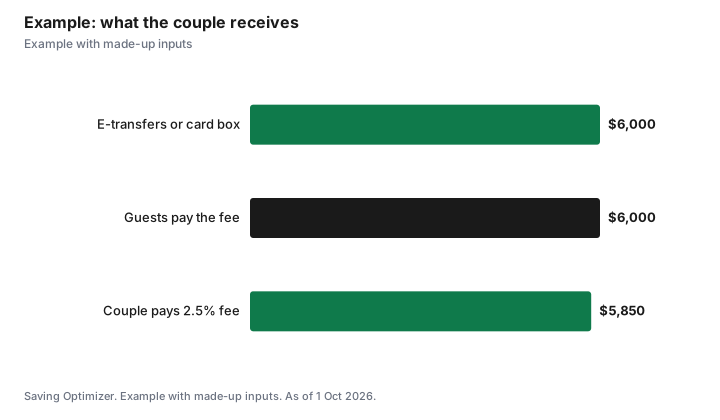
- Example with made-up inputs: what reaches you after fees.
Pros and cons
| Registry | Cash fund | Honeymoon fund | |
|---|---|---|---|
| Best for | Setting up a home | Down payment, debt, flexible goals | Trip experiences |
| Guest experience | Pick a tangible gift | Simple transfer | Fund a specific activity |
| Fees | Usually none to guests; check store terms | Platform or payment fees may apply | Platform or payout fees may apply |
| Flexibility | Returns or exchanges per store policy | Fully flexible | Depends on platform redemption rules |
| Etiquette concerns | Few | Some guests prefer giving items | Some guests prefer giving items |
Platform fees
Fees vary by platform and change over time, so read the platform's own fee page before choosing. As one example, Honeyfund's fee page says its Wallet is available to couples using U.S. dollars, that redeeming through its prepaid Mastercard or gift cards is fee-free, that paying out to PayPal, Venmo or a bank carries a small third-party fee, and that guests may be asked to add an optional amount at checkout to support the platform, which couples can turn off. For Canadian couples, check which options are available in Canadian dollars and what a bank payout costs. A simple alternative is to share an e-transfer address or a card box at the reception.
Registry items shipped from abroad
The CBSA says that under the Postal Imports Remission Order, items mailed to you worth CAN$20 or less are free of duty and tax, and above that you pay duty, GST or HST and any PST on the full value. Gifts worth CAN$60 or less are exempt only when a friend or relative sends them personally with a card or note saying it is a gift, and items sent by a business do not qualify. A registry item shipped directly from a U.S. or overseas store is sent by a business, so duty and tax can apply on delivery. Favour Canadian retailers or stores that ship duty-paid.
Etiquette
- Put registry or fund details on the wedding website, not the invitation itself, if you want to keep invitations traditional.
- Describe what a cash fund is for: a down payment, a first-year fund, or the honeymoon.
- Offer a range of price points on any registry.
- Never state a minimum gift amount.
- Thank every guest for any gift, or for coming.
Store terms to check
- Return and exchange policy for registry gifts, including duplicates and gift receipts.
- Whether the store offers a completion discount on unpurchased items after the wedding, and for how long.
- Shipping: to whom, at what cost, and whether items can be held until after the wedding.
- Price changes: what happens if a guest buys an item that later goes on sale.
- Whether guests can buy in store and online from the same list.
Group gifts
For expensive items, some registries allow guests to contribute part of the price. That keeps big-ticket items on the list without asking anyone for a large amount. If the platform charges for partial contributions, compare that cost with simply listing a cash fund for the same purpose.
Thank-you tracking
Keep a list of every gift: who, what or how much, and when the thank-you went out. Registry and fund platforms may provide a gift log; export it into one spreadsheet along with cash and cheques from the card box. Write notes within a few weeks while details are fresh, and mention how you will use the gift. Note cheques that still need depositing.
Mixing approaches
A small registry of essentials plus a cash or honeymoon fund covers most guests' preferences. Keep the registry short so items are bought, and remove items once you have them. Some guests will bring cash or cheques regardless; have a secure card box and one person responsible for it at the reception.
Taxes
The CRA lists most gifts and inheritances among amounts that are not reported or taxed. Income earned on gifts, such as interest after you invest them, is taxable. If you put cash gifts into a TFSA or FHSA, normal contribution room rules apply.
Decision
| Your situation | Consider |
|---|---|
| Moving in together, few household items | Registry |
| Already have everything; saving for a home | Cash fund |
| Big trip planned | Honeymoon fund, or cash fund labelled for the trip |
| Guests with mixed preferences | Short registry plus a fund |
| Many guests outside Canada | A fund, so nothing is shipped across the border |
Example with made-up inputs
These numbers are an example with made-up inputs. Guests give $6,000 through a fund platform. If the platform takes a made-up 2.5% from the couple on payout, the couple receives $5,850. If guests instead pay a made-up 3% fee on top, the couple receives the full $6,000 and guests pay $180 more in total. A $250 registry item shipped by a U.S. store with a made-up $55.10 in duty and tax due on delivery would cost $305.10; the same item from a Canadian store costs $250 plus 13% HST, $282.50, paid by the guest.
| Scenario | Guests pay | Couple receives |
|---|---|---|
| Fund, couple pays 2.5% payout fee | $6,000 | $5,850 |
| Fund, guests pay 3% fee | $6,180 | $6,000 |
| E-transfers or card box | $6,000 | $6,000 |
Common mistakes
- Choosing a platform without reading its fee page.
- Registering at a foreign store that ships with duty due.
- Listing only expensive items.
- Losing track of who gave what.
- Leaving the card box unattended.
Related: wedding gift amounts and honeymoon on a budget.
Sources
- Canada Revenue Agency, Amounts that are not reported or taxed; GST/HST rates, canada.ca, as of 1 Oct 2026.
- Canada Border Services Agency, Importing by mail or courier: determining duty and taxes owed, as of 1 Oct 2026.
- Honeyfund, Honeyfund fees explained, honeyfund.com, as of 1 Oct 2026.
- Gift totals, fee rates and duty rates in the example are made-up inputs.
Frequently asked questions
Is it rude to ask for cash for a wedding?
Not if it is done politely. Put details on the wedding website, explain what the money is for, and never state an amount.
Do honeymoon fund sites charge fees?
Some do, to guests, couples or on payout. Read the platform's fee page; for example, Honeyfund says payouts to a bank carry a third-party fee.
Are wedding gifts taxable in Canada?
The CRA lists most gifts and inheritances among amounts not reported or taxed. Income earned on them is taxable.
Do I pay duty on registry gifts from a U.S. store?
Possibly. The CBSA says items over CAN$20 face duty and tax, and the CAN$60 gift exemption does not apply to items sent by a business.
Should we have a registry and a cash fund?
It can work well. A short registry plus a fund covers different guest preferences.
How should we track gifts?
Keep one list with each giver, gift and thank-you date, combining platform logs and the card box.
Researched and drafted with AI assistance and fact-checked against official Canadian sources. How we create content.
Disclosure: Saving Optimizer may earn a commission if a partner link is added later. No partnership is claimed on this page. Education only.