
Weddings · Canada
Wedding Vendor Contracts in Canada: Deposits, Cancellation and Red Flags
Before signing a wedding vendor contract in Canada, check five things: how much the deposit is and whether it is refundable, the payment schedule, what happens if either side cancels or postpones, which taxes and mandatory service charges are added, and who exactly will provide the service, as of 1 October 2026. A written contract protects both sides, and most disputes come from terms the couple did not read: a non-refundable deposit, a minimum spend, or a service charge that is taxed on top. Paying by credit card, keeping every message, and knowing your provincial consumer protection office are the best protections if something goes wrong.
Key takeaways
- Get everything in writing: date, times, services, names, prices, taxes and payment dates.
- Know whether the deposit is refundable and under what conditions.
- Read cancellation, postponement and force majeure clauses before signing, not after a problem.
- Mandatory service charges are taxable under GST/HST rules; ask how they are calculated.
- Pay by credit card where you can, keep receipts and messages, and avoid cash-only vendors.
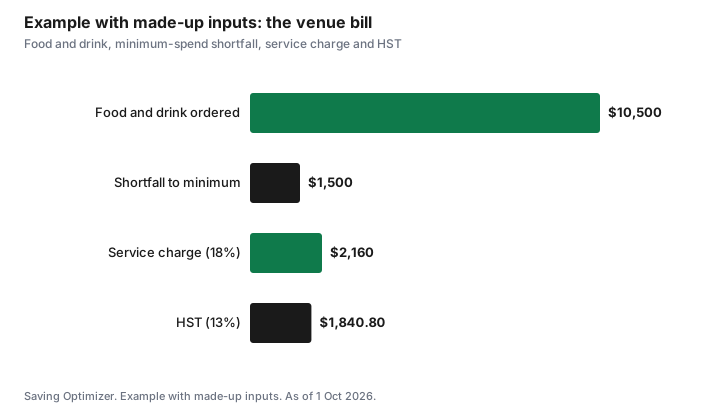
- Example with made-up inputs: a $1,500 minimum-spend shortfall with an 18% service charge and HST add $2,000.10 to a venue bill.
The deposit
Most wedding vendors ask for a deposit to hold the date. The contract should say the amount, whether it is refundable, and whether it is applied to the final bill. Many deposits are non-refundable because the vendor turns away other bookings for your date. Some contracts call it a retainer, which usually means non-refundable. Before paying, ask: if we cancel a year out, do we lose only the deposit, or more? If the vendor cancels, do we get everything back?
The payment schedule
After the deposit, payments are often due in stages, with the balance due a few weeks before the wedding. Put every date in a calendar. Ask whether late payments carry fees and whether the final guest count, which sets the final bill for caterers, is due on a specific date.
Cancellation and postponement
| Clause | What to look for |
|---|---|
| Cancellation by you | How much you owe at each stage; whether payments beyond the deposit are refundable |
| Cancellation by the vendor | Full refund, and whether they will find a replacement |
| Postponement | Whether you can move the date, how far, and at what cost |
| Force majeure | Which events (weather, public health orders, venue closure) release both sides, and what happens to money paid |
| Price increases | Whether prices can rise between signing and the wedding, and by how much |
| Minimum spend | The minimum food and drink total, and what happens if you fall short |
| Substitution | Whether a different photographer, DJ or planner can be sent |
| Liability and insurance | Whether the vendor carries liability insurance; whether the venue requires you to buy event insurance |
Force majeure clauses became familiar during the pandemic, when many weddings were postponed. Read what counts as force majeure and what happens to your money. Some contracts convert payments to a credit for a later date rather than a refund.
Taxes, service charges and minimum spends
A venue quote may show food and drink before a service charge and before tax. A mandatory service charge or gratuity is part of the price of the service under GST/HST rules, so tax is charged on it. Ask what the service charge is calculated on and whether it goes to staff. A minimum spend means you pay at least a set amount on food and drink; if your final bill is lower, you pay the difference. Make sure you know whether the minimum is before or after tax and service charge.
Who will show up
If you book a photographer, planner or band because of a particular person, write that person's name into the contract. Some companies send an associate unless the contract says otherwise. For caterers and venues, the contract should list what is included: staff, tables, chairs, linens, cake cutting, corkage and cleanup.
Insurance
Ask whether each vendor carries liability insurance; many venues require it from other vendors. Some venues also require the couple to buy event liability insurance. Wedding or event insurance can cover some cancellation and postponement costs, with exclusions; read what is covered before buying. Home insurance does not usually cover event cancellation.
Paying and keeping records
- Pay by credit card where possible. Card issuers have dispute processes if a service is not delivered, though rules and time limits apply.
- Avoid cash-only vendors, or get a signed receipt every time.
- Keep the signed contract, every invoice and receipt, and all emails and messages in one folder.
- Confirm changes by email so there is a written record.
If something goes wrong
Start with the vendor, in writing, referring to the contract clause. If that fails, your provincial consumer protection office can explain your rights and may accept complaints; Ontario, Quebec and other provinces have consumer protection laws covering many service contracts. Misleading advertising, such as false claims about what is included, can be reported to the Competition Bureau. For larger amounts, small claims court is an option; limits vary by province. A card dispute may help if you paid by credit card.
Red flags
- No written contract, or a contract that leaves out prices, dates or names.
- Cash only, or a request for payment by e-transfer to a personal account before any contract.
- Pressure to sign the same day because "someone else wants the date".
- No reviews, no business address and no references from recent couples.
- Vague terms such as "prices subject to change" without limits.
Example with made-up inputs: the venue bill
These numbers are an example with made-up inputs. A couple's Ontario venue contract has a $12,000 food and drink minimum before service charge and tax, an 18% mandatory service charge, and 13% HST. Their final food and drink order is $10,500.
| Line | Amount |
|---|---|
| Food and drink ordered | $10,500 |
| Shortfall to minimum | $1,500 |
| Subtotal (minimum) | $12,000 |
| Service charge (18%) | $2,160 |
| HST (13% on $14,160) | $1,840.80 |
| Total | $16,000.80 |
The $1,500 shortfall, with service charge and HST on it, costs $2,000.10. If the couple had read the minimum at the start, they could have used it on items they wanted, such as a late-night snack, rather than paying for nothing.
Checklist before you sign
- Date, times, location and every service written in.
- Deposit amount and refund terms.
- Payment dates and final count date.
- Cancellation, postponement and force majeure terms.
- Taxes, service charges and minimum spend.
- Named staff and substitution rules.
- Insurance requirements.
- Both signatures and a copy for you.
| Term | Vendor A | Vendor B |
|---|---|---|
| Deposit and refund | ||
| Payment dates | ||
| Cancellation terms | ||
| Service charge and tax | ||
| Minimum spend | ||
| Named staff |
Common mistakes
- Signing before reading the cancellation clause.
- Assuming a quote includes tax and service charge.
- Missing the final guest count date.
- Paying cash without receipts.
- Not naming the person you hired.
Sources
- Canada Revenue Agency, GST/HST treatment of mandatory gratuities and service charges, as of 1 Oct 2026.
- Competition Bureau Canada, deceptive marketing practices and how to file a complaint (competition-bureau.canada.ca), as of 1 Oct 2026.
- Government of Ontario, Consumer protection and filing a complaint (ontario.ca); Office de la protection du consommateur (Quebec), as of 1 Oct 2026.
- All amounts, rates and the minimum spend in the example table and chart are made-up inputs.
Frequently asked questions
Are wedding deposits refundable in Canada?
It depends on the contract. Many wedding deposits and retainers are non-refundable because the vendor holds the date for you. Read the deposit and cancellation terms before you pay.
Is a wedding service charge taxable?
Yes. A mandatory service charge or gratuity is part of the price of the service and is subject to GST or HST. A voluntary tip is not taxed.
What is a minimum spend at a wedding venue?
It is the least you must pay for food and drink. If your order is below the minimum, you pay the difference, often with service charge and tax added. Check whether the minimum is before or after those charges.
What can I do if a wedding vendor does not deliver?
Contact the vendor in writing first. Then contact your provincial consumer protection office, consider a dispute with your credit card issuer if you paid by card, or use small claims court. Misleading advertising can be reported to the Competition Bureau.
Researched and drafted with AI assistance and fact-checked against official Canadian sources. How we create content.
Disclosure: Saving Optimizer may earn a commission if a partner link is added later, such as a credit card or event insurance offer type. No partnership with any vendor or insurer is claimed on this page, and no vendor is ranked. This is not legal advice. Education only.