
Events · Canada
Holiday Gift Budget for Adults in Canada: How Much to Spend, Family Draws and Secret Santa Rules
A holiday gift budget for adults in Canada works best as one total for the season, divided across a written list of names, with a cap for each name. Most families and offices that keep gift spending under control also cut the number of gifts, through a family draw or a Secret Santa where each person buys for one other person under a set limit. Gift cards are a reasonable fallback in Canada because Ontario, Quebec, British Columbia, Alberta, Manitoba, Saskatchewan and Nova Scotia restrict expiry dates on most retail gift cards. For gifts from an employer, the Canada Revenue Agency lets an employee receive non-cash gifts and awards worth up to $500 a year without a taxable benefit. Set the total before Black Friday on 27 November 2026, and the flyers become a way to fill the list rather than a list of their own.
Key takeaways
- Set one season total first, then divide it across a written list of names with a cap beside each one.
- A family draw or Secret Santa turns ten gifts into one, with the same spending cap for everyone.
- Write the rules down: cap, deadline, a wish list, and whether gift cards are allowed.
- Gift cards: most provinces with gift card laws ban expiry dates on ordinary retail cards, with exceptions for single-service and charity cards.
- CRA: non-cash employee gifts up to $500 a year, including tax, are not a taxable benefit; cash and near-cash gifts are taxable.
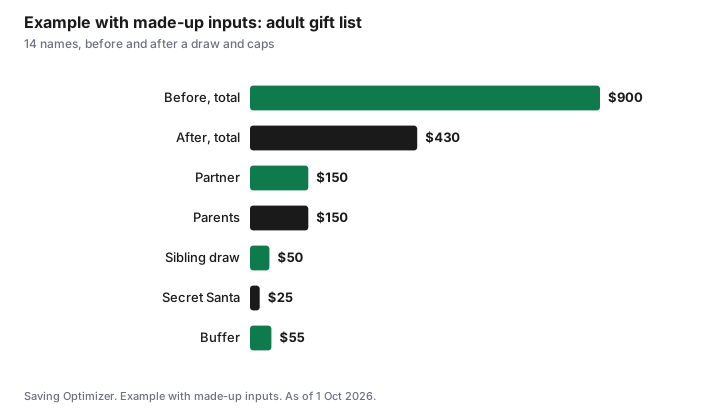
- Example with made-up inputs: a $900 list for 14 people becomes $430 with a sibling draw and a household cap.
Start with the season total, not the person
Gift spending usually runs over one person at a time. Each gift feels reasonable, and the sum is a surprise in January. Turn it around: decide what the whole season can cost, out of money you have or will have by December, then fit the people inside that number.
Use money you already have. The total should come from savings, a holiday sinking fund or December income, not from a credit card balance you plan to pay off later. If you need help building that number, the December spending plan puts gifts beside food, travel and hosting so one line does not quietly eat the others.
Write the total before Black Friday, which is Friday 27 November 2026. Once the total exists, a sale is useful only if the item is already on the list. Without a total, a sale becomes the reason to buy.
Make the list of names, then cap each one
List everyone you plan to buy for, grouped by how close they are: partner, children, parents, siblings and their families, friends, coworkers, and the thank-you gifts for teachers, neighbours or service people. Next to each name write a cap. The caps should add up to the total, with a small amount held back for the gift you forgot.
| Group | Names | Cap per name | Group subtotal | Idea or wish list item |
|---|---|---|---|---|
| Partner | Your cap | |||
| Parents | Your cap | |||
| Siblings and their families | Your cap or a draw | |||
| Friends | Your cap or a shared outing | |||
| Coworkers | Office draw cap | |||
| Thank-you gifts | Small fixed amount | |||
| Held back for the forgotten gift | — | — | A small buffer |
If the caps add up to more than the total, change the list, not the total. Some names can move from a gift to a card or a shared outing. Some groups can move into a draw. A household gift, one present for a sibling's whole family, often replaces three or four separate gifts.
Family draws: how to run one that people accept
In a family draw, each adult buys for one other adult instead of everyone. The cap is set together. A draw works because it lowers the number of gifts without lowering the effort put into each one. It also takes pressure off members of the family whose budgets are tighter, which is often the real reason to suggest one.
- Raise the idea early, in October or the first week of November, before anyone has started shopping.
- Agree on who is in. Many families keep children out of the draw and give them small gifts from everyone, or set a separate cap for kids.
- Agree on the cap, and agree that the cap is a ceiling, not a target.
- Draw names with a free online name-drawing tool, a hat at Thanksgiving dinner, or one neutral person who sends each name privately.
- Ask each person for a short wish list with three items at different prices under the cap.
- Set a deadline that leaves room for shipping if anyone lives in another city.
The most common objection is that a draw feels less generous. It helps to say what the money is for instead: a family outing, a dinner together, or a contribution to a child's RESP. The guide to capturing the CESG on an RESP explains why a contribution to a child's plan can be worth more than its face value.
Secret Santa rules for offices, friends and clubs
Secret Santa is a draw with one more rule: the giver stays anonymous until the exchange. The rules matter more than the gifts, because a vague rule produces one $10 gift and one $60 gift in the same circle.
| Rule | What to decide | Why it matters |
|---|---|---|
| Cap | One number for everyone, tax included or not | Stops a mismatch in effort and money |
| Opt-in | Participation is voluntary | Coworkers on tight budgets can say no without explaining |
| Wish list | Three ideas or a short list of likes and dislikes | Reduces gifts that go unused |
| Gift cards | Allowed or not | Some groups prefer a gift card at the cap; others want an object |
| Exclusions | No alcohol, no joke gifts, allergies noted | Keeps it appropriate for a workplace |
| Date and place | The exchange date and how remote people take part | Allows time for shipping |
At work, Secret Santa is between coworkers and is not an employer gift. If the employer buys gifts for staff, the CRA's policy is different and is covered below. Keep participation voluntary and the cap modest. A white-elephant exchange, where people pick or swap wrapped gifts, uses the same cap rule.
Gift cards: what provincial rules protect
A gift card at the cap is the easy answer for people you do not know well, and provincial consumer protection rules make it safer than it once was. The details vary by province, and every province carves out exceptions.
| Province | Expiry on ordinary retail cards | Fees and exceptions to know |
|---|---|---|
| Ontario | Not allowed | Exceptions include cards for a specific single service and charity cards. Mall and open-loop cards can charge up to $1.50 to activate and, after 15 months of inactivity, up to $2.50 a month |
| Quebec | Not allowed | Exceptions apply; see the Office de la protection du consommateur |
| British Columbia | Not allowed | Exceptions apply; see Consumer Protection BC |
| Alberta | Not allowed | Exceptions apply; see Alberta's gift card information page |
| Manitoba | Not allowed | Exceptions apply; see Manitoba Consumer Protection |
| Saskatchewan | Not allowed | Exceptions apply; see the Financial and Consumer Affairs Authority |
| Nova Scotia | Not allowed | Exceptions apply; see Service Nova Scotia |
Prefer a store card from a retailer the person already uses over a mall or prepaid network card, which can carry activation and dormancy fees in Ontario. Keep the receipt with the card, and tell the person where the card was bought. If a retailer closes, a gift card can become hard to redeem, so a card the person will spend soon is better than one kept for a rainy day. For more on gift cards and exchanges, see clothing gifts, gift cards and exchanges.
Gifts from an employer: the CRA's $500 policy
If you run a small business or a team, the tax treatment of gifts to staff is worth knowing. Under the CRA's administrative policy, an employee who deals at arm's length with the employer can receive non-cash gifts and awards with a total fair market value of up to $500 a year, including taxes, without a taxable benefit. Anything above $500 is a taxable benefit. Cash and near-cash gifts, such as most gift cards that work like cash, are always a taxable benefit under the same policy. A gift card can count as non-cash only if it meets the CRA's conditions, including being for a specific retailer, not convertible to cash, and tracked by the employer. Long-service awards have their own separate $500 limit.
The CRA's page also says that a modest social event, such as an office holiday party, is generally not a taxable benefit when it meets its conditions. That matters when a team is choosing between a lunch for everyone and individual gifts.
Thank-you gifts and the people who are easy to forget
Teachers, child-care staff, coaches, neighbours, building staff and delivery people are easy to leave out of the plan and then buy for at the last minute. Put them on the list with a small fixed amount each, or group them into one line. A card with a handwritten note costs little and is often remembered longer than the gift. Some schools and child-care centres set group gifts where families each contribute a small amount; joining one is often cheaper than buying alone.
Example with made-up inputs: 14 names to 8 gifts
These numbers are an example with made-up inputs. They are not store prices. An adult starts with a list of 14 names: partner, two parents, three siblings and their partners, four friends and two coworkers. At the gifts they bought last year, the list adds up to $900.
They propose a sibling draw at Thanksgiving with a $50 cap, which replaces six gifts with one. The four friends agree to a shared dinner in January instead of gifts, which each pays for separately later. The two coworkers join an office Secret Santa with a $25 cap. The partner and parents keep individual gifts at caps of $150 and $75 each. A $55 buffer covers the forgotten gift and wrapping. The season total falls from $900 to $430.
| Group | Before | After |
|---|---|---|
| Partner | $200 | $150 |
| Parents (2) | $200 | $150 |
| Siblings and partners (6) | $300 | $50 (draw) |
| Friends (4) | $120 | $0 (shared dinner) |
| Coworkers (2) | $80 | $25 (Secret Santa) |
| Buffer and wrapping | $0 | $55 |
| Total | $900 | $430 |
Common mistakes
- Setting caps per person without a season total, so the list grows in December.
- Agreeing to a draw but not to a cap, so gifts in the same circle vary widely.
- Buying on Black Friday before the list exists.
- Giving a mall gift card that charges an activation fee when a store card would do.
- Forgetting shipping time for people in other provinces; see Canada Post's holiday dates before the deadline week.
- Putting gifts on a card balance that is still there in March.
For children's gifts, which follow different rules and caps, use the kids' holiday gift budget. For electronics on the list, compare timing in Black Friday versus Boxing Day for tech.
Sources
- Canada Revenue Agency, Gifts, awards, and long-service awards, canada.ca, as of 1 Oct 2026. Non-cash gifts and awards up to $500 a year including taxes; cash and near-cash gifts taxable; separate $500 long-service limit; gift card conditions.
- Canada Revenue Agency, Social events and hospitality functions, canada.ca, as of 1 Oct 2026.
- Government of Ontario, Buying or using gift cards, ontario.ca, as of 1 Oct 2026. No expiry; exceptions; $1.50 activation and $2.50 monthly dormancy fee after 15 months on mall cards.
- Office de la protection du consommateur (Quebec), Consumer Protection BC, Alberta gift card information page, Manitoba Consumer Protection Office, Saskatchewan Financial and Consumer Affairs Authority, and Service Nova Scotia, gift card pages, as of 1 Oct 2026.
- Calendar: Black Friday is 27 November 2026.
- The 14-name list, the $900 and $430 totals and every amount in the example table and chart are an example with made-up inputs.
Frequently asked questions
How much should I spend on holiday gifts for adults?
There is no right amount. Set one season total from money you have or will have by December, write the list of names, and give each name a cap so the caps add up to the total. If the caps exceed the total, shorten the list or move people into a draw.
How do you run a family gift draw?
Raise it early, agree who is in and set one cap as a ceiling. Draw names with a free online tool, a hat or one neutral person, ask everyone for a short wish list under the cap, and set a deadline that leaves time for shipping.
What are good Secret Santa rules for work?
Make it voluntary, set one cap, ask for a short wish list, decide whether gift cards are allowed, exclude alcohol and joke gifts, note allergies, and set the exchange date and how remote coworkers take part.
Do gift cards expire in Canada?
In Ontario, Quebec, British Columbia, Alberta, Manitoba, Saskatchewan and Nova Scotia, ordinary retail gift cards generally cannot have an expiry date, with exceptions such as single-service and charity cards. Ontario allows mall and open-loop cards to charge up to $1.50 to activate and up to $2.50 a month after 15 months of inactivity.
Are employer holiday gifts taxable in Canada?
Under the CRA's policy, non-cash gifts and awards to an arm's-length employee are not a taxable benefit up to a total of $500 a year, including taxes. Cash and near-cash gifts are taxable, and amounts above $500 are taxable.
Researched and drafted with AI assistance and fact-checked against official Canadian sources. How we create content.
Disclosure: Saving Optimizer may earn a commission if a partner link is added later, such as a gift card, cash-back or budgeting offer type. No partnership is claimed on this page, and no store, brand, card or product is ranked. Education only. This is not tax advice.