
Kids · Canada
Kids' Holiday Gifts on a Budget in Canada (2026): Timing, Toy Safety and Avoiding Regret Buys
November flyers arrive before the household has decided what December can hold. A toy that looks cheaper on Friday 27 November 2026 can be a regret by the time a return window closes, and a secondhand toy can be a saving or a recall. This guide is a timing and safety method: a cap per child, the Competition Bureau's ordinary-price tests, Health Canada's toy checks, and the return question you ask at the till. It does not name toys or rank stores. The dollars in the worksheet are an example with made-up inputs.
Disclosure: Cash-back portal offers and Amazon.ca storefront offers are offer types. Saving Optimizer may earn a commission if a partner link is added later. No partnership is claimed. An offer does not change a toy's age label, a recall, or a return window. Education only.
Key takeaways
- Write a household cap, then a split per child, before you open a flyer. The table below is an example with made-up inputs.
- Black Friday is Friday 27 November 2026. Cyber Monday is Monday 30 November 2026. Boxing Day is Saturday 26 December 2026. None of those dates is automatically the lowest price.
- A "was" price is judged, in the Competition Bureau's ordinary-price guidelines, by a volume test or a time test. Those guidelines say they are not law.
- Follow the age label. Keep small parts away from children under 3. Search recalls-rappels.canada.ca before you pay, including for a used toy.
- Ask for a gift receipt and read the return window. Store rules differ. A portal offer does not change them.
Set a per-child budget before the flyers arrive
Start with the amount December can lose without touching rent, groceries, or a bill that is already late. Split that amount by child, and split each child again: a main gift, a stocking, an experience, and a note of what a grandparent has already said they will buy. The grandparent line is there so the same toy is not bought twice. Experiences, a museum afternoon or a skating session you already planned, count against the cap if you would have spent the money anyway.
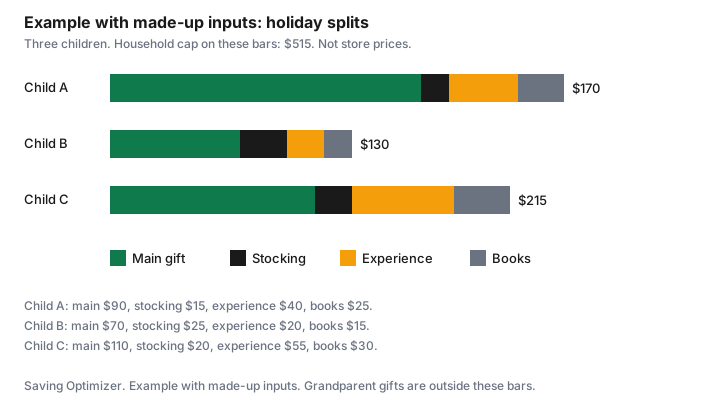
Example with made-up inputs, for three children, with a household cap of $515 on what this household buys. Child A: main gift $90, stocking $15, experience $40, books $25, total $170. Child B: main gift $70, stocking $25, experience $20, books $15, total $130. Child C: main gift $110, stocking $20, experience $55, books $30, total $215. Those three totals are $515. A separate grandparent column, $40, $30, and $50, is coordination, not an extra $120 inside the $515. These are not store prices and not a recommended spend. If $515 is too high for your month, the method is the same at a lower cap. The zero-based budget is where the cap has to land. This page does not use that guide's numbers.
| Date | What it is | What to check |
|---|---|---|
| Friday 27 November 2026 | Black Friday | Ordinary-price claim on the "was" figure. Return window, counted from this date. Gift receipt. |
| Monday 30 November 2026 | Cyber Monday | Same price test. Shipping cutoff if the toy has to arrive before the holiday. Return window. |
| Saturday 26 December 2026 | Boxing Day | Whether the toy is still the one you wanted, or a leftover size. Return window from this later date. Gift receipt. |
Black Friday (27 Nov) vs Boxing Day (26 Dec) for toys
A toy bought on 27 November has been in the house for a month by Boxing Day. A toy bought on 26 December has a return window that starts later, which matters if the child opens it on the 25th and the size or the age fit is wrong. Neither date wins on its own. The clothing comparison of those two sale days is on the Black Friday and Boxing Day clothing guide. Toys add a safety check that a sweater does not: the age label and the recall search, before the price comparison.
If you track prices, do it on the product you will actually buy, over the weeks you are willing to wait. The Amazon.ca price-tracking guide is the household method for that retailer's history. A cash-back portal or an Amazon.ca storefront offer, if you use one, comes off the price you would have paid. It does not make a recalled toy acceptable, and it does not extend a return window. The clothing price-history guide is the same habit for apparel, including a "was" price that only existed on a tag.
Price history and 'was' prices
The Competition Bureau's ordinary-price guidelines, dated 16 October 2009, say they are not a legal document. The Bureau's page also says it is reviewing the guidelines after changes to the Competition Act. The tests in those guidelines are still the plain-language description the Bureau publishes. This page is not legal advice.
The ordinary selling price is determined by one of two tests. The volume test: a substantial volume of the product was sold at that price or a higher price, within a reasonable period of time. The time test: the product was offered for sale, in good faith, for a substantial period of time at that price or a higher price. The guidelines apply the idea both to suppliers generally in the market and to the seller's own ordinary price. A crossed-out price that the product never sold at, and was never really offered at, is the situation those provisions are aimed at. You can keep your own notes: the price on a week you looked, the price on the sale day, and whether the "was" figure matches either. You do not have to finish the Bureau's analysis to decide the toy is outside your cap.
| Child | Main gift | Stocking | Experience | Books | Child total | Grandparent, coordinated |
|---|---|---|---|---|---|---|
| Child A | $90 | $15 | $40 | $25 | $170 | $40 |
| Child B | $70 | $25 | $20 | $15 | $130 | $30 |
| Child C | $110 | $20 | $55 | $30 | $215 | $50 |
| Household | $270 | $60 | $115 | $70 | $515 | $120, outside the cap |
Toy safety and recalls
Health Canada's toy safety tips say toys in Canada must meet safety requirements, and that unsafe toys can still reach stores, online markets, and homes. Before you buy, new or used, check the age label and follow the manufacturer's range. Age labels are there to reduce choking, strangulation, and hearing damage for younger children. Buy toys that have clear warnings and the manufacturer's contact information. The tips say not to give toys with small parts or accessories to children under 3, including building sets meant for older children, loose puzzle pieces, buttons, beads, marbles, pellets, magnets, eyes or noses that can be pulled off, and wheels from small vehicles. If the toy or a removable part fits inside a toilet paper roll, the page says it is too small for children under 3.
Look for a secure battery compartment, especially with button batteries. Parts should be firmly attached, with no sharp edges. After you buy, discard plastic wrap and bags. Search recalls-rappels.canada.ca for the brand and the product name before you pay. The recalls home page was checked 29 September 2026. This guide does not cite a specific toy recall. Health Canada's page for second-hand shoppers says not to buy a used toy that is broken, has sharp edges, or has loose eyes or noses, and to check recalls because of lead in paint on some recalled toys. Loose small powerful magnets are a swallowing hazard. The used-gear checks for car seats and cribs are on the secondhand gear guide. A holiday toy is a smaller version of the same habit.
Experience gifts, secondhand and grandparent coordination
An experience you were going to pay for in January can be the December gift, if you move the spending into the cap and do not also buy a main toy of the same size. A secondhand toy from someone you know still needs the age-label check and the recall search. A swap with another family works when you agree the items in advance, which is the grandparent column in the worksheet: write the item, not a vague "they'll get them something."
Clothing gifts have their own return and gift-card rules on the clothing gifts guide. Keep toys on this page. If the experience is a day camp in the summer, that cost may be a child care expense rather than a gift. That question belongs with the CRA and the activities budget, not in the stocking.
Return windows for gifts
Return rules are the retailer's. They are not a national holiday extension. Ask, before you pay, what the window is, whether it is longer in December, and whether a gift receipt lets someone else return the item without the price showing. Count the window from the purchase date you are actually using. A 27 November purchase and a 26 December purchase do not share a deadline. The household method for reading those policies is the store return policies guide. Keep the receipt with the recall check, not in the bag that gets recycled on the 26th.
Sources & date stamps
- Competition Bureau, ordinary price claims, guidelines dated 16 October 2009, page checked 29 Sep 2026. Volume test and time test. The publication says it is not a legal document. The page says the Bureau is reviewing the guidelines after Competition Act changes. Not legal advice.
- Health Canada, toy safety tips, checked 29 Sep 2026. Age labels, small parts and children under 3, toilet-paper-roll size check, battery compartments, recalls.
- Health Canada, information for shoppers of second-hand products, page details 4 February 2021, checked 29 Sep 2026. Used toys with damage or loose small parts. Magnets. Recall check.
- Recalls and safety alerts home page, recalls-rappels.canada.ca, checked 29 Sep 2026. No specific toy recall is cited.
- Calendar dates used as scheduled dates: Black Friday Friday 27 November 2026, Cyber Monday Monday 30 November 2026, Boxing Day Saturday 26 December 2026.
- Gift dollars are an example with made-up inputs.
Frequently asked questions
How much should I spend on each child's holiday gifts?
There is no single right amount. Set a household cap before the flyers arrive, then split it per child across a main gift, a stocking, an experience, and anything a grandparent is already buying. The worksheet on this page is an example with made-up inputs: three children at $170, $130, and $215, totalling $515. Your number is the one that still leaves December's bills intact.
Are Black Friday toy deals better than Boxing Day?
Black Friday is Friday 27 November 2026 and Boxing Day is Saturday 26 December 2026. Neither date is automatically the cheaper one. A was-price has to meet the Competition Bureau's volume test or time test before the saving is what it looks like. Check the return window, because a toy bought in November may be past the return date by New Year.
How can I tell if a 'was' price is real?
The Competition Bureau's ordinary-price guidelines, which the Bureau says are not law, use a volume test and a time test. The volume test asks whether a substantial volume sold at that price or higher within a reasonable period, and the time test asks whether the product was offered in good faith for a substantial period at that price or higher. Keep your own price notes. This page is not legal advice.
How do I check whether a toy has been recalled?
Search the brand and product name at recalls-rappels.canada.ca before you pay, and again if you are buying it used. Health Canada's toy safety tips say to follow the age label and to keep small parts away from children under 3. Do not use a recalled toy. This guide does not name a specific recall.
What should I know about returning toys after the holidays?
Return rules are the retailer's, and they differ by store. Ask for a gift receipt at purchase, and read the window before you assume a Boxing Day purchase can go back in January. A November purchase and a December purchase do not share a deadline. A cash-back portal or an Amazon.ca offer does not change the return rules.