
Weddings · Canada
Credit Card Points and Welcome Bonuses on Wedding Spending in Canada: Surcharges, Timing and Protection
Putting wedding costs on a rewards credit card only pays off if the card's rewards are worth more than any surcharge and you pay the full statement balance every month. In Canada, merchants outside Quebec may add a credit card surcharge of up to 2.4%, and must tell you before you pay, according to the Financial Consumer Agency of Canada (FCAC). Merchants may also offer a discount for cash or debit. Ask each vendor how they accept payment and whether there is a surcharge or a cash discount, then decide. A welcome bonus timed to your large deposits can be worth more than ongoing rewards, but only if the spending was already planned and you can repay it within the grace period.
Key takeaways
- Surcharges up to 2.4% may apply outside Quebec, and must be disclosed.
- Ask about cash or debit discounts before paying by card.
- Time a welcome bonus to deposits you were going to pay anyway.
- Pay in full within the grace period, at least 21 days at federally regulated issuers.
- Read the certificate of insurance before relying on purchase protection.
- Example with made-up inputs: rewards minus surcharges and interest.
Which vendors accept cards
Some wedding vendors accept credit cards, some accept only e-transfer, cheque or cash, and some accept cards for deposits only. Ask at the quote stage, and get the payment method and any fee written into the contract. Payment options vary from vendor to vendor, so do not assume.
Surcharges and cash discounts
| Rule | Details |
|---|---|
| Where allowed | Credit card transactions, everywhere except Quebec |
| Maximum | 2.4%, and not higher than the merchant's actual cost to accept the card |
| Combined fees | Not in addition to a service or convenience fee |
| Disclosure | Before the transaction is completed, at the point of sale, in store and online |
| Your options | Cancel without penalty; pay another way such as debit or cash |
| Discounts | Merchants may offer discounts for different payment methods under the Code of Conduct |
FCAC's guide to choosing a credit card puts it simply: you may end up paying up to 2.4% more for each purchase. If your card earns less than the surcharge, pay another way.
Welcome-bonus timing
A welcome bonus may require a minimum spend within a set period after approval; read the offer terms. Map your wedding payment schedule first, then apply for a card only when a cluster of planned payments falls inside the bonus window. Check the card's annual fee, whether the bonus requires the card to stay open, and whether an application will affect other borrowing you plan, such as a mortgage. Never buy extra things to hit a spending target. If the planned payments do not reach the threshold comfortably, skip the bonus.
Grace period and paying off in full
FCAC says federally regulated card issuers must provide a minimum 21-day interest-free grace period on purchases, starting on the last day of the billing period, if you pay the full balance. There is no grace period on cash advances or cash-like transactions. Carry even part of a balance and interest applies; FCAC's example rates are 19% on purchases and 22% on cash advances. FCAC also says a missed payment can cost you a promotional interest rate and raise your regular rate. Set up an automatic full-balance payment before you put any large deposit on a card. Check your credit limit too, since a large deposit can push you over it.
Purchase protection
Some cards include purchase protection, extended warranty or event-related coverage. These are insurance benefits with conditions, limits and exclusions set out in a certificate of insurance. Before relying on one for a wedding deposit, read the certificate: does it cover services or only goods, deposits for future services, cancellations by the vendor, and what proof is needed? Do not assume a card will refund a vendor that goes out of business. Your contract terms come first; see vendor contracts and deposits.
Points vs cash back
FCAC suggests weighing how likely you are to use each benefit and how long it takes to earn rewards. Points programs can be worth more when redeemed for travel, which may suit a honeymoon, but values vary by program and redemption. Cash back is simple and predictable. Either way, compare the rewards rate with any annual fee and the surcharges you might pay. Read the program terms on expiry and on what happens to unredeemed points if you close the card, and redeem before you downgrade or cancel it.
Vendors who do not take cards
Do not route a vendor payment through a third-party service or a cash advance just to earn points. FCAC says cash advances and cash-like transactions have no interest-free grace period, interest starts on the day of the transaction, and fees may apply. Those costs can easily exceed any reward. Pay vendors who prefer e-transfer or cheque that way, and put only surcharge-free card payments on the rewards card.
Tracking
Keep one spreadsheet for the wedding with each payment, its date, the method, any surcharge and the rewards earned. It shows quickly whether the card strategy is worth it, helps with any dispute, and makes it easy to check that every payment appears correctly on your statement. Save receipts and the contract for each card payment in case you need to claim under a card benefit.
Plan
- List vendors, payment dates and amounts.
- Ask each vendor about card acceptance, surcharges and cash discounts.
- Pick a card whose rewards beat surcharges, or pay surcharge-free vendors by card only.
- Time any welcome bonus to planned payments.
- Automate full-balance payments.
- Track rewards and redeem them, for example toward the honeymoon.
Example with made-up inputs
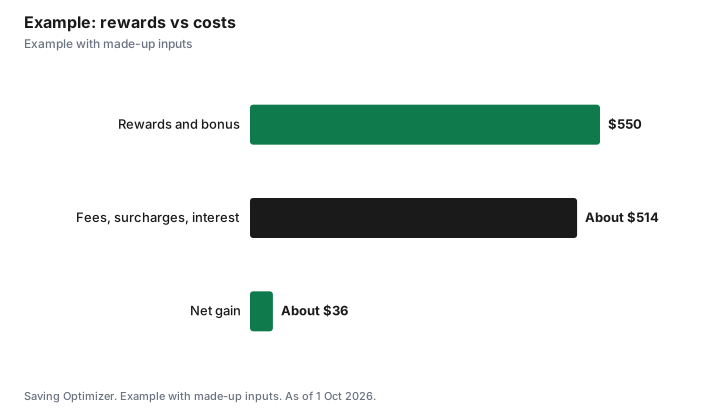
These numbers are an example with made-up inputs, apart from the 2.4% surcharge cap. A couple puts $15,000 of wedding payments on a 2% cash back card: $300 in rewards. A welcome bonus worth a made-up $250 brings that to $550, less a $120 annual fee, $430. If $6,000 of those payments carry a 2.4% surcharge, they pay $144 extra, reducing the net gain to $286. If they also carry a $5,000 balance for three months at 19.99%, interest of about $250 cuts it to about $36.
| Item | Amount |
|---|---|
| 2% cash back on $15,000 | +$300 |
| Welcome bonus | +$250 |
| Annual fee | -$120 |
| Surcharges on $6,000 at 2.4% | -$144 |
| Interest on $5,000 for 3 months | About -$250 |
| Net | About +$36 |
Common mistakes
- Paying a 2.4% surcharge to earn 1% to 2% back.
- Carrying a balance, wiping out rewards.
- Applying for a card shortly before a mortgage application without checking the effect.
- Buying unplanned extras to meet a bonus.
- Assuming purchase protection covers vendor deposits.
Related: paying for a wedding without debt and 2027 wedding budget.
Sources
- Financial Consumer Agency of Canada, Merchant surcharges, service and convenience fees, and discounts, canada.ca, as of 1 Oct 2026.
- Financial Consumer Agency of Canada, How credit cards work; Choosing a credit card, canada.ca, as of 1 Oct 2026.
- Spending, rewards rates, fees and balances in the example are made-up inputs.
Frequently asked questions
Can wedding vendors charge a credit card surcharge in Canada?
Yes, except in Quebec. FCAC says the surcharge is capped at 2.4% and must be disclosed before you pay.
Can I avoid a surcharge?
Yes. FCAC says you must be able to cancel without penalty and pay another way, such as debit or cash.
Is it worth putting a wedding on a credit card?
Only if the rewards beat any surcharges and fees, and you pay the full balance within the grace period.
How long is the credit card grace period?
At least 21 days at federally regulated issuers, on purchases paid in full. There is none on cash advances.
Does purchase protection cover wedding deposits?
It depends on the card's certificate of insurance. Read the terms for services, deposits and vendor failure.
Can merchants give a cash discount?
Yes. Under the Code of Conduct, merchants may offer discounts for different payment methods.
Researched and drafted with AI assistance and fact-checked against official Canadian sources. How we create content.
Disclosure: Saving Optimizer may earn a commission if a partner link is added later. No partnership is claimed on this page. Education only, not financial advice.