
Technology · Canada
Family Phone Plans in Canada: Multi-Line Discounts vs Separate Plans for Each Person
In Canada, a multi-line family plan lowers the price per line on many carriers, but it is not automatically cheaper than giving each person their own plan. Compare the household total: add up what a family plan costs for every line, then add up the cheapest plan that fits each person's data use, including lower-cost and prepaid brands. Light users often save on separate plans; families who all need similar data often save with a multi-line discount. Remember that one account holder is responsible for every line on a family account.
Key takeaways
- Write down each person's real data use from recent bills or phone settings.
- Price the family plan for all lines, including taxes and any device payments.
- Price the cheapest fitting plan for each person separately, including prepaid and lower-cost brands.
- Family accounts: one account holder is responsible for all lines and charges.
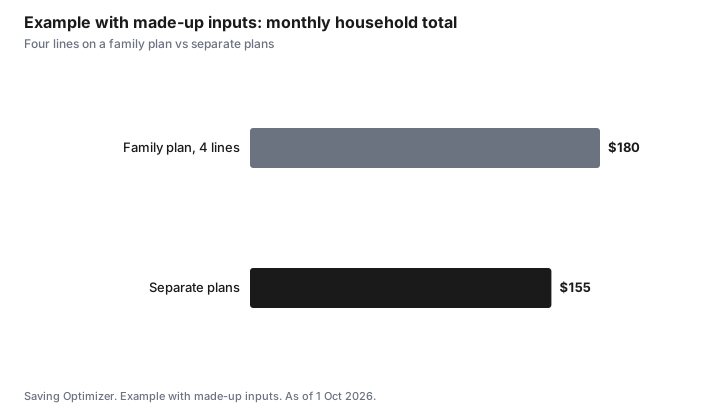
- Example with made-up inputs: 4 lines at $45 = $180 vs separate plans totalling $155.
How multi-line discounts work
Carriers often price the first line at the full rate and give a discount on each added line, or offer a family plan price per line that drops as lines are added. Discounts may require every line to be on a similar tier. Check whether the discount is permanent or promotional, and what happens if a line leaves.
Family plan vs separate plans
| Factor | Family multi-line plan | Separate plans |
|---|---|---|
| Price per line | Lower as lines are added | Each person picks the cheapest fitting plan |
| Data needs | Best when everyone needs similar data | Best when use varies a lot |
| Account | One account holder responsible for all lines | Each person responsible for their own |
| Device financing | Devices tied to the account | Tied to each person's plan |
| Leaving | A line leaving can change the others' discount | Independent |
What to check before switching
- Device balances: leaving a carrier early means paying the remaining device balance on financed phones.
- Trial period: under the CRTC Wireless Code, you can cancel a new contract within at least 15 days if within the usage limits (30 days for people with a self-identified disability).
- Kids' lines: parental controls and spending limits; see the first-phone guide.
- Bundles: some carriers discount mobile when combined with home internet.
Step by step: price your household both ways
- Pull the last three bills for every line, or open each phone's data usage screen, and note the highest month for each person. Plan for the high month, not the average.
- List what each person needs besides data: Canada-US calling or roaming, international texting, hotspot use, or a 5G device.
- Ask your current carrier for its multi-line price with every line on the cheapest tier that fits the heaviest user, then with mixed tiers if it allows them.
- Price each person separately on the cheapest plan that fits their own needs. Include lower-cost brands owned by the same networks and prepaid plans with an autopay discount.
- Add device payments. A line with a financed phone carries its remaining device balance with it if it leaves.
- Add sales tax to both totals. GST, HST, PST and Quebec's QST apply to phone service and vary by province.
- Compare the two household totals, then decide whether the saving is worth having one person responsible for every bill.
Who can authorize what on a family account
Under the CRTC Wireless Code, the account holder is the person who signed the contract and is responsible for paying. On a family or shared plan, only the account holder can consent to data overage charges beyond $50 or data roaming charges beyond $100 in a monthly billing cycle, unless they authorize another user to do so. Those caps apply per account, not per device. That protects the payer, but it also means a teen cannot add a roaming pass on their own unless you set them up as an authorized user.
| Protection | What it means for a family account |
|---|---|
| Data overage cap | Overage charges stop at $50 per account per billing cycle unless the account holder (or an authorized user) agrees to more |
| Data roaming cap | Roaming data charges stop at $100 per account per billing cycle unless the account holder agrees to more |
| Trial period | At least 15 days, with usage under half the plan's monthly limits, for a contract with an early cancellation fee; for multi-user plans, the limits apply to the whole account |
| Unlocked phones | Phones sold since 1 Dec 2017 are unlocked, so a line can move to another carrier |
Common mistakes
- Sizing everyone to the heaviest user. A shared or uniform tier can mean paying for data three people never use.
- Forgetting the promotion end date. A multi-line discount that ends after 12 or 24 months changes the comparison; ask in writing.
- Moving a line with a financed phone. The remaining device balance comes due when that line cancels its agreement.
- Keeping an unused line. Tablets, smartwatches and old phones on the account still bill each month.
- Adding an adult child who then cannot leave easily. Agree up front on who pays and how a line will move out.
Example with made-up inputs: when the family plan wins
These numbers are an example with made-up inputs. Three adults all use a lot of data. A family plan prices each line at $50 for $150 in total. Each adult's cheapest fitting separate plan is $60, for $180. Here the multi-line discount wins by $30 a month, or $360 a year, because everyone needs a similar plan.
| Setup | Monthly | 12 months |
|---|---|---|
| Family plan, 3 lines at $50 | $150 | $1,800 |
| Separate plans, 3 at $60 | $180 | $2,160 |
Example with made-up inputs: four people
These numbers are an example with made-up inputs, not current prices.
| Person | Family plan line | Separate plan |
|---|---|---|
| Parent 1 (heavy data) | $45 | $55 |
| Parent 2 (moderate) | $45 | $40 |
| Teen (moderate) | $45 | $40 |
| Child (light) | $45 | $20 prepaid |
| Total | $180 | $155 |
Sources
- CRTC, The Wireless Code, as of 1 Oct 2026. Trial period of at least 15 days within usage limits (30 days with a self-identified disability); device balance rules.
- CRTC, The Wireless Code, as of 1 Oct 2026. Data overage cap $50 and data roaming cap $100 per account per monthly billing cycle; account holder consent on shared plans; trial usage limits for multi-user plans.
- The prices in the example table and chart are made-up inputs.
Frequently asked questions
Are family phone plans cheaper in Canada?
Sometimes. Multi-line discounts lower the per-line price, but separate plans can cost less when people use very different amounts of data. Compare the household total both ways.
Who is responsible for a family phone account?
The account holder is responsible for all lines and charges on the account.
What happens if someone leaves a family plan?
Their line may owe a remaining device balance, and the discount on the remaining lines can change. Ask the carrier before moving a line.
Can kids have prepaid plans instead?
Yes. A low-data prepaid plan can be cheaper for a child than a family line, and it caps spending.
Is there a trial period for new plans?
Under the CRTC Wireless Code, there is a trial period of at least 15 days within usage limits, or 30 days for people with a self-identified disability.
Who can approve roaming charges on a family plan?
Under the Wireless Code, the account holder must consent to data overage charges beyond $50 or data roaming charges beyond $100 in a billing cycle, unless they authorize another user. The caps apply per account.
Should I count tax when comparing plans?
Yes. Sales tax applies to phone service and varies by province, so compare totals with tax for both the family plan and the separate plans.
Researched and drafted with AI assistance and fact-checked against official Canadian sources. How we create content.
Disclosure: Carriers and plans are described as offer types; none is named or ranked. Saving Optimizer may earn a commission if a partner link is added later; no partnership is claimed. Education only.