
Housing · Canada
Moving back with parents in Canada: a savings plan that respects everyone
Adult children move home to “save for a down payment” and then treat the spare bedroom as a rent holiday. Parents absorb groceries and hydro. Nobody writes a date. Three years later the FHSA is still empty and the only thing that compounded is resentment. The Canadian version of this story has a named wrapper — the First Home Savings Account — and it does not accrue room for the years you meant to open it.
CRA (verified on our FHSA page, 16 Sep 2026): first-year FHSA room is $8,000; lifetime contributions and RRSP-to-FHSA transfers $40,000. HBP still allows eligible RRSP withdrawals up to $60,000. CMHC’s First-Time Home Buyer Incentive is closed to new applicants (21 Mar 2024). The rent you are not paying has to land in one of those buckets — or a debt plan — or it is just cheaper lifestyle.
Disclosure: FHSA and brokerage account offers are an offer type. Saving Optimizer may earn a commission if we later add partner links. We do not currently claim issuer partnerships. This is not tax, legal, or family-mediation advice.
Key takeaways
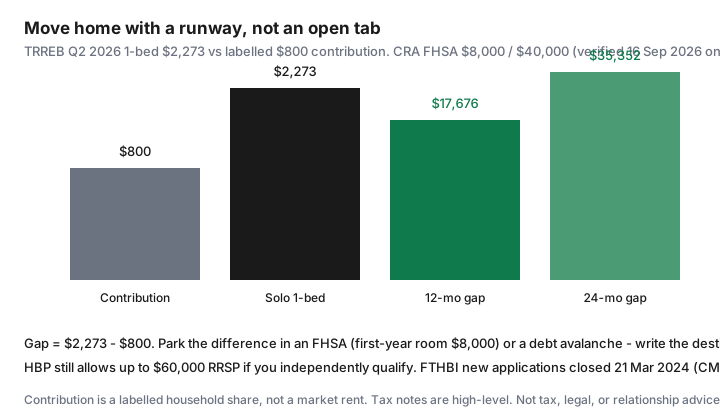
- Set a contribution that is fair and still builds runway — labelled $800 vs TRREB Q2 2026 1-bed $2,273.
- Write the destination: FHSA $8,000, debt, or a 3-month buffer. Open the account in month one.
- Put chores, groceries, guests, and quiet hours on one page with a review date.
- 12 months of the labelled gap ≈ $17,676; 24 months ≈ $35,352 before you actually contribute.
- Tax notes are high-level. Healthy adult children are not automatic dependants.
Set a shelter contribution that is fair but builds runway
Fair is not “market rent for a Mississauga basement.” Fair is a share of the incremental cost you impose: groceries, heat, hydro, water, internet, and a slice of property tax or condo fees, plus something for wear. A labelled $800 leaves a $1,473 gap against a $2,273 Toronto one-bed. In a cheaper CMA, shrink both sides. Paying $0 teaches the household that your presence is free; paying the full old rent teaches you nothing about a future mortgage stress test. Put the contribution on e-transfer the day the city tax or the mortgage comes out — not “when I remember.”
Written timelines for FHSA/down-payment or debt goals
One page, three numbers, a date:
- Open the FHSA (or the debt-avalanche account) this calendar month if you are eligible.
- Automatic transfer the morning after payday toward the $8,000 room — or the highest-interest balance.
- Review on the first Sunday of months 4, 8, and 12. If the balance is off-plan, change the contribution or the exit date, in writing.
If you will also use the Home Buyers’ Plan, do not raid the RRSP for a vacation because “HBP exists.” HBP is a repayment calendar. Stacking FHSA + HBP on one purchase is powerful and easy to mess up. FTHBI is not coming back for a 2026 worksheet.
Chores, groceries, and privacy agreements
- Kitchen nights, laundry, snow, and bins — named people, not “we’ll figure it out.”
- Grocery fund: shared staples plus your own perishables. One person “just grabbing it” is how a Venmo war starts in week six.
- Guests and partners: nights per month before they contribute or book a hotel.
- Work-from-home hours and a closed door. Parents retired at home are not a co-working space by default.
- Cars in the driveway and insurance: whose name, whose deductible.
A one-page PDF in the same folder as the contribution calendar is enough. Politeness that cannot survive a written date will not survive February.
How long is too long for career and relationships
Twelve months is a sprint. Twenty-four months is a plan if the FHSA and the job are both moving. Longer can still be rational for a documented caregiving stretch or a licensed program with an end date. It is too long when interviews are declined because the commute is “fine from here,” or when a partner is a secret, or when the only housing hunt is scrolling. Career and relationship costs do not show up on a rent spreadsheet and still spend your thirties.
Tax and benefit high-level notes (dependants, etc.)
This is not a T1. High-level patterns people miss:
- A healthy adult child is generally not a dependant for the federal eligible-dependant credit.
- If parents charge more than a share of household expenses, CRA may see rental income. Below-cost board is often treated as sharing expenses — confirm with a tax advisor.
- GST/HST credit, CCB, and some provincial benefits look at household facts. A returning adult can change a parent’s file. Check My Account; do not assume silence is approval.
- Your own credits (including the FHSA deduction) still need a return. File even if you “had no tax.”
Exit criteria and check-ins
Write the exit before the first Sunday: a dollar amount in the FHSA or a debt balance of $0, plus a calendar date. If the city you want is still $2,273 for a one-bed, the exit might be a roommate split or a cheaper CMA — name it. If a parent’s health is the real reason you stayed, say that out loud so the FHSA is not a cover story. Check-ins are 20 minutes with the spreadsheet open, not a fight in the kitchen.
Sample 12- and 24-month savings trackers
| Month | Move the gap | Cumulative (if moved) | Check |
|---|---|---|---|
| 1 | Open FHSA; PAD $1,000; rest to buffer | $1,473 | Account number exists |
| 4 | Stay on PAD | $5,892 | Review Sunday |
| 8 | Hit $8,000 FHSA room; overflow to TFSA/debt | $11,784 | CRA room vs deposits |
| 12 | Year-one room full; decide stay or exit | $17,676 | Lease hunt or 12 more months |
| 24 | Second $8,000 year if still eligible | $35,352 | Written exit or a new dated plan |
If the gap only exists because groceries quietly moved onto a parent’s card, the tracker is fiction. Pair housing goals with a boring application package so month 12 is not a panic PDF.
Sources & date stamps
- CRA, First Home Savings Account — $8,000 first-year room, $40,000 lifetime (pages used 16 Sep 2026 on the FHSA guide).
- CRA, Home Buyers’ Plan — $60,000 limit; 2026–2028 first-withdrawal repayment-start relief.
- CMHC, First-Time Home Buyer Incentive — new submissions ended 21 Mar 2024.
- TRREB Condo Market Report, Q2 2026 — GTA one-bedroom average $2,273.
Frequently asked questions
How much should an adult child contribute at home in Canada?
Enough to be fair to the household and still build a written runway. A labelled $800 toward groceries, utilities, and property-tax share versus a TRREB Q2 2026 Toronto one-bedroom at $2,273 frees about $1,473 a month. Charging yourself $0 is how year three arrives with the same chequing balance.
What should the money be for?
A named destination: FHSA room (CRA $8,000 first year, $40,000 lifetime), HBP-eligible RRSP if you independently qualify (up to $60,000), a debt avalanche, or a 3-month emergency fund. FTHBI new applications closed 21 March 2024. Do not park the gap in a vacation tab.
Are there tax issues when an adult child moves home?
High-level only. A healthy adult child is generally not a dependant for federal credits. If parents charge more than a share of expenses, they may have rental income to report. Benefit programs that test household composition can change — confirm in CRA My Account. This is not a T1 review.
How long is too long?
When the written goal is met or missed and nobody will name a new date. Twelve months can fund an $8,000 FHSA year plus a buffer. Twenty-four months can fund two contribution years. Year four without an exit review is usually drift, not a plan.
Is this family or tax advice?
No. It is a household cash plan. FHSA/brokerage offers are an offer type only. Talk to the people you live with, and to a tax advisor if money changes tax slips.