
Transportation · Canada
How to compare public EV charging costs vs home charging for Canadian drivers
Home overnight charging is why an EV beats gasoline on energy. Public DC fast charging is why some condo and apartment drivers discover they bought a more expensive petrol. Canadian networks bill per kilowatt-hour, per minute, or a mix; idle fees and memberships change the receipt; workplace and condo politics decide whether you ever see the cheap home number. This is a bill comparison, not a charger-brand sermon.
Install costs: Level 2 charger guide. Commute TCO: EV vs gas. Used EVs: Québec used-rebate context. Ontario overnight plans: ULO vs TOU.
Disclosure: EV charging-network memberships and credit cards with transit or EV-adjacent categories are offer types. Saving Optimizer may earn a commission if we later add partner links. We do not currently claim network or card partnerships. Station prices are set locally — read the screen.
Key takeaways
- Home: Ontario TOU off-peak 9.8¢/kWh commodity; ULO 3.9¢ 11 p.m.–7 a.m. (OEB 1 Nov 2025–31 Oct 2026). Delivery extra. Québec and Manitoba kWh are often cheaper; B.C. step 2 can sting.
- Public DC: treat ~30–65¢/kWh as a 2026 working band from network and consumer guides; Electrify Canada often lands ~48–60¢ before Pass+. Confirm the app.
- Per-minute networks (some Petro-Canada DC) punish slow-charging cars. Per-kWh is easier to compare to home.
- Idle fees and prepaid app balances are how a “$12 charge” becomes $20. Memberships only pay if you use that network.
- A labelled 15,000 km year: ~$294 at 9.8¢ commodity vs ~$1,500 at 50¢ DC (3,000 kWh). That spread is the charger — or the reason not to buy the EV yet.
Network pricing models (per kWh vs per minute)
After Measurement Canada allowed energy-based billing at many DC sites, Electrify Canada moved to station-specific ¢/kWh (announced for January 2024; still the model in 2026 app copy). FLO hosts set their own Level 2 and DC prices — some hourly, some ¢/kWh (FLO’s March 2025 energy-billing note used 45¢/kWh as an example host rate, not a national tariff). Tesla Superchargers in Canada generally bill per kWh. Petro-Canada’s public DC has often been per minute, so a car that tapers early or a cold battery that charges slowly costs more for the same kWh. Always screenshot the session price before you plug in.
| Where | How you are billed | Working 2026 band |
|---|---|---|
| Home (Ontario TOU off-peak) | ¢/kWh on the hydro bill | 9.8¢ commodity; mid-teens–low-20s all-in typical |
| Home (Ontario ULO) | 3.9¢ 11 p.m.–7 a.m.; 39.1¢ weekdays 4–9 p.m. | Only a win if you actually charge overnight |
| Public Level 2 (FLO / ChargePoint / municipal) | Often $/hour or free | About $0–$3/hour in common write-ups |
| Electrify Canada DC | ¢/kWh + idle; Pass+ ~20% off energy | Often ~48–60¢ before membership |
| Other DC (Tesla, Ivy, FLO Ultra, Petro-Canada) | ¢/kWh or ¢/minute | Roughly 30–65¢/kWh equivalent |
Idle fees and app membership gotchas
Idle fees start after a grace period once charging stops. Grocery + 40 minutes of sitting is how people donate $15 to the network. Memberships: Electrify Canada has advertised Pass (no monthly fee) and Pass+ at $7/month for up to 20% off energy, idle excluded. FLO and others have their own accounts, RFID cards, and prepaid wallets. A $20 authorization hold is not the final price. Delete dead apps so you do not keep a membership you forgot.
Workplace and condo charging politics
Free or cheap workplace Level 2 can delay a home install for years. Ask whether it is first-come, whether overnight is allowed, and whether payroll will ever call it a taxable benefit — that last question is for HR, not this article. Condos: visitor stalls with a dying 120 V plug are not a plan. Board approval, load management, and who pays the house meter are the project. If the answer is “we’ll discuss it next AGM,” you are a public-charging household until then. See condo parking vs car-share if the stall itself is the expensive line.
Road-trip DC fast-charge budget planner
Worked sketch (labelled): 800 km corridor, car uses 20 kWh/100 km, you arrive at stalls at 15% and leave at 80% twice. Energy ~ 2 × 0.65 × usable pack. If the pack is 64 kWh usable, that is about 83 kWh × 50¢ ≈ $42 plus idle if you eat slowly. Winter and roof boxes raise kWh. Compare to a gasoline compact at 8 L/100 km and $1.50/L ≈ $96 for the same 800 km — DC can still win versus gas on a trip and lose versus home on a commute. Budget a 20% time-and-taper pad. Do not plan every stall at 350 kW if your car tops out at 100 kW.
When public-only ownership still pencils out
It can, when kilometres are low, workplace covers the week, or municipal Level 2 is actually empty at 8 p.m. It fails when you DC-charge four times a week at 55¢ to live downtown without a stall. Run one calendar month of receipts before you sell a paid-off Civic. If public-only costs approach gasoline, the EV’s other merits (maintenance, carpool lanes, values) have to carry the decision — energy will not.
Loyalty apps and credit-card cash back on charging
Some cards code EV charging as gas, utilities, or “other.” Test a $20 session before you buy a card for a category that does not exist at that terminal. Network memberships plus card cash back stack only if both actually apply. Do not keep a $120 annual-fee card for 8¢ back on $40 of DC. If the card’s grocery category is the real earn, put charging on a no-fee card and stop thinking about it.
Sample monthly bill: home-heavy vs public-heavy
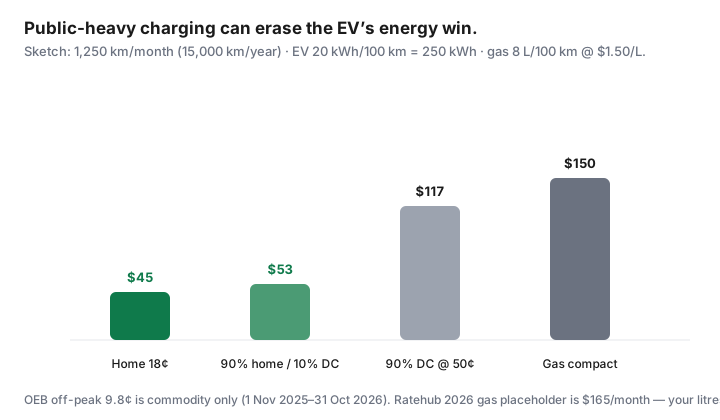
Same labelled month: 1,250 km (15,000 km/year ÷ 12). EV at 20 kWh/100 km = 250 kWh. Gas compact at 8 L/100 km and $1.50/L = 100 L = $150. Ratehub’s 2026 gas placeholder is $165 — close enough to treat as “a thrifty compact.”
- 100% home at 18¢ all-in: 250 × $0.18 = $45.
- Home-heavy (90% home / 10% DC at 50¢): 225 × $0.18 + 25 × $0.50 = $53.
- Mixed (50/50): 125 × $0.18 + 125 × $0.50 = $85.
- Public-heavy (10% home / 90% DC): 25 × $0.18 + 225 × $0.50 = $117.
- Gasoline compact: $150 at $1.50/L (or $165 on Ratehub’s placeholder).
Home-heavy still beats this gas line on energy. Public-heavy can close most of the gap — and exceeds gasoline if DC is dearer than 50¢, the car is thirstier than 20 kWh/100 km, or you add idle fees. Québec residential ¢ or Ontario ULO at 3.9¢ commodity makes home look even better; a 12 L/100 km SUV makes gas look worse. Put your hydro line and your litres in the cells. The chart is the public-heavy trap, not a promise that every EV saves fuel money.
Use the worksheet, not the slogan: kWh/month × your ¢. DC sessions × their ¢. Gas litres × posted ¢. The EV wins on energy when home or workplace dominates. It can lose when DC dominates and the gas car is already efficient.
Sources & date stamps
- Ontario Energy Board RPP — TOU 9.8 / 15.7 / 20.3¢; ULO 3.9¢ overnight (1 Nov 2025–31 Oct 2026).
- Electrify Canada pricing and Pass+ ($7/month, up to 20% off energy; idle excluded) — public pages reviewed 20 Sep 2026; station prices vary.
- Companion Level 2 and EV-vs-gas guides — $1,000–$3,000 install; 50¢/kWh DC sketch; Ratehub gas placeholder $165/month (29 Apr 2026 TCO).
- ThinkEV / network consumer guides 2026 — public DC 30–65¢/kWh working band; Level 2 $0–$3/hour. Confirm live stalls.
Frequently asked questions
How much is public DC fast charging in Canada?
It varies by network and station. 2026 consumer round-ups commonly place Electrify Canada in the high-40s to about 60¢/kWh before membership discounts, with other networks in a roughly 30–65¢/kWh band. Petro-Canada has used per-minute pricing that works out differently by charge speed. Always read the app or charger screen that day.
How does that compare to home charging in Ontario?
OEB RPP commodity from 1 Nov 2025–31 Oct 2026 is 9.8¢/kWh off-peak TOU and 3.9¢ Ultra-Low Overnight (11 p.m.–7 a.m.). Delivery still applies — many bills land in the mid-teens to low twenties all-in off-peak. That is still far below typical highway DC.
Do charging-network memberships pay off?
Only if you actually use that network enough to beat the monthly fee. Electrify Canada’s Pass+ has been advertised at $7/month for up to 20% off energy (not idle fees). A condo driver who DC-charges twice a week should run the arithmetic. A home-heavy driver should not buy a membership for vibes.
Can I own an EV without home charging?
Yes if workplace, condo, or cheap public Level 2 covers most kilometres. It fails when almost every commute ends on 50¢/kWh DC. Price a month of your real sessions before you buy the car.
What are idle fees?
Charges that start after the car is full (or after a grace window) if you stay plugged in. They exist to free the stall. Budget them on grocery stops. Move the car when the app pings.