
Internet · Canada
Splitting the Internet Bill With Roommates in Canada Without the Drama
Shared internet is cheap per person until someone ghosts an e-Transfer and the account holder’s credit takes the hit. Canadian ISPs bill the name on the contract. Roommates bill each other with hope. This playbook fixes the hope: account risk, fair formulas, payment cadence, mid-contract exits, equipment, and a one-page agreement template. It is not legal advice and not a CCTS shortcut for roommate fights.
Disclosure: Education only. ISP plans are offer types. Saving Optimizer does not claim an ISP partnership. This page is not a lawyer, not a roommate matching service, and not a substitute for a provincial tenancy review.
Key takeaways
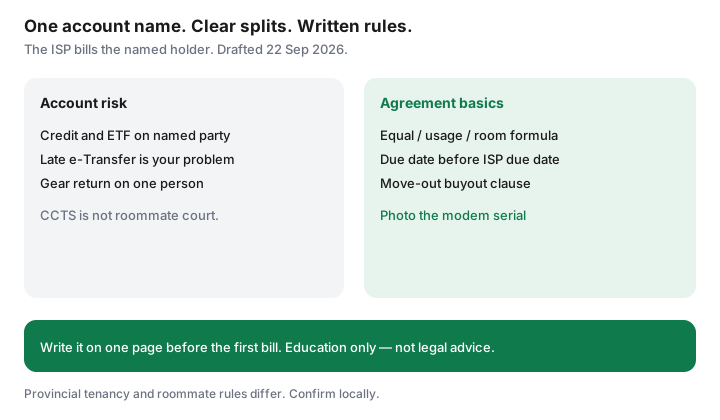
- The named account holder owns late fees, ETFs, and credit reporting risk — not “the house.”
- Pick a split formula before the first bill: equal, usage, or room size. Write it down.
- e-Transfer due dates should land a few days before the ISP due date.
- Move-outs need notice, a buyout of the remaining share, and a decision on who keeps the service.
- Photograph modem serials and agree who pays damage or non-return fees.
Whose name is on the account—and why it matters
ISPs rarely treat a verbal “we all share it” as a multi-party contract. The person who signs:
- Gets collection calls and credit damage if the bill lapses.
- Faces any fixed-term early cancellation charge if the house cancels early.
- Must return equipment. Non-return fees do not care who spilled coffee on the gateway.
Choose a holder who will stay for the term, has stable income, and is organised enough to send payment requests. If two names are allowed, understand you may both be on the hook. Autopay from a joint account helps only if everyone funds that account on time.
Fair split formulas (equal vs usage vs room size)
| Formula | Best when | Watch-out |
|---|---|---|
| Equal | Similar rooms, similar streaming and WFH | Heavy users feel subsidised; still usually worth the peace |
| By room size / rent share | One person has the large room and already pays more rent | Internet use may not track square metres |
| Usage uplift | One roommate WFH video all day or hosts game nights | Needs a simple rule (e.g. +$10) — not packet logging |
| Guest / partner surcharge | A partner stays most nights on the Wi-Fi | Agree the dollar before the first visit becomes permanent |
Do not install invasive traffic monitoring to “be fair.” A blunt uplift beats a surveillance argument.
e-Transfer cadence and late-payer rules
- Account holder pays the ISP by autopay on a fixed date.
- Roommates e-Transfer their share two to three business days earlier.
- Payment request includes the invoice PDF or a screenshot of the amount due.
- Late rule examples: reminder day one; $5 admin after day three; after day seven the holder may change the Wi-Fi password until paid — only if everyone agreed in writing first.
- Keep e-Transfer notes labelled “Internet Mar 2026” for your own records.
Interac e-Transfer is the Canadian default. Cash without a receipt is how memories diverge.
What happens when someone moves out mid-contract
Write this before anyone dates a new city:
- Minimum notice to roommates (e.g. 30 days) separate from provincial tenancy notice if you are on a lease.
- Whether the leaver pays until a replacement is found, or pays a fixed buyout (e.g. two months of their share).
- Who keeps the ISP account. Transfers mid-term are not always free or allowed — price a new install if needed.
- ETF exposure if the household cancels entirely. That lands on the named holder unless your agreement reallocates it.
Equipment responsibility and damage
- Photo the modem, pods, and serial numbers on install day.
- Rental gear stays with the account holder’s return obligation — see buy vs rent.
- Agree that intentional damage or loss is paid by the person responsible; ordinary wear is shared or absorbed by the holder as you prefer, but write it down.
- Do not let departing roommates “keep the mesh pods for the next place” if they are rentals.
A one-page roommate internet agreement template
Copy into a shared note and fill the blanks. Not a formal contract solicitor template — a clarity tool.
- ISP / plan / monthly total before tax: ________
- Account holder name: ________
- Split formula: equal / room / uplift (describe): ________
- Each person’s share: ________
- e-Transfer due date each month: ________ (ISP due date: ________)
- Late rule: ________
- Move-out notice and buyout: ________
- Equipment photos stored at: ________
- Signatures / date: ________
If the building has a bulk internet fee in rent, say whether that fee is shared through rent already and whether a second retail ISP is allowed — see apartment and condo rights.
Sources & date stamps
- CCTS — mandate covers certain telecom complaints by customers against participating providers, not roommate-versus-roommate collections (framing re-read 22 Sep 2026).
- CRTC Internet Code / ETF context — account holder obligations; see ETF and Code guides. Not legal advice.
- Provincial residential tenancy rules for leases and roommate arrangements differ — confirm locally. Drafted 22 Sep 2026.
Frequently asked questions
Whose name should be on the ISP account?
Someone who will stay for the term and can carry the credit risk. Co-sign only if the ISP allows it and everyone understands ETF and non-payment land on named parties.
Is equal split always fair?
Equal is simplest for similar rooms and usage. Heavy WFH or a gaming PC can justify a usage or room-size formula written down before move-in.
What if a roommate leaves mid-contract?
The named account holder remains liable to the ISP. Your roommate agreement should cover notice, a buyout of the remaining share, and who keeps the service.
Can the ISP help chase a roommate?
Usually no. The ISP bills the account holder. Interpersonal recovery is your agreement, e-Transfer trail, and if needed small claims — not CCTS for roommate disputes.
Is this legal advice?
No. It is a practical money and account-risk playbook. Provincial roommate and tenancy rules differ. Education only.