Utilities · Canada
How to compare residential solar quotes in Canada without getting upsold
Canadian solar quotes still arrive with a U.S. 30% tax credit in the fine print, a dead Greener Homes grant in the payback, and a production estimate that never saw a snow year. The number that matters is not “$0 hydro.” It is avoided imports plus whatever export credit your utility actually posts, minus delivery you still pay.
This is a homeowner scorecard for the post-grant era. Learn the credit machine in net metering basics. Ontario bill math is in is solar worth it in Ontario. B.C. shoppers need RS 2289 literacy before they compare ¢.
Disclosure: There is no natural affiliate product in a quote-comparison checklist. Saving Optimizer does not claim installer, financier, or utility partnerships. This is education — not an investment recommendation or a permit review.
Key takeaways
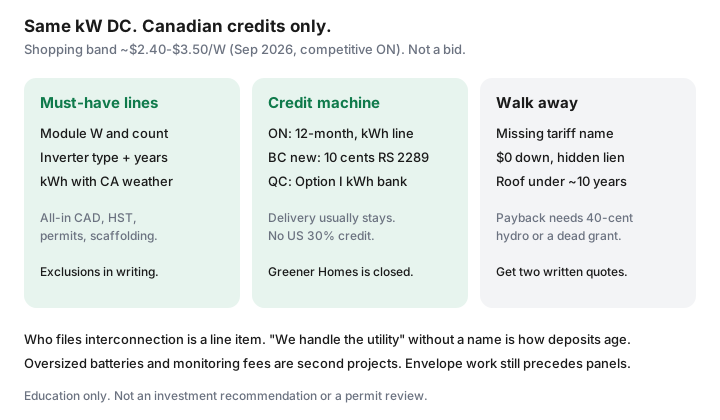
- Force every quote onto the same kW DC, roof planes, and inverter type. Then compare $/W, kWh/year, warranties, and exclusions — not the salesman’s “monthly payment.”
- Ontario shopping band we used in September 2026: about $2.40–$3.50/W installed in competitive markets. Treat outliers as a question, not a bargain.
- Credits: Ontario consumption-only, 12-month expiry; BC Hydro new customers 10¢/kWh on RS 2289; Hydro-Québec Option I kWh bank. Delivery usually stays. No U.S. 30% residential credit. Greener Homes is closed.
- Financing that only works if rates stay fantasy, or a 25-year roof lease you cannot exit, is a walk-away. Door-to-door Ontario PPAs have disclosure and a 10-day cooling-off — the OEB does not set the price.
- Who files interconnection is a line item. “We handle the utility” without a name and a timeline is how deposits age.
Must-have quote lines: panel watts, inverter, warranties, exclusions
| Line | What “good” looks like | Walk-away smell |
|---|---|---|
| kW DC and module count | Same system size on every bid; make and wattage of panels | “About 20 panels” with no wattage |
| Inverter | String vs micro vs hybrid; make; warranty years (often ~10–12 vs 25 on modules) | No inverter line; “monitoring included” with a $10/month fee in year 3 |
| Production | kWh/year with a Canadian TMY weather file, shade, snow, and soiling shown | Phoenix or “we guarantee your bill goes to zero” |
| Price | All-in CAD: equipment, labour, scaffolding, electrical, permits, HST treatment | Low $/W plus “permits extra,” “panel upgrade extra,” “roof extra” |
| Warranties / workmanship | Who climbs in year nine; what a service call costs after year five | Manufacturer-only; installer numbered company you cannot find |
| Exclusions | Reroof, tree work, ESA / Technical Safety, utility fees, snow guards | A smile |
Production estimates vs your actual bill history
Bring 12 months of kWh — Green Button or a utility download — not the dollar total. The array should be sized against that load and the tariff, not against a future hot tub. Ontario: unused net-metering credits fall to $0 after 12 months. B.C. new customers: summer export at 10¢ does not become January Step 2 heat. Québec: Option I banks kWh; the daily access charge still prints.
Ask the installer to model your plan (TOU vs ULO vs Tiered; Rate D; BC Hydro tiered vs flat). A quote that uses “average Canadian ¢/kWh” is fiction. Run Ontario numbers through the OEB calculator so delivery stays visible.
Debt vs cash vs secured financing red flags
- A “$0 down” payment that is a consumer loan at a rate that only looks cheap because they inflated the system price.
- A lien on the house you did not expect, or a transfer fee that scares buyers.
- Ontario energy-retailer solar PPAs: OEB does not set the price; door-to-door PPA sign-up is not allowed; disclosure statement and 10-day cooling-off. Read them.
- Dealerboard financing that expires if a rebate is late. Rebates are not cash until they post.
- A payback that includes the U.S. federal residential credit or a Greener Homes Grant you cannot apply for.
Cash vs loan is a household emergency-fund question. This page will not tell you to borrow.
Who handles permits and utility interconnection
Write the names. Electrical safety authority (or provincial equivalent), building permit if the city wants one, and the LDC / BC Hydro / Hydro-Québec interconnection. Ask how many weeks, who pays a failed inspection, and whether export is allowed before the last sticker. Condo / strata boards can say no — get it in writing before a deposit. A 100 A panel with a heat pump and an EV is a service-upgrade quote, not a footnote.
Add-ons to question: bird guards, oversized batteries, monitoring fees
Bird guards and critter mesh can be rational on a low-slope suburban roof. Price them as a line, not a surprise. An oversized battery “because net metering died” is a second project — required only if you want backup or a rebate path that demands it. Monitoring should not become a subscription that bricks the app. Optimizers and microinverters have different failure modes; pick one on purpose. Snow guards are a roof conversation, not a solar upsell by default.
Walking away checklist when numbers only work with fantasy rates
- The payback needs a U.S. credit, a closed federal grant, or “hydro will be 40 ¢ in three years.”
- The tariff name is missing (no O. Reg. 541/05, no RS 2289, no Option I).
- Two quotes on the same kW DC differ by more than a scaffolding story and nobody will explain why.
- The roof has under ~10 years left and reroof is “later.”
- You will sell within a few years and the contract punishes the next owner.
- Envelope work is untouched and you heat with baseboards — upgrade order still puts air sealing first.
Walking away is a successful comparison. The second installer is why you asked for two quotes.
Sources & date stamps
- OEB, Net metering and electricity rates — consumption-only credits; 12-month expiry; RPP 1 Nov 2025–31 Oct 2026 (used 20 Sep 2026).
- BC Hydro, Self-generation / RS 2289 — 10¢/kWh exports from 1 Jul 2026.
- Hydro-Québec, Net Metering Option I — kWh bank; access charge remains.
- NRCan home energy-efficiency — no new Greener Homes rooftop grant; envelope-first framing.
- OEB consumer pages — PPA disclosure and cooling-off (Ontario). Not a price regulation.
Frequently asked questions
What is the first thing two quotes must share?
The same kW DC, the same roof planes, and the same inverter type. Otherwise you are comparing two different roofs and a smile.
Can I use a U.S. solar payback spreadsheet?
No. The U.S. residential tax credit and many U.S. 1:1 net-metering rules do not apply. Canadian Greener Homes is closed. Start from your utility’s tariff.
What installed price should I expect?
Treat about $2.40–$3.50 per watt (September 2026, competitive Ontario markets) as a shopping band, not a bid. Thin markets and complex roofs sit higher.
Is a $0-down offer a good deal?
Only if you can see the cash price, the interest rate, any house lien, and a payback that still works without fantasy ¢ or a dead grant. Many $0-down decks hide a marked-up system.
When should I walk away?
Missing tariff name, U.S. credits in the math, a roof that needs replacing, or a payback that requires hydro to jump to 40 ¢. The second installer is why you got two quotes.