
Subscriptions · Canada
Annual vs Monthly Subscriptions in Canada: A Break-Even Framework Before You Prepay
Annual looks cheaper because the per-month figure is smaller. It is cheaper only if you still want the service in the months after the break-even point, and only if leaving early does not trigger a fee that eats the discount. Canadian households get hurt when a quiet March charge covers a service they stopped opening in June. The fix is a division, a six-month use test, and a cash plan for the tax that lands on one statement.
Prime’s own annual-versus-monthly check is the Prime guide. Microsoft seat math is the Family plan guide. Put the renewal on the calendar before you click yearly.
Disclosure: Budget spreadsheets and similar tracker tools are offer types. Saving Optimizer may earn a commission if we later add a partner link. We do not currently claim a partnership with a budget-app or spreadsheet vendor. Prices below are the publishers’ figures, date-stamped. Education only.
Key takeaways
- Months to break even equals the annual price divided by the monthly price. Prime is about 9.9 months. Microsoft 365 Personal and Family, and Disney+ Standard, land on about 10 months on the prices checked for this draft.
- Prepay only a service you used every month for the last six months. A skipped month means stay monthly.
- An Adobe-style early fee can erase the annual discount. The terms page updated 17 Apr 2026 allows 50 percent of the remaining balance on an annual plan billed monthly.
- GST or HST on an annual plan hits once. Budget the lump. A labelled Ontario 13 percent illustration turns Prime’s $99 into $111.87 on one bill.
- Disney+, meal-kit weeks, and seasonal gaming stay monthly. Cancel at the end of the period you will actually use.
Calculate months-to-break-even: annual price divided by monthly price
Write two numbers from the checkout, not from a blog. Annual price. Monthly price. Divide annual by monthly. The result is how many months of the monthly plan equal one annual prepayment. If you will cancel before that month, monthly costs less, because you stop paying. If you will still be using it after that month, and you will keep it through month twelve, annual costs less than twelve monthly charges.
The quotient is not “the annual plan lasts this many months.” The annual plan lasts twelve months. You pay for the quiet months either way once you have prepaid. The quotient only tells you the month where the monthly path catches up to the prepaid price.
| Service | Monthly | Annual | Annual ÷ monthly | 12 × monthly, before tax |
|---|---|---|---|---|
| Amazon Prime | $9.99 | $99 | 9.91 months | $119.88 |
| Disney+ Standard | $15.99 | $159.99 | 10.01 months | $191.88 |
| Disney+ Premium | $16.99 | $169.99 | 10.01 months | $203.88 |
| Microsoft 365 Personal | $11.50 | $115 | 10.00 months | $138 |
| Microsoft 365 Family | $14.50 | $145 | 10.00 months | $174 |
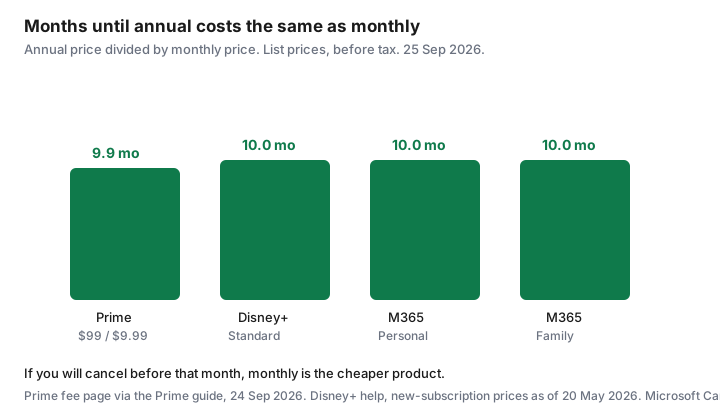
Prime’s fee help page, used for the companion guide on 24 Sep 2026, lists $9.99 a month or $99 a year. Twelve monthly payments are $119.88, so the year of monthly costs $20.88 more than annual, before tax, if you stay all year. Disney+ Standard at four months is 4 × $15.99 = $63.96, against an annual price of $159.99. Microsoft’s Canada store page on 25 Sep 2026 listed Personal at $11.50 a month or $115 a year, and Family at $14.50 or $145. Twelve months of Personal monthly is $138, so annual saves $23 if you keep it. Confirm the live checkout. A price change belongs on the publisher’s page, not in your memory of this table.
iCloud+ does not offer this choice on Apple’s Canada price table published 16 Sep 2026. Those tiers are monthly. There is no annual bar to chase. The decision there is which tier, covered in the iCloud guide.
Only prepay services you used every month for the last 6 months
The math can say “ten months” while your behaviour says “we opened it in January and April.” Prepay only when both gates pass. Gate one: the break-even month is a month you expect to still be using it, and you expect to want it through the renewal. Gate two: you used it in every one of the last six months. Not “someone in the house meant to.” Used. A login, a delivery, a workout, a file saved.
Six months is long enough to include a boring stretch. A new show, a move, or Prime Day can make two months look like a habit. The third quiet month is the one the annual plan will bill you for anyway. If any of the last six months is blank, stay on monthly for another season and review it on the quarterly audit. The 30-day use test on that page is the same idea, stretched to half a year before you lock cash in.
A service you use every month can still be the wrong annual plan if a second product already covers it. Prime Video plus a rotating Disney+ month is not a reason to prepay Disney+. Microsoft 365 for one person who opens Word twice a year fails the use test even if the break-even math is tidy. Write the six months as yes or no in the sheet. A maybe is a no.
Risk of early-exit fees (Adobe-style) that erase annual savings
Some “annual” plans are not a single prepay. Adobe’s subscription-terms help, updated 17 April 2026 and used for the Adobe cancel guide on 24 Sep 2026, describes three shapes. A full refund if you cancel within 14 days of the initial purchase, for most plans. After that, an annual plan billed monthly may cost 50 percent of the remaining contract balance. A prepaid annual plan is described as non-refundable and runs to the end of the term. A true month-to-month plan has no remaining annual balance.
Labelled fee, the same illustration as that guide, not a Canadian list price. Eight months left at $60 is a remaining balance of $480. Fifty percent is $240. The annual discount you thought you captured is smaller than that fee. Two months left at the same $60 is a $60 fee, which can be less than finishing the term. Do the arithmetic with the price and the months on your account screen. The confirmation screen is the bill. A third-party tracker is not.
Gyms can erase a prepaid year in a different way. GoodLife’s public contact page does not print a buyout. Employer-program FAQs describe paid-in-full as a one-year commitment and bi-weekly or monthly as one month’s notice through the portal. If someone offers a buyout, compare it with the payments still owing. The steps are the GoodLife guide. In Ontario, a prepaid personal-development contract of $50 or more can be cancelled within 10 days of the written copy, under the province’s gym page. That right is the cooling-off guide. Do not prepay a year and then discover the exit.
Before you choose annual, read the cancel sentence. If the sentence is “50 percent of what is left,” or “non-refundable until the end date,” monthly is the honest product unless the six-month test is clean and you accept the exit cost in writing. Turning off auto-renew is not the same as a refund. Do both jobs: pick the term you can leave, and calendar the date.
Tax timing: GST/HST on annual hits once—budget the cash-flow hit
The list price is not the amount that leaves the account. Amazon’s fee page says the Prime membership may be subject to applicable taxes. Microsoft’s Canada store shows CAD list prices; read the checkout for tax. Provincial sales tax is not one national rate. This page uses a labelled Ontario HST illustration at 13 percent so the cash-flow point is visible. Alberta at 5 percent GST is a smaller lump. Other provinces differ. Your receipt wins.
| Plan | Pre-tax | Illustrated HST | One-time or monthly hit |
|---|---|---|---|
| Prime annual | $99 | $12.87 | $111.87 once |
| Prime, 12 monthly payments | $119.88 | $15.58 | about $11.29 each month |
| Microsoft 365 Personal annual | $115 | $14.95 | $129.95 once |
| Microsoft 365 Personal, 12 months | $138 | $17.94 | $13.00 each month, rounded from $12.995 |
| Disney+ Standard annual | $159.99 | $20.80 | $180.79 once |
A household that can spare $13 in a normal month may not have $130 free in the month the annual renews, especially if Adobe, a domain, and a gym land in the same week. That is a cash problem, not a proof that monthly is “more expensive” in total. If you choose annual, move the after-tax lump into the month before renewal. The renewal calendar is where that transfer gets a date. If the chequing account cannot hold the lump without touching rent or groceries, stay monthly even when the break-even math favours annual.
Do not spread one tax rate across a gym draft and a streaming charge without reading the receipts. Many club dues already include tax in the amount that hits the bank. Digital checkouts often add tax at the last step. Add the figures you were actually charged.
Seasonal services (Disney+, meal kits, gaming) usually stay monthly
Disney+ Standard annual is $159.99 before tax on the prices above. Four months at $15.99 is $63.96. The annual plan is the wrong product for a rotating slot. The household rule is one always-on service and one slot that turns with a named show, on the rotation guide. Standard with ads at $8.99 a month is even easier to start and end. Annual Disney+ fits only a home that will open it in the months after month ten, and that has already done so for six months.
Meal kits are seasonal in the same way. A promo week, a new-baby month, or a stretch of late shifts is a reason to be on a weekly plan you can skip or cancel. It is not a reason to prepay a year of boxes. Whether a trial week beats a grocery shop is a food question, on the meal-kit trial guide. Here the subscription job is operational: skip the weeks you will not cook, cancel when the promo price ends, and do not let a paused week turn back on without a date. Grocery delivery passes, including PC Express, stay on the pickup and delivery guide. Costco is a warehouse membership, not this spreadsheet, on the Costco guide.
Gaming passes and sports add-ons follow the season, not the calendar year. If the household plays in winter and not in July, monthly is the plan that can stop. This page does not print a Game Pass or PlayStation price. Read the current Canada checkout, run the same division, and require the six-month test before any annual offer. A “save 15 percent” badge is the division you have not done yet.
Spreadsheet template: keep / monthly / annual / cancel columns
One sheet for the household. A spreadsheet is enough. A budget app is an offer type if you want one later. It is not required to run this test. Columns:
- Service and the biller (Apple, Google, Amazon, the publisher, the gym, the carrier).
- Monthly price and annual price, copied from the checkout, with a note if tax is included.
- Months to break even, annual divided by monthly. Blank if there is no annual option.
- Used all of the last 6 months? Yes or no.
- Early-exit note. “50 percent remaining,” “non-refundable,” “one month notice,” or “none seen.”
- Keep, monthly, annual, or cancel. One of those four. Not “maybe.”
- Next date and where you will cancel if the decision is monthly or cancel.
Decision rule, in order. If you will not use it, the column is cancel, and you follow the biller’s path. The trial checklist covers Apple and Google. If you use it in bursts, the column is monthly. If you used it all six months, the break-even month is inside a year you will finish, the exit fee is acceptable or absent, and the after-tax lump fits the month it lands, the column is annual. Keep is for a service that is already on the right term. Do not change a working monthly plan to annual on the morning a sale email arrives.
Review the sheet when a new row appears, and again in January with the other bills. New subscriptions follow one-in-one-out from the audit guide: a new annual row replaces a cancel, it does not sit beside it. The cap that stops the sheet from growing is the household cap.
Sources & date stamps
- Amazon.ca Help, “The Amazon Prime Membership Fee,” node G34EUPKVMYFW8N2U, used 24 Sep 2026 in the Prime guide: $9.99 a month or $99 a year; taxes may apply. Twelve monthly payments are $119.88 before tax.
- Disney+ Help Centre (CA) and the Disney+ Canada FAQ: new-subscription prices as of 20 May 2026; Standard $15.99 a month or $159.99 a year; Premium $16.99 or $169.99; Standard With Ads $8.99 a month. Still the figures shown when this page was drafted on 25 Sep 2026. Confirm the tier before you join.
- Microsoft Canada store, compare plans, fetched 25 Sep 2026: Personal CAD $11.50 a month or $115 a year; Family CAD $14.50 or $145. Tax treatment is whatever the checkout shows.
- Adobe subscription terms help, updated 17 Apr 2026: 14-day refund on most initial purchases; annual billed monthly may cost 50 percent of the remaining balance; prepaid annual non-refundable. The $60 example is labelled, not a list price.
- Ontario HST illustration uses 13 percent. Labelled, not a tax ruling. Ontario gym cooling-off and GoodLife notice rules are summarized from the companion guides, which cite ontario.ca and GoodLife pages used 24 Sep 2026.
Frequently asked questions
How do I calculate months to break even?
Divide the annual price by the monthly price. Prime at $99 and $9.99 is about 9.9 months. Microsoft 365 Personal at $115 and $11.50 is 10 months. If you will cancel before that month, stay on monthly.
Should I prepay a service I like but skipped for two months?
No. Prepay only a service you used every month for the last six months. A skipped month is evidence the annual plan will be paid for in a month you do not open it.
Can an early-exit fee wipe out the annual discount?
Yes. Adobe’s terms page updated 17 Apr 2026 says an annual plan billed monthly may cost 50 percent of the remaining contract balance to leave. A labelled eight months at $60 leaves a $240 fee. Read the plan type before you prepay. The $60 figure is not a Canadian list price.
Does the annual price include GST or HST?
Often it does not. Amazon’s Prime fee page says taxes may apply on top of $99 or $9.99. A labelled Ontario HST illustration at 13 percent turns $99 into $111.87 on one statement. Budget that lump, then read your own checkout.
Is annual Disney+ a good deal if we watch it in bursts?
Usually no. Disney+ Standard checked for this draft is $15.99 a month or $159.99 a year. Four months of monthly is $63.96 before tax. Keep seasonal services on monthly and cancel at the end of the period.