
Travel · Canada
Car Camping vs Hotels for Canadian Family Trips: A Comfort-Adjusted Cost Compare
Families treat camping as free once the car is packed. It is not. Year one includes a tent, pads, bags, and a stove you may use six nights. A wet Tuesday becomes a motel. A hotel quote that ignores municipal tax is just as fictional. This comparison is for households who want a bed they can stand up from in the morning, not an ultralight gear list.
Disclosure: Camping retailers are an offer type only. Saving Optimizer does not claim a gear partnership and does not rank tents, bags, or stoves. Park fees were read from Parks Canada’s Banff fee page on 24 Sep 2026. Hotel tax lines are a labelled method, not a reservation. Education only.
Key takeaways
- Separate year-one gear from the nightly site. A labelled $700 kit over six nights is about $117 a night in year one before the site fee, and about $39 a night spread over three seasons (18 nights). Year three’s new cash for gear is zero if the kit survived. The marginal night is the site, the food, and a bailout reserve.
- Banff regular rates from 8 Sep 2026: toilets and showers $34 a night, toilets only $26.75, electrical $40, full hook-up $47.25. Add $11.50 online once per stay, not once per night.
- A labelled $189 pre-tax room is $198.45 with 5% GST only, and about $224.91 if you also add 13% HST and 6% municipal tax on the room the way a Toronto checkout might. Use the city you are actually in.
- One weather motel night is part of the camping column. Pretending it will not happen is how camping “always saves.”
- A hybrid — hotel after the long drive in, camp the middle, hotel before a flight — is often the comfort-adjusted winner for this age group.
- Short trips, young children, and anyone who sleeps badly lean hotel. Long trips with gear you already own lean camp. Teens who will not use a pad are a hotel problem, not a gear problem.
Gear amortization: tent, sleep system, stove—year-one vs year-three cost
The kit this comparison means is ordinary car camping: a tent that stands up, a pad per person that is not a yoga mat, a bag or quilt rated for the season you will actually meet, and a stove with a pot. It is not a backpacking kit. If you already own it, year-one cost is zero and you can skip to the nightly fees. If you are about to buy it for one long weekend, the purchase is the trip.
Label the new kit $700. That is an illustration you replace with the till, not a recommended bundle and not a retailer. Six nights a year is a plausible family season: one park weekend and a few nights on a longer drive.
- Year one, six nights: $700 ÷ 6 = $116.67 of gear per night, before the site.
- If you will camp six nights a year for three years, 18 nights: $700 ÷ 18 = $38.89 of gear per night, spread across the years. In year one the cash still leaves the account all at once. The $38.89 is the honest nightly cost only if the kit survives and you keep using it.
- Year three, if the kit is already paid and still serviceable: gear per night is $0 of new cash. The marginal night is the site fee, food, fuel, and the bailout motel you should still reserve in your head.
Used gear and a borrowed tent change the bar. So does a kit that fails in year one and gets replaced. Write the replacement into year one if you already know the cheap tent will not survive a windy site. A camping retailer is a place to buy the kit when you have decided the nights will happen. It is not a reason to take the trip.
Nightly camping fees vs hotel+MAT after tax
Compare a night with a night, after the fees both sides hide.
| Night | What you pay | Three nights |
|---|---|---|
| Unserviced, toilets only | $26.75 | $80.25 plus $11.50 reservation once |
| Unserviced, toilets and showers | $34.00 | $102.00 plus $11.50 once |
| Electrical | $40.00 | $120.00 plus $11.50 once |
| Full hook-up (Tunnel Mountain example) | $47.25 | $141.75 plus $11.50 once |
| Hotel, $189, 5% GST only | $198.45 | $595.35 |
| Hotel, $189, 13% HST and 6% city tax on the room | $224.91 | $674.73 |
The reservation fee is per stay, not per night, and it is non-refundable. Three nights at $34 is $102 plus $11.50 = $113.50. Three hotel nights at the GST-only illustration are $595.35. The gap is large on cash. It is the wrong gap if the $189 room was never the room you would have booked, or if the campsite is a 40-minute drive from the day you planned. Put the real hotel quote in the right-hand column. The method for cleaning fees and short-term rentals is the all-in lodging guide. Do not add a municipal tax the province does not charge, and do not skip one it does.
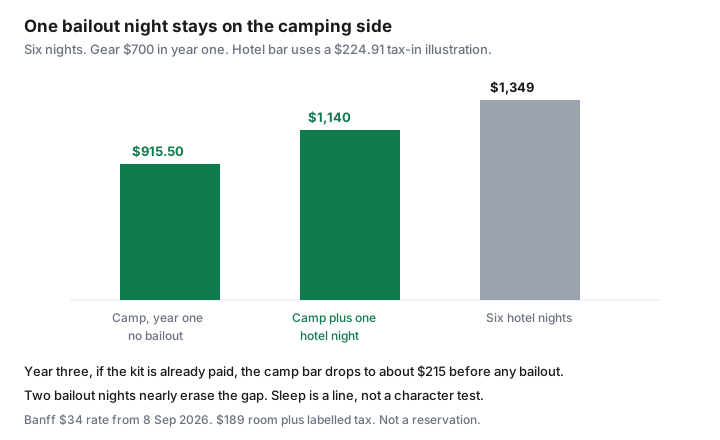
Six shower-site nights are 6 × $34 = $204, plus one $11.50 fee if it is a single stay, $215.50 before gear. Add the $700 kit and year one is $915.50 if you ignore a second reservation fee on a second trip. Six tax-in hotel nights at $224.91 are $1,349.46. Camping wins that illustration by about $434, and then loses some of it the night it rains and you take the hotel anyway. Put one bailout night, $224.91, into the camping column before you announce the winner. $915.50 plus $224.91 is $1,140.41, still under $1,349.46. Two bailout nights and the gap is nearly gone. That is the comfort adjustment, priced instead of shrugged off.
Weather and sleep-quality adjustments middle-aged travellers care about
A night on a thin pad is not a moral test. It is a cost. If you wake up unable to drive the next day, or you spend the next day looking for a pharmacy and a coffee because you did not sleep, the cheap night was not cheap. Households in this season of life should write that down before the trip, when nobody is cold yet.
Weather is the other adjustment. Shoulder months are when sites exist and nights are cold. A bag rated for a July basement will fail in late September in the mountains. Either the bag matches the forecast you checked, or the plan is a hotel. A refundable hotel held until the cancellation window, beside a campsite you can still cancel under the three-day rule, is a strategy. It is two deposits on purpose, and you release the one you will not use before its penalty.
Food is smaller and still real. Camping dinners are not free. A cooler, ice, and a stove fuel canister belong on the camping side. Hotel breakfast you will not eat does not belong on the hotel side. Count what you will buy.
Hybrid itinerary: camp mid-trip, hotel at drive ends
The hybrid is the version many households should run first. Sleep in a hotel the night you arrive after a long drive, camp the nights in the middle when you are no longer unpacking in the dark, and take a hotel again the night before a flight or a long drive home. You pay hotel rates where sleep and a shower protect the next day, and site fees where the campground is the point.
Price it as two columns added together, not as a vibe. Example shape, still labelled: two hotel nights at your real tax-in rate, plus three site nights at $34, plus one reservation fee, plus gear only if this trip is why you are buying it. If the gear is only justified by the three camp nights, divide the kit by those three nights and watch year one get expensive. Borrow or buy used, or skip the kit and hotel the whole way.
The drive’s fuel still comes from the road-trip sheet. This page does not rebuild litres. It decides where you sleep.
Safety, showers, and accessibility constraints
Showers are a fee tier, not a personality. At the Banff examples, toilets and showers are $34 and toilets only are $26.75. A household that will not use a vault toilet for three mornings should buy the shower tier or the hotel. Do not book the cheaper loop and then pay for a recreation-centre day pass you did not plan.
Safety is site-specific. In bear country, food storage is part of the booking: read whether the site has a locker or requires a hard-sided unit. Cell coverage at a trailhead is not coverage at the loop. Tell someone the site number. These are not reasons to skip the park. They are reasons the “free” night has a procedure.
Accessibility is a filter before the price. An unserviced site can mean a gravel path and a washroom that does not work for the person travelling. Parks Canada’s site description is the check. If the description does not clearly fit, the hotel is the correct cheap option, because the alternative is a night you cannot use. A full hook-up at $47.25 may be the site that works. Compare that to the hotel, not the primitive site you cannot enter.
Decision matrix by trip length and kids’ ages
| Trip | Lean camp when | Lean hotel when |
|---|---|---|
| 1–2 nights | Gear is already owned, the site is booked, and nobody is using the trip to “try camping.” | You would be buying the kit for this weekend, or children are under about six and the night is the holiday. |
| 3–5 nights | The hybrid: hotel on the drive ends, camp in the middle, shower tier if you need it. | The forecast is wet or near freezing and the bags do not match, or the only site left is one you cannot access. |
| A week, gear owned | Cash favours the site. Keep one bailout night in the budget so a storm does not become a panic rate. | Teens will not sleep on a pad, or the week is a family event that needs a door and a table. |
| School-age children who like the site | The campground is the activity. Paid attractions can stay off the sheet. | The children are too young for the night temperatures you are walking into. Hotel, or a roofed Parks Canada stay priced as lodging. |
Run the matrix after the reservation, not instead of it. A theoretical camping win with no site is a hotel. How to get the site is the reservation guide. If the winner is the hotel, book it with the tax in the total and stop adding camping gear “for next time” on the same credit-card slip unless next time is on a calendar.
Sources & date stamps
- Parks Canada, Banff fees — unserviced toilets only $26.75, toilets and showers $34.00, electrical $40.00, Tunnel Mountain full hook-up $47.25, regular rates from 8 Sep 2026. Read 24 Sep 2026.
- Parks Canada reservation terms — online reservation fee $11.50 per campsite per stay. Read 24 Sep 2026.
- Toronto 6% municipal accommodation tax from 1 Aug 2026, as dated on this site’s lodging guide. Other cities differ. The $189 room rows are illustrations.
Frequently asked questions
Is camping always cheaper than a hotel in Canada?
Not in year one, and not if you add the motel you will book when it rains. A labelled $700 kit over six nights is more than $100 a night before the site fee. The same kit over three seasons of six nights is under $40 a night of gear. A Banff toilets-and-showers site is $34 a night plus an $11.50 reservation fee per stay, from the regular rates in effect 8 Sep 2026.
What hotel tax should I compare against?
The checkout’s tax, not a national average. A labelled $189 room is $198.45 with 5% GST only. If the city also charges 13% HST and a 6% municipal tax on the room, the illustration is $224.91. Toronto’s 6% accommodation tax dates from 1 Aug 2026 on this site’s lodging guide. Your city may differ.
How should we count a bad night’s sleep?
As a hotel night you either book on purpose or risk paying at the last minute. One bailout night in the camping column is the adjustment. Two bailout nights can erase the cash gap in the six-night illustration. Hybrid trips put hotels on the long driving nights and campsites in the middle.
Does this change with kids’ ages?
Yes. One or two nights, a new kit, or young children in the wrong season lean hotel. A week with gear you own, and school-age children who like the site, leans camp. Teens who will not sleep on a pad are a hotel decision. Check accessibility on the site description before you take the cheaper loop.