
Transportation · Canada
Can a cargo bike replace a second car for Canadian families? An honest cost test
Parents romanticize a Dutch box bike and then discover February, a 12 km arterial with no path, and a condo elevator that will not take a longtail. A cargo e-bike can delete a second car for school and grocery loops. It cannot delete a winter highway, a weekly IKEA, or a building with no storage. This is a cost test against insurance and parking — not a lifestyle brochure.
Second-car TCO sits inside real cost of a car and car-share vs owning. Protect the asset with locks and insurance questions. City substitutes: Toronto, Vancouver, Montréal.
Disclosure: Cargo-bike retailers and child bike-safety gear are offer types. Saving Optimizer may earn a commission if we later add partner links. We do not currently claim retailer partnerships. Prices are labelled bands. This is not a safety certification or a dealer pitch.
Key takeaways
- A usable family cargo e-bike in Canada is often $4,500–$9,000 plus seats, canopy, and locks ($400–$1,500). That is capital. A second compact’s insurance + parking + fuel can still be $400–$700/month before the loan.
- School runs under ~6 km with a protected path are the fit. Two kids, groceries, and a daycare that allows bike-in drop-off. 25 km of 80 km/h shoulder is not a cargo-bike commute.
- Winter is the honesty test. Salt, ice, and −20 °C wind are why you keep a car-share account — not why you keep a second VIN “just in case” every day.
- Storage is a purchase constraint. Measure the elevator, the locker, and the charging rule before you pay a deposit.
- Run a 90-day trial (including November if you can) before you sell the second car. Book the share days you still need.
School run and grocery use cases that fit
The cargo bike wins when the trips are short, repeated, and currently creating a second insurance card:
- School or daycare under ~6 km, with a route you will ride in the rain (fenders, canopy, lights).
- Grocery runs that currently take the “spare” car because the first car is at work.
- Park and library loops where parking is the actual cost, not kilometres.
It loses when the second car exists for a 40-minute highway job, weekly big-box, or three extracurriculars in different suburbs on the same Tuesday. Write last month’s trips down. If four of them needed a trunk and a 400-series highway, you are shopping a van, not a bike.
Upfront cost vs second-car insurance and parking
| Line | Cargo e-bike (family) | Second compact |
|---|---|---|
| Upfront | $4,500–$9,000 + $400–$1,500 gear | Used cash or a loan (Ratehub principal+interest is most of $1,373) |
| Insurance / protection | Home rider or specialty bike policy; locks | Ratehub $164/month placeholder — urban second cars often more |
| Parking | Locker / in-unit (politics) | $200 placeholder; Toronto stall or permit can be much more or much less |
| Energy | A few dollars of kWh | Ratehub gas $165/month on a first car; a second car is the trips you log |
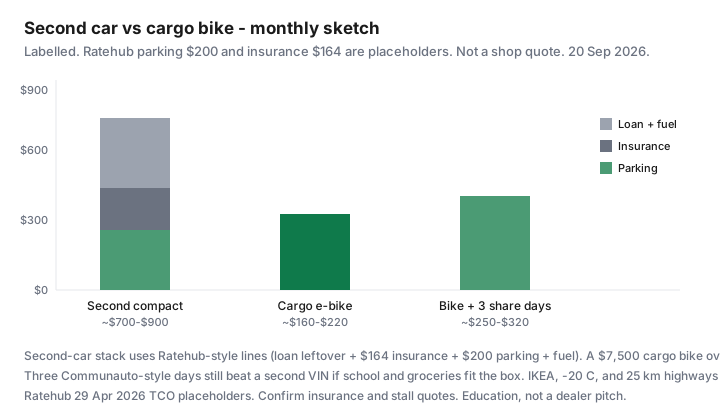
Worked example (labelled): $7,500 bike + $800 kid kit = $8,300. Over 48 months that is about $173/month before $20 running and a lock refresh. A second car that “only” costs insurance $180, parking $200, and $80 fuel is $460/month — and that is the cheap story, with no loan. The bike does not have to be free. It has to beat the second VIN.
Winter and distance limits
Canadian winter is why people keep the second car and then never sell it. Be specific:
- Studded or winter rubber on a cargo bike exists; ice and wind with kids is a judgment call, not a spreadsheet cell.
- Salt destroys cheap drivetrains. Budget a shop that will touch e-cargo bikes ($150–$300/year is a sane envelope).
- Range drops in the cold. A 15 km round trip that worked in September can be a battery-anxiety trip in January.
Distance: most families who succeed stay inside a neighbourhood radius. If the “sometimes” trip is 25 km on a regional road, that is a Communauto or Zipcar day, not a reason to keep $460/month idle.
Storage and building access requirements
Measure before you buy. A longtail plus two seats does not fold like a Brompton. Ask:
- Will it fit the elevator diagonally? Will the board allow it in the unit?
- Is there a ground-floor bike room that is not a theft gallery?
- Where does it charge, and is the pack allowed indoors?
- Can you lock it at school for 20 minutes without a scene?
Houses with a garage win. Downtown condos without a stall sometimes still have no cargo-bike plan. That is a veto, not a “we will figure it out.”
Safety with kids — gear and routes
This is not a certification. Use manufacturer child seating, harnesses, and a helmet you will actually buckle. Rain canopies are comfort and visibility, not armour. Pick routes with protected lanes or quiet streets; arterial paint is not a family facility. Practice empty, then with groceries, then with kids on a weekend. If you will not ride the route at 8:10 a.m. in November, the bike is a Saturday toy and the second car stays.
90-day trial before selling the second car
Park the second car (or do not renew the insurance) for 90 days after the bike is set up — seats, locks, a real route. Log every trip that still needed four wheels. If that log is three IKEA runs and one airport, you needed car-share, not a VIN. If it is every Tuesday swim meet on a highway, you needed the car. Sell only when November is in the log or you honestly live in a mild pocket and have a share pod you will walk to in sleet.
When a car-share day is still needed
Keep the membership. Four Communauto Value Extra days in the Toronto 15 Jun 2026 sketch (~$136 + km) are the pressure valve. Big-box, grandparents, −25 °C, and the week both adults have off-site work are share days. The cargo bike replaces the default second car, not the existence of automobiles in Canada. If share pods are a 20-minute walk you will not do with kids, the trial will fail — believe that before you list the Civic.
Sell test: insurance + parking + fuel of the second car for 90 days, minus bike payment and three share days. If the leftover is still large and the log is school-and-groceries, the VIN is a habit. If the leftover is small, keep the car and stop calling the bike a financial product.
Sources & date stamps
- Ratehub 2026 TCO (29 Apr 2026) — $1,373 blended; parking $200 and insurance $164 as placeholders to replace.
- Communauto Toronto fee schedule effective 15 Jun 2026 — companion car-share guide.
- Canadian cargo e-bike retail bands (2026 shop / brand ranges) — confirm live quotes; gear and locks extra.
- Companion e-bike theft and transit guides for protection and pass math (20 Sep 2026).
Frequently asked questions
How much does a family cargo e-bike cost in Canada?
A usable longtail or box bike is often $4,500–$9,000 before child seats, canopy, and locks. Entry models exist; budget the kit or you will not ride in rain.
Can it replace a second car in winter?
Sometimes, in a tight neighbourhood with good paths. Ice, wind, and 20 km arterials are why you keep car-share — not a second insured VIN every month. Trial through a cold month before you sell.
What about two kids and groceries?
That is the designed use if weight and seating limits allow. Practice without kids first. If Tuesday is three suburbs, you still need four wheels that day.
Do I need a garage?
You need a legal, lockable place to store and charge. A garage is easiest. A condo without a plan is a reason not to buy yet.
Should I sell the second car immediately?
No. Run 90 days with the bike set up and a share membership active. Sell when the trip log says the car was a weekend exception.