
Housing · Canada
Condo vs freehold monthly costs in Canada: fees, maintenance, and true shelter spend
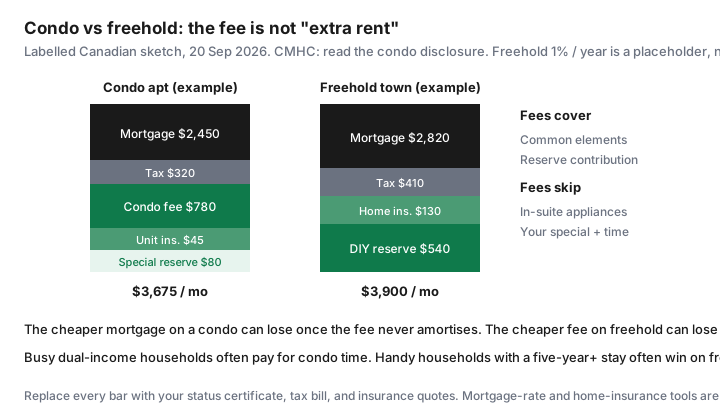
Buyers rank a condo “cheaper” because the mortgage line is smaller, then discover the corporation invoices $780 every month for a fee that never becomes principal. Other buyers rank a freehold “cheaper” because there is no fee, then put a roof on a card in year four. CMHC’s condominium FAQs treat the disclosure package as how you learn whether the reserve can replace common elements. Freehold has no package — you are the reserve.
This is an all-in monthly comparison, including time. It is not a reason to panic-buy either type. Put the result back on the rent-vs-buy stack and, in Toronto or Vancouver, on the city pages for dual LTT and strata-first math.
Disclosure: Home-insurance comparison tools and mortgage-rate comparison tools are offer types. Saving Optimizer may earn a commission if we later add partner links. We do not currently claim insurer, lender, or realtor partnerships. This is not legal, brokerage, engineering, or insurance advice.
Key takeaways
- Compare all-in shelter: mortgage + tax + (condo fee or DIY reserve) + insurance + parking. Headline P+I is incomplete.
- Fees usually cover common operations and a reserve contribution — not your fridge, not a thin-reserve special.
- Freehold placeholder: about 1% of value / year, then adjust. Skipping it is how a water heater becomes a credit card.
- Insurance is a different product on each side. Quote the address. Corporate deductibles can leak to condo owners.
- Busy households often pay for condo time. Handy households with a long stay often win on freehold if the reserve is real.
Line-item comparison template
Write two columns on one page. Use statements, not listing slogans:
| Line | Condo apartment | Freehold |
|---|---|---|
| Mortgage P+I | Usually smaller balance | Usually larger balance / lot |
| Property tax / 12 | Often lower land share | Full parcel |
| Fee or DIY reserve | Listed fee + special reserve | ~1% value / 12, then adjust |
| Insurance | Unit policy + corp notes | Home policy on the structure |
| Parking / storage | Sometimes inside the fee | Driveway — still has asphalt |
| Time | Meetings, elevator bookings | Yards, snow, vendor days |
What condo fees usually cover—and what they do not
CMHC: fees fund operations and contributions to a reserve so roofs, elevators, and parkades can be replaced over the building’s life. Typical inclusions: caretaker or concierge, common-area utilities, contracts, amenities, and the reserve line. Typical exclusions: in-suite appliances, your unit’s interior, your insurance deductible, and a special assessment if the board under-collected. A “heat included in fees” tower is a different stack than an all-electric suite — do not double-count hydro. Read the status certificate / Form B for reserve vs study, specials, litigation, and arrears.
Ontario status certificates: CAO commonly cites delivery within 10 days and a fee cap (often discussed as $100 including tax). Other provinces: estoppel, Form B, syndicate documents. Same job, different stationery.
Freehold maintenance you must self-fund
You own the envelope. Roofs, furnaces, driveways, fences, eavestroughs, trees, and the appliance that fails on a Sunday are yours. The 1% rule is a crude placeholder from the year-one cash page: $650,000 × 1% ÷ 12 ≈ $540. A new build can sit lower until year eight. 1970s brick and a 20-year roof can sit higher tomorrow. Skipping the PAD because “nothing broke this month” is how freehold looks cheap in a spreadsheet and expensive in May.
Insurance differences
Condo: the corporation insures the building and common property; you insure contents, betterments, and liability. Deductibles on water and sewer backup have grown in some markets and can become an owner invoice. Freehold: one home policy on the structure and contents, usually a larger premium than a unit policy, because the walls are yours. Earthquake and sewer endorsements are location-specific. Quote both addresses. We do not rank insurers. Comparison education only.
Time cost and DIY reality for busy households
Condo time is evenings at meetings you skip and elevator bookings you cannot skip. Freehold time is Saturday snow, contractor quotes, and the afternoon a sump pump dies. Price your hours. $40 × 8 hours of yard work is $320 you will not invoice yourself. Dual-income households that travel often pay for condo time and still win. Households that already own a ladder and a truck often win on freehold — if they actually fund the reserve, not just the vibes.
City examples: townhouse vs condo apartment
- Toronto / Mississauga: apartment fees plus dual LTT on a city-of-Toronto purchase can make a Mississauga freehold town look “expensive” on the mortgage and cheaper on the 10-year stack — until you add commute. Run both postal codes.
- Metro Vancouver: many “townhomes” are still strata. You can have a fee and a fence. Do not file them under freehold.
- Calgary / Ottawa suburbs: more true freehold in the mix. Insurance and tax still belong on the stack. A two-year posting is a stay-horizon problem.
Decision framework by stay horizon and DIY appetite
- If you may move in under five years, transaction costs dominate. Building type is secondary to year-one cash.
- If you will not maintain a roof, do not buy the roof. Pay the fee — then interrogate the reserve.
- If you will maintain a roof and will stay 10 years, freehold’s case is strongest when the DIY PAD is automatic.
- If the condo fee already exceeds 30% of P+I, ask whether you bought shelter or a cost-sharing contract.
- Stress-test qualification is a separate gate. Shelter cost is yours. See the buyer stress-test worksheet.
Townhome strata sits in the middle: some shared elements, some DIY, a smaller fee than a tower, and documents you still have to read. If the spreadsheet only balances when overtime is permanent, you do not have a housing plan.
Sources & date stamps
- CMHC, condominium buying FAQs and home-buying consumer hub — fees, reserves, disclosure packages (used 20 Sep 2026).
- Condominium Authority of Ontario — status certificates (timing and fee-cap themes).
- Saving Optimizer, condo fee red flags and hidden first-year costs — 1% freehold placeholder and fee-to-mortgage sanity checks reused here as labelled sketches.
Frequently asked questions
Is a condo cheaper per month than a freehold in Canada?
Not automatically. The condo mortgage can look smaller while the fee never amortises. Freehold looks cheaper until you fund a roof, driveway, and home insurance. Build two all-in stacks: mortgage + tax + (fee or DIY reserve) + insurance + parking.
What do Canadian condo fees usually cover?
Operations for common elements (caretaker, common hydro, contracts) and a contribution to the reserve or contingency fund. They usually do not cover in-suite appliances, your unit insurance deductible, or a special assessment if the reserve is thin. CMHC: read the disclosure package.
How much should I set aside for freehold maintenance?
A common placeholder is about 1% of value per year, divided by 12, then adjusted down for a new build and up for 1970s brick. A $650,000 house sketch is about $540/month you do not spend on furniture. It is a reserve, not a quote from a roofer.
How do insurance lines differ?
Condo owners usually carry a unit policy (contents, betterments, liability) while the corporation insures the building. Freehold owners carry a home policy for the structure. Corporate deductibles on water can leak to condo owners. Quote both addresses. Comparison education only.
Is this brokerage or insurance advice?
No. Mortgage-rate and home-insurance comparison tools are offer types only. Have a lawyer read the status certificate or Form B before you waive. This is a household worksheet.