
Housing · Canada
How many years do you need to own in Toronto before buying beats renting?
Toronto buyers compare rent to the mortgage screenshot and declare victory. The city then invoices them twice for land transfer tax, the corporation invoices them every month for a fee that never becomes equity, and a listing agent invoices them again when they leave in year three. The Canada-wide rent-vs-buy worksheet already said city stacks beat national memes. This page is the Toronto stay-horizon: provincial plus municipal land transfer tax, condo-fee drag, and exit costs.
Figures are labelled sketches using official brackets (ontario.ca; toronto.ca MLTT page used 20 Sep 2026). They are not a quote on your midtown one-bed. Statistics Canada’s CPI for August 2026 (Daily, 14 Sep 2026) had national rent +2.8% year over year — mood music, not your King West ask.
Disclosure: Mortgage-rate comparison tools and home-insurance quote comparison tools are offer types some households use beside this worksheet. Saving Optimizer may earn a commission if we later add partner links. We do not currently claim lender, broker, or insurer partnerships. This framework is not mortgage, tax, legal, or brokerage advice.
Key takeaways
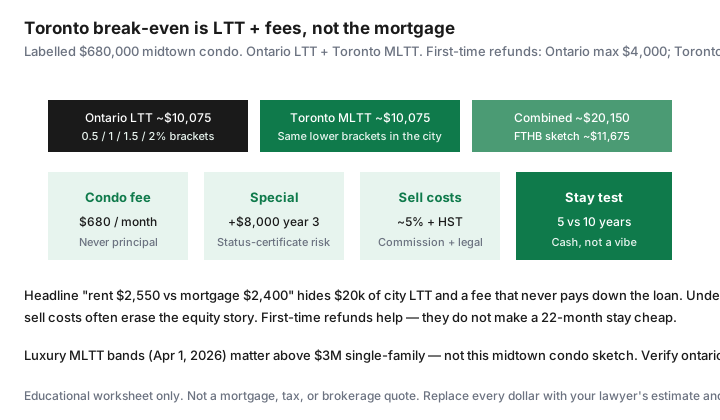
- Toronto is the Ontario city that adds municipal land transfer tax on top of provincial LTT. Combined tax on a labelled $680,000 condo is about $20,150 before first-time refunds.
- Ontario first-time refund: max $4,000 (full relief on the first $368,000). Toronto’s municipal rebate is separate — commonly cited at up to $4,475; verify on toronto.ca.
- Condo fees never amortise. A $680 fee is $8,160/year that does not pay down the loan.
- Exit costs (commission + HST + legal + staging) often exceed $30,000 on that price. Under five years, renting can still win even if you qualified.
- Run a five-year and a ten-year model. A 22-month job posting is not a ten-year hold.
Toronto ownership costs beyond the mortgage payment
Write the same monthly column as the national worksheet, then refuse to stop at principal and interest:
- Mortgage: the payment you can document, not last spring’s screenshot. Qualification is a separate gate — see the buyer stress-test worksheet.
- Property tax: last year’s bill ÷ 12, or the city’s estimator. Escrow does not make it free.
- Condo fees: the listing number plus what the status certificate implies for reserve-fund catch-up. Then compare all-in shelter to freehold DIY if you are choosing building types.
- Unit insurance: quote the address. Comparison education only.
- In-suite maintenance and a special-assessment reserve: the fee is not a roof for your appliances.
Renters still have tenant insurance, parking, and a moving reserve. They do not have dual LTT or a corporation that can levy a parkade project. Pair this stack with year-one cash.
Land transfer tax (provincial + municipal) as a break-even drag
Ontario’s residential LTT brackets (unchanged in the 2026 conversation we used): 0.5% on the first $55,000, 1.0% to $250,000, 1.5% to $400,000, 2.0% to $2 million, 2.5% above that. Toronto’s MLTT matches those lower bands for ordinary condos. On 1 April 2026 the city added steeper luxury bands above $3 million for one- and two-unit residential properties — relevant to a Forest Hill house, not this midtown sketch.
Worked LTT on $680,000 (one side): $275 + $1,950 + $2,250 + 2% × $280,000 = $10,075. Both sides: $20,150. Qualifying first-time buyers: Ontario refund max $4,000 (ontario.ca, updated 10 Feb 2026) plus Toronto’s municipal rebate (verify the live cap on toronto.ca; $4,475 is the figure most 2026 explainers still cite). Labelled first-time net: about $11,675 plus the city’s MLTT administration fee ($102.56 + HST on the toronto.ca rates page). Eligibility, occupancy timing, and the lawyer checklist live on the first-time LTT refund stack.
If owning is only $250/month “cheaper” on the monthly stacks, dual LTT alone takes 81 months to earn back at the non-first-time number — before legal fees, before sell costs. That is the drag national charts skip.
Condo fee and special-assessment scenarios for common unit types
Toronto one-beds in older midtown towers often list fees in the mid-hundreds; amenity-heavy new glass can run higher. The number is not a bargain until the reserve matches the study. Three labelled scenarios — replace with the certificate:
| Unit type | Fee sketch | What breaks break-even |
|---|---|---|
| Older midtown 1-bed | $550–$750 | Envelope or elevator special in year 2–4 |
| Amenity tower 1-bed | $650–$900 | Fee already rivals a 0.40% rate win |
| 2-bed + locker/parking | $800–$1,100 | Parking stall specials; hydro if not in-suite |
| “Low-fee” listing | Under $450 | Ask whether the reserve is a slogan |
A labelled $8,000 special in year three is 32 months of a $250 monthly “owning is cheaper” gap. Read the certificate like it can invoice you, because it can.
Rent growth vs ownership cost growth: a simple five- and ten-year model
Do not use one inflation number for both columns. Sitting Ontario tenants on guideline units saw a 2.1% cap in 2026 (ontario.ca). New-lease asking rents move with the market. Ownership costs grow when the mortgage renews, when the corporation raises fees, and when property tax follows CVA. Principal paydown is real — it is not cash you can spend without selling or refinancing.
Labelled five-year test: start both stacks, grow rent at a sitting-tenant 2.1% if you would actually stay in a guideline unit, or at a new-lease assumption if you would move. Grow fees at 3–5% if the study looks thin. Add year-one LTT and legal. At year five, subtract remaining mortgage from a conservative sale price, then subtract sell costs. If the leftover equity is smaller than the extra cash you paid versus renting plus the opportunity cost of the down payment, buying has not won yet.
Ten years: renewals and fee paths dominate. A cheap five-year fixed that jumps at renewal can erase a pretty year-one screenshot. Shop the renewal as shelter cost — see 2026 renewal shopping.
Transaction costs on exit (commission, lawyer, staging)
Toronto resale still typically pays a listing-side commission that households experience as something like 3.5–5% of the sale price, plus HST, plus legal, plus optional staging and a vacant-month risk. On $680,000, 5% + 13% HST is about $38,420 before legal. Even a 4% + HST sketch is about $30,736. That cash appears only when you leave. It is why a three-year hold that “made” $40,000 on paper can finish near zero after dual LTT on the way in and commission on the way out.
Moving out of a condo still needs an elevator window and a COI — price it with written moving quotes, not a hope.
Worked example for a midtown condo vs similar rental
Labelled, not a listing. Purchase $680,000. 20% down = $136,000. Mortgage $544,000. Use your own rate; a 4.5% / 25-year sketch is roughly $3,020/month P+I. Property tax sketch $340. Condo fee $680. Unit insurance $45. In-suite reserve $80. Ownership stack ≈ $4,165.
Similar rental $2,550 + tenant insurance $25 + parking if the owned unit’s stall was “included” in fees. Rental stack ≈ $2,575 if parking is already in rent. Monthly cash gap: owning costs about $1,590 more. Buying does not win on cash flow here. It wins only if principal + appreciation after sell costs beat (a) that extra cash, (b) dual LTT, and (c) what $136,000 could earn elsewhere.
If your actual rent is $3,200 and you found a $620,000 fee-light unit, the gap shrinks — that is why this is a worksheet, not a slogan. First-time FHSA / HBP wrappers change the down-payment tax, not the MLTT invoice.
Decision checklist before you lock a pre-approval
- Write both monthly stacks with statements, not screenshots.
- Calculate Ontario LTT + Toronto MLTT on the offer price. Subtract only refunds you qualify for.
- Read the status certificate for reserve vs study and specials levied or contemplated.
- Pick a stay horizon you would still believe if the job went hybrid in 18 months.
- Price sell costs at a conservative commission + HST + legal.
- Keep a year-one cash reserve after closing. If the deal only works on overtime forever, it is not a deal.
- If renting still wins, hunt without scams and negotiate the renewal instead of panic-buying the first lock.
Sources & date stamps
- Ontario.ca, Land transfer tax — residential brackets; first-time refunds max $4,000 / $368,000 full-relief threshold (updated 10 Feb 2026).
- City of Toronto, Municipal land transfer tax rates and fees — lower bands aligned with the province; luxury residential bands from 1 Apr 2026; administration fee $102.56 + HST (page used 20 Sep 2026).
- Statistics Canada, The Daily, 14 Sep 2026 — CPI August 2026, rent +2.8% YoY.
- Ontario.ca, Residential rent increases — 2026 guideline 2.1% (sitting tenants, not asking rent).
- CMHC home-buying and condominium consumer pages — closing costs and disclosure packages.
Frequently asked questions
Why is Toronto rent-vs-buy break-even longer than a national chart?
Because the City of Toronto charges municipal land transfer tax on top of Ontario’s provincial LTT, and typical condo fees never amortise. Combined LTT on a labelled $680,000 purchase is about $20,150 before first-time refunds. Sell-side commission plus HST often exceeds $30,000.
What is the Ontario first-time land transfer tax refund?
Up to $4,000 for qualifying purchases, which fully covers provincial LTT on the first $368,000 of consideration (ontario.ca, updated 10 Feb 2026). Toronto’s municipal rebate is separate and commonly cited at up to $4,475 — verify on toronto.ca before you spend it in your head.
Do condo fees count toward break-even years?
Yes. Fees are shelter cost that never pays down the mortgage. A $680 monthly fee is $8,160 a year that renters do not send to a corporation. Special assessments are extra year-one or year-three cash.
How many years do most Toronto condo buyers need?
There is no honest single number. A labelled midtown sketch that includes dual LTT, fees, and 5% plus HST on exit often needs something like seven to ten years of staying put before owning clearly beats a similar rental — and a three-year job posting can still favour renting. Run your own stay test.
Is this mortgage or tax advice?
No. It is a household worksheet. Mortgage-rate comparison tools and home-insurance quote tools are offer types only. A licensed mortgage professional, lawyer, or tax advisor should check your numbers before you waive conditions.