
Housing · Canada
Rent vs buy in Metro Vancouver: how strata fees change the math
Metro Vancouver buyers treat strata fees as a rounding error after they win a rate. Then the Form B shows a parkade membrane in year two and the “cheap” $380 fee becomes a levy. Most ownership stock here is strata. The Canada worksheet already said fees belong on the stack. This page puts the fee first, then B.C. property transfer tax, then the stay horizon for tech and dual-income households who might leave when the team’s office policy changes.
CMHC’s condominium buying FAQs have said for years that the disclosure package is how you learn whether the contingency can actually replace common elements. That is not optional reading on Broadway, Metrotown, or a Richmond tower.
Disclosure: Mortgage-rate comparison tools and home-insurance quote comparison tools are offer types. Saving Optimizer may earn a commission if we later add partner links. We do not currently claim lender, insurer, or realtor partnerships. This is not mortgage, tax, legal, or brokerage advice.
Key takeaways
- Put the strata line on the ownership stack before you celebrate a 0.15% rate. Fees never amortise.
- B.C. PTT on a labelled $750,000 purchase is $13,000 (1% + 2%). First-time buyers in the $500,000–$835,000 band get an $8,000 reduction (gov.bc.ca amounts effective 1 Apr 2024; used 20 Sep 2026).
- A low fee plus a stale depreciation report is a hypothesis of a future levy.
- Apartment vs townhome: tax, insurance, and yard/roof responsibility are different sports.
- Renting a better location can beat owning a smaller, fee-heavy unit if you would actually stay in the rental.
Why Vancouver rent-vs-buy needs a strata line item from day one
Ontario-style “mortgage vs rent” talk fails here because the corporation’s invoice is often hundreds a month on day one and can jump after a study. Toronto at least puts dual land transfer tax on the closing statement where you can see it. Vancouver hides the chronic cost in a monthly PAD labelled “strata.” Write it beside the mortgage, not under “misc.”
B.C. sitting tenants have a published rent-increase limit — 2.3% for 2026, 2.2% already posted for 2027 (gov.bc.ca; see the RTB-7 guide). That is the rental column’s growth path if you stay. Ownership’s growth path is fees + renewal + tax. They are not the same number.
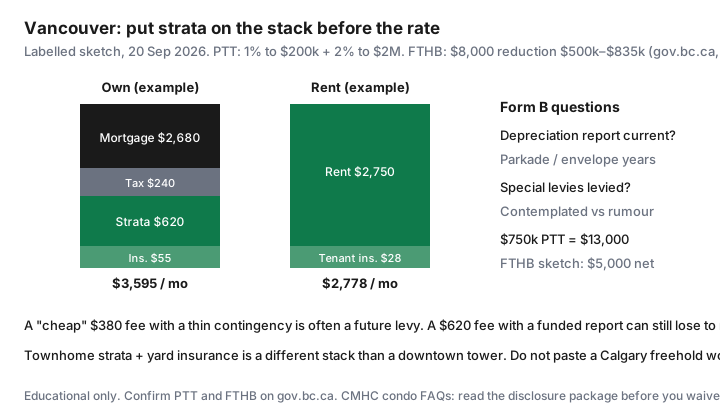
Typical fee ranges vs red-flag special assessments
Public listings and mover/condo explainers talk about Metro Vancouver apartment fees often landing in the mid-hundreds, with townhome strata lower on the fee line and higher on DIY. Treat those as bands to replace, not averages you paste into an offer:
| Pattern | What to ask | Red flag |
|---|---|---|
| Downtown / Broadway tower | What is in the fee (heat, caretaker, amenities)? | Low fee + 1990s parkade + old report |
| Burnaby / New West SkyTrain | Special levies last five years, per unit | “Being discussed” in minutes, absent on Form B |
| Richmond / South Surrey townhome | Which elements are strata vs owner | Fee excludes roofs you still share |
| New concrete | Warranty leftover vs first study | Fees held down for listings |
Circle special levies levied and contemplated. CMHC: the contingency exists so common elements can be repaired over the building’s life. Adequacy is versus the report, not versus a “low-fee” slogan. Depth on documents: condo fee red flags.
Property tax and insurance differences for apartments vs townhomes
Assessed value and municipal rates differ by city (Vancouver, Burnaby, Richmond, Surrey are not one tax bill). Apartments often show lower tax than a townhome at the same purchase price because land is shared. Insurance: the corporation’s policy covers common property; your unit policy covers contents and often betterments, with deductibles that have grown. Townhomes can look like freehold until you read which roofs and fences are strata. Quote both addresses. Comparison education only — we do not rank insurers.
Earthquake and water deductibles in this market are not a footnote. A $50,000 corporate deductible that leaks to owners is a year-one problem hiding in the package.
Stay-horizon scenarios for tech and dual-income households
A lot of Metro buyers are two incomes and one employer that still experiments with office days. Three labelled horizons:
- Under three years: PTT + legal + sell costs + elevator move usually beat any “rent vs mortgage” gap. Stay a renter; use the half-month deposit rules correctly.
- Five years: possible if fees are funded, you will not be posted to Toronto, and you do not need to sell into a thin week. Still model a levy.
- Ten years: ownership’s case is strongest if the Form B is clean and you can fund renewals. Dual income that becomes one income in year four is a stress-test problem, not a strata problem.
Rental alternatives: longer commute vs roommate vs smaller unit
Before you buy a 450-square-foot concrete box to “get in,” price the rental you would actually accept: a Surrey two-bed with a longer SkyTrain ride, a shared East Van house, or a smaller downtown rental with heat included (see heat vs hydro leases). Commute cost belongs on the stack — transit passes live under Transportation; do not invent a Compass number here. Roommate math is real until the roommate leaves.
When buying a smaller unit still loses to renting a better location
Owning a studio next to a construction site so you can say you bought is not a savings strategy. If the owned unit’s all-in stack plus a worse walk-score plus a thin reserve exceeds the rental you already like, you are paying for a title, not shelter. Location you will use for ten years can justify a higher purchase. Location you will flee in month nine cannot.
Worksheet: plug your strata docs into a break-even model
- Monthly own = mortgage + tax/12 + strata fee + unit insurance + parking if extra + in-suite reserve.
- Monthly rent = rent + tenant insurance + parking + a moving reserve. Grow rent at 2.3% for 2026 if you would stay in an RTB-covered unit.
- Cash to close = PTT (minus FTHB or newly built exemption if you qualify) + legal + Form B review + inspection + move. $750,000 PTT = $13,000; FTHB sketch $5,000 net.
- Levy risk = specials contemplated ÷ months you will stay. Add it. Do not “hope.”
- Exit = conservative commission + legal + elevator/COI. If leftover equity after that is smaller than extra cash versus renting plus opportunity cost of the down payment, buying has not won.
Newly built homes can use a different PTT exemption (full to $1.1 million, phase-out to $1.15 million — mutually exclusive with first-time; verify gov.bc.ca). Do not stack slogans. FHSA and HBP still only wrap the down payment.
Sources & date stamps
- CMHC, condominium buying FAQs and home-buying consumer hub — disclosure, contingency, special assessments (used 20 Sep 2026).
- Government of B.C., Property transfer tax calculation examples; first-time home buyers’ program — $8,000 reduction $500,000–$835,000; phase-out to $860,000 (amounts effective 1 Apr 2024).
- Government of B.C., Rent increases — 2026 limit 2.3%; 2027 limit 2.2%.
- Statistics Canada Daily, 14 Sep 2026 — national rent CPI +2.8% YoY (August 2026), not a Vancouver ask.
Frequently asked questions
Why do Metro Vancouver strata fees change rent-vs-buy math?
Because a large share of ownership stock is strata, and the monthly fee can rival a rate change. Fees never amortise. A thin contingency plus a dated depreciation report is often a future special levy, not a bargain listing.
How much is B.C. property transfer tax on a $750,000 home?
The general residential rate is 1% on the first $200,000 and 2% on the next $550,000, which is $13,000 (gov.bc.ca calculation examples). Qualifying first-time buyers in the $500,000–$835,000 band get an $8,000 reduction, so a labelled net of $5,000. Confirm eligibility and the $835,000 / $860,000 thresholds on gov.bc.ca.
What strata documents belong on a break-even model?
Form B Information Certificate, the depreciation report, recent minutes, the budget, special-levy history, and insurance notes. CMHC’s condominium FAQs treat the disclosure package as how you learn whether the reserve can actually replace the parkade. From phased 2026 dates in some districts, a current depreciation report must accompany Form B — confirm your corporation’s rules.
When does renting a better location beat buying a smaller unit?
When the owned studio’s fee plus commute plus stay-horizon risk exceeds the rental two-bed you would actually live in. A cheaper mortgage on a worse postal code is not a win if you spend the gap on SkyTrain time or a second car.
Is this mortgage or strata legal advice?
No. Mortgage-rate and home-insurance comparison tools are offer types only. Have a lawyer read the Form B package before you waive. This is a household worksheet.