
Entertainment · Canada
Dynamic Pricing for Concert Tickets in Canada, Explained
Dynamic pricing means a ticket's price changes over time based on demand, so the same seat can cost more on the day sales open than it did during a pre-sale, or less if a show is not selling. In Canada, Ticketmaster says event organizers set the face value of tickets and can change it at any time, and that its Platinum seats are priced by the organizer rather than by an algorithm. What the law does control is how prices are shown: Ontario requires primary sellers to display the total price in Canadian dollars with fees itemized, and the Competition Bureau says advertising a price you cannot actually pay because of mandatory fees is against the law. To pay less, join pre-sales, set a firm budget before the sale, compare the all-in price, and be ready to wait for prices to drop.
Key takeaways
- Organizers set face value and can change it at any time (Ticketmaster Canada).
- Platinum tickets are priced by the organizer; Ticketmaster says it does not use algorithmic surge pricing.
- Ontario: total price in Canadian dollars with fees itemized, before you buy.
- Ontario caps resale at the original total plus taxes and platform fees.
- Competition Bureau: an advertised price must be attainable, apart from government taxes.
- Example with made-up inputs: waiting a week saves $68 on two seats.
What dynamic pricing means
With fixed pricing, a seat section has one price for the whole sale. With dynamic pricing, prices for some or all seats are adjusted as demand changes. The adjustments can go up, when many people are in the queue, or down, when a show is not selling. The seller decides which seats are priced this way and when to change them.
What Ticketmaster Canada says
Ticketmaster Canada's help centre says event organizers set the face value of tickets and can change it at any time, and that Ticketmaster does not keep any part of the face value. It describes Platinum tickets as popular seats offered at a price set by the event organizer, and says it does not use any algorithmic surge pricing technology. Platinum tickets are not VIP packages, and they can be resold subject to the event's terms. In short, the organizer, such as the artist's team or promoter, decides the prices, and those prices can move during a sale.
| Ticket type | Who sets the price | Can the price change? |
|---|---|---|
| Standard tickets | Event organizer | Yes, the organizer can change face value at any time |
| Platinum tickets | Event organizer | Yes; set by the organizer, not an algorithm according to Ticketmaster |
| VIP packages | Event organizer | Sold as a package with extras |
| Resale tickets | Individual sellers | Yes; capped in Ontario |
Fees on top of the price
Ticketmaster lists four kinds of fees: a service fee per ticket, an order processing fee per order (not charged at the box office), an optional delivery fee and a facility charge collected for the venue, which can vary over time. For Canadian events with all-in pricing, the total is shown up front. Compare the all-in total, not the base price, between dates and sections.
What Ontario's Ticket Sales Act requires
Ontario's Ticket Sales Act, 2017 does not set a ceiling on what an organizer can charge, but it does require transparency. The province says primary sellers must disclose, before the sale, how tickets are distributed, including pre-sales, and the venue's capacity. They must show the total ticket price in Canadian dollars with fees itemized and print the total price on the ticket. On resale, the price cannot exceed the original total price plus applicable taxes and the platform's standard fees. Using or selling software designed to get around a seller's security measures, known as ticket bots, is banned. The province says an individual convicted of an offence under the Act can face penalties of up to $50,000, imprisonment of up to two years less a day, or both, and a corporation up to $250,000.
| Rule | What it means for you |
|---|---|
| Total price in CAD with fees itemized | You see the full cost before paying |
| Total price printed on the ticket | Resale buyers can see the original price |
| Capacity and distribution disclosed | You know how many seats go to pre-sales |
| Resale cap | No reselling above the original total plus taxes and platform fees |
| Bot ban | Software that gets around a seller's security measures is illegal |
Drip pricing and the Competition Bureau
The Competition Bureau of Canada says that when companies advertise low prices and then add mandatory fees so the advertised price cannot be attained, the practice, known as drip pricing, raises concerns under the Competition Act. It says promoting a price that cannot be attained because of fixed fees consumers must pay is against the law, unless the fee is an amount imposed by government on purchasers, such as sales tax, and that variable fees can still raise concerns. Its signs of drip pricing: the price you see is not the price you pay, the true total is not shown up front, and there are charges you were not expecting. You can report suspected drip pricing to the Bureau.
How to pay less when prices move
- Sign up for artist, venue and card pre-sales; they open before the general sale.
- Decide your maximum all-in price for two seats before the sale opens.
- Check several dates in a tour; weeknights or added shows may be lower.
- Look at side or rear sections, which can be priced well below the centre.
- If a show is not selling out, prices may drop closer to the date; watch the official page.
- Use resale only with a guarantee, and in Ontario check the original total shown on the listing.
- Do not panic-buy in a queue; you can leave and check again later.
Example with made-up inputs
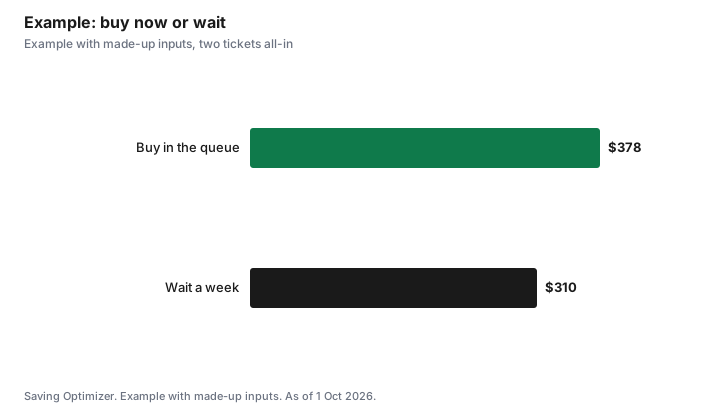
These numbers are an example with made-up inputs. Two friends join a general sale for an arena show. When they reach the front of the queue, the seats they want are priced at $189 each all-in, above their $160 budget. They skip the purchase and check the official page each morning. A week later, after a second date is added, similar seats are listed at $155 all-in. They pay $310 instead of $378, saving $68.
| Scenario | Per ticket all-in | Two tickets |
|---|---|---|
| Buy in the queue | $189 | $378 |
| Wait a week | $155 | $310 |
| Saving | $34 | $68 |
Steps
- Register for pre-sales and set a firm all-in budget.
- Read the capacity and pre-sale disclosure on the event page.
- Compare all-in totals across sections and dates.
- Skip prices above your budget and check back later.
- Buy resale only with a written guarantee.
- Report unclear pricing to the Competition Bureau or, for Ontario ticket rules, to Consumer Protection Ontario.
Common mistakes
- Thinking the platform, not the organizer, sets the price.
- Comparing base prices instead of all-in totals.
- Buying instantly in the queue out of fear of missing out.
- Paying more than the original total on resale in Ontario.
More: ticket fees and all-in pricing and refunds for cancelled or postponed concerts.
Sources
- Ticketmaster Canada Help, ticket pricing, Platinum tickets and fees, help.ticketmaster.ca, as of 1 Oct 2026.
- Government of Ontario, Buying tickets to events in Ontario, ontario.ca, as of 1 Oct 2026.
- Competition Bureau Canada, Drip pricing, competition-bureau.canada.ca, as of 1 Oct 2026.
- Prices in the example are made-up inputs.
Frequently asked questions
What is dynamic pricing for concert tickets?
Prices that change over time with demand, rising when many people want seats and possibly falling when a show is not selling.
Who sets concert ticket prices on Ticketmaster?
Ticketmaster Canada says event organizers set face value and can change it at any time.
What are Ticketmaster Platinum tickets?
Popular seats sold at a price set by the event organizer. Ticketmaster says it does not use algorithmic surge pricing, and Platinum is not a VIP package.
Is dynamic pricing legal in Canada?
Organizers can change prices, but Ontario requires the total price in Canadian dollars with fees itemized, and the Competition Bureau says advertised prices must be attainable apart from government taxes.
Is there a cap on resale prices in Ontario?
Yes. Resale cannot exceed the original total price plus applicable taxes and the platform's standard fees.
How can I avoid paying surge prices?
Join pre-sales, set an all-in budget, compare dates and sections, and wait if prices exceed your budget.
Researched and drafted with AI assistance and fact-checked against official Canadian sources. How we create content.
Disclosure: Saving Optimizer may earn a commission if a partner link is added later, such as a ticketing offer type. No partnership is claimed on this page. Education only, not legal advice.