
Personal Care · Canada
Laser Hair Removal vs Waxing vs Shaving: Lifetime Cost in Canada
Shaving, waxing, and laser hair removal are not three prices. They are three different bills spread over different years. A low visit price that never stops can cost more than a large first-year package that mostly stops. This page is that comparison, with Health Canada’s risk wording beside it. It does not quote a clinic fee, and it does not rank a clinic. Shaving hardware is the per-shave guide. A cosmetic procedure on a tax return is the medical expense guide. Nothing here is medical, tax, or legal advice.
Disclosure: Amazon.ca storefronts are an offer type. Saving Optimizer may earn a commission if a partner link is added later. No partnership is claimed with Amazon, a salon, a clinic, or a brand. Education only. This page does not name a best product.
Key takeaways
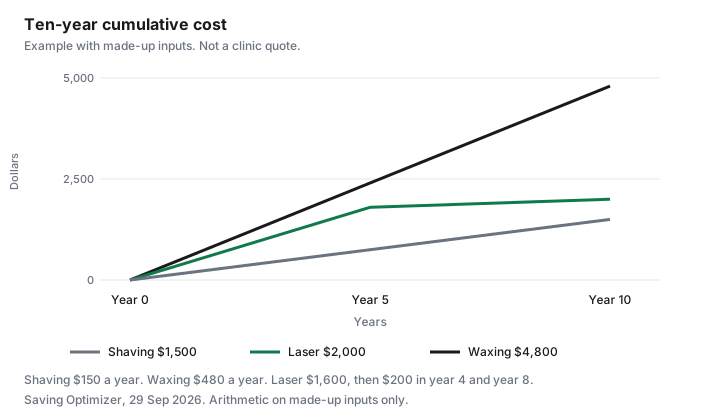
- No clinic price list is quoted. A range you were handed in a consult goes in your column. The ten-year chart is an example with made-up inputs.
- Health Canada’s cosmetic laser treatments page says laser hair reduction works best on light skin and dark hair, is less effective on blond, red, grey, or white hair and on dark skin, and usually needs multiple sessions. About 30 percent permanent reduction is mentioned, with no guarantee.
- The 2011 facility guidelines put hair-removal lasers in Class 3B and Class 4 and say the rules differ by province and territory.
- In the made-up ten-year example, waxing at $480 a year reaches $4,800, the laser plan reaches $2,000, and shaving at $150 a year reaches $1,500.
- Saving for a first-year package is a sinking-fund job, not a credit-card surprise. That method is the sinking fund guide.
Typical price ranges (collect at draft)
A price range counts when a clinic prints it or puts it on the quote you can keep. This page does not cite a clinic menu, so it does not print a Canadian low, high, or average for a session, a package, or a waxing visit. Write the number from the quote in the blank column: the area of the body, the session count, what a missed session costs, and whether tax is included. A per-session price without the number of sessions is not a lifetime cost.
Until you have that quote, the only honest comparison is the method. Shaving is razors and cream over the years you keep shaving, which the per-shave guide already divides. Waxing is the visit price times the visits per year times the years you will keep booking. Laser is the package, plus the touch-ups the clinic says you should expect, plus the time off if a visit leaves skin you will not cover with a normal day. Student clinics, if a school offers hair removal, are the beauty school guide. This page does not quote a student price.
Sessions and touch-ups
Health Canada’s cosmetic laser treatments page says most people need multiple sessions to get good results. It says there may be some permanent hair reduction, about 30 percent, depending on the operator and the laser system, and that there are no guarantees for every person or every part of the body. The same page says laser hair reduction works best for light skin and dark hair, and is not as effective on blond, red, grey, or white hair, or for people with dark skin. Avoid tanning before and after, because tanning increases melanin and can reduce the treatment’s effectiveness. Those are the page’s words. They are not a promise about your hair.
The 2011 facility guidelines, Laser Hair Removal Safety Guidelines for Facility Owners and Operators, tell staff to discuss realistic outcomes, including the need for multiple sessions, possible maintenance sessions, and variable responses. They do not print a single session count. Ask the clinic what “package” means if you stop early, and what a maintenance visit costs after the package. A package that is cheap per session and expensive to abandon is a commitment, which is why the cash belongs in a sinking fund before you book, not on a card you will revolve.
At-home IPL devices
A plug-in device for home use is a different purchase from a clinic laser. The 2011 guidelines describe Class 3B and Class 4 lasers used in facilities, and they mention intense pulsed light only to say that an IPL system in that setting needs protective eyewear appropriate for emissions across more than one band. This page does not call a home device a Class 3B or Class 4 laser. It also does not say a home device is licensed. Class II, III, and IV medical devices offered for sale in Canada are listed in the Medical Devices Active Licence Listing. Class I devices do not appear there. If a seller gives you a licence number, search it. If they do not, you do not have a listing to check.
Worth it, as money, is use. Example with made-up inputs: a device at $300, and waxing you would have booked eight times at $40, which is $320 in that year. The device is ahead by $20 in year 1 only if you use it instead of those eight visits, and only inside this example. Two uses and a shelf is $300 spent to save $80. Heading 85.10 of the 2026 Customs Tariff covers hair-removing appliances with a self-contained electric motor, and no 85.10 item appears in the surtax order. Whether a light-based home device is classified there: check with CBSA (1-800-461-9999) or your carrier. Watch a listing with the price tracker before you treat a sale price as the cost.
Safety and regulation
Health Canada’s cosmetic laser treatments page, checked 29 Sep 2026, says that even with the correct instrument there is a risk of temporary effects, including immediate pain, reddening, bruising, and swelling. Some lasers have cooling devices to reduce that risk. Other possible side effects include blisters, burns, and infection. Lightening or darkening of the skin can happen, and the page says those complications are rarely permanent. The page says to be sure the operator has the training and experience to do the procedure safely, and to ask for references. Health Canada regulates laser devices under the Radiation Emitting Devices Act, the Medical Devices Regulations, and the Food and Drugs Act. The page says those rules are there so laser systems sold in Canada are safe and effective when used for their licensed medical purposes by trained professionals, following the manufacturer’s directions.
Who may perform it is not one national job title. The 2011 guidelines say owners must comply with municipal and provincial requirements, and that use of these lasers is regulated differently in each province or territory. In that document’s appendix, Alberta’s Radiation Protection Regulation is described as requiring a registration certificate for Class 3B and 4 lasers. Saskatchewan’s Radiation Health and Safety Regulations, 2005, as summarized there, say deliberate exposure of a person to the direct beam of a Class 3 or Class 4 laser is under the direction of a qualified medical practitioner or, for a non-medical procedure, a person formally trained for that procedure. That is a 2011 summary of two provinces. Check the current rule where you live. Do not treat another province’s line as yours.
Lifetime cost comparison
Stack ten years, not one visit. Example with made-up inputs. Shaving supplies are $150 a year, so $1,500 over ten years. Waxing is $480 a year, so $4,800. Laser is $1,600 in year 1, a $200 touch-up in year 4, and a $200 touch-up in year 8, which is $2,000 by year 10. In that example laser costs more than shaving and less than waxing. Change any one input and the order can change. A quote of $1,600 that leaves out tax, a missed-session fee, or a numbing product is not the $1,600 in the chart.
Risk sits beside the dollars, not under them. A plan that is cheaper on the chart and wrong for your hair colour, on Health Canada’s own description, is not the cheap plan. A plan you cannot claim as a medical expense is paid with after-tax dollars. Confirm eligibility with the CRA using the medical expense guide. This page does not say laser hair removal qualifies.
| Method | Cost drivers | Sessions and upkeep | Risk and who may do it |
|---|---|---|---|
| Shaving | Handles, blades or cartridges, cream. The per-shave guide. | Repeats for as long as you shave. No package. | Not a laser. Cuts and irritation are a product question, not this page’s medical advice. |
| Waxing | Visit price times visits per year. No menu quoted here. | Ongoing. Stops only when you stop booking. | A salon service. Student clinics, if offered, are on the beauty school guide. No student price here. |
| Epilators | Device once, then use. No shelf price quoted. | Home maintenance. No session count on this page. | Not described as a clinic laser on the pages cited here. |
| At-home IPL | Device price, and whether you use it. Made-up example only. | Follow the device booklet. This page sets no session count. | Not called a Class 3B or Class 4 laser here. Licence: search MDALL if a number is offered. Classification for the surtax: check with CBSA. |
| Clinic laser | Package, touch-ups, tax, and anything the quote adds. No menu quoted. | Multiple sessions, possible maintenance. About 30 percent reduction is Health Canada’s figure, with no guarantee. | Temporary pain, redness, bruising, swelling. Possible blisters, burns, infection. Rules differ by province. Ask about training and the device. |
| Plan | Made-up arithmetic | At year 10 | Your quote |
|---|---|---|---|
| Shaving | $150 × 10 years | $1,500 | |
| Waxing | $480 × 10 years | $4,800 | |
| Laser | $1,600 in year 1 + $200 in year 4 + $200 in year 8 | $2,000 |
Sources & date stamps
- Health Canada, Cosmetic laser treatments, checked 29 Sep 2026. Temporary pain, reddening, bruising, swelling. Possible blisters, burns, infection. Pigment change rarely permanent. Best on light skin and dark hair. Multiple sessions. About 30 percent permanent reduction, no guarantee. Ask about training. Avoid tanning before and after. Devices regulated under the Radiation Emitting Devices Act, the Medical Devices Regulations, and the Food and Drugs Act.
- Health Canada, Laser Hair Removal Safety Guidelines for Facility Owners and Operators, first edition October 2011, checked 29 Sep 2026. Class 3B and Class 4. Rules differ by province and territory. Alberta registration certificate described for Class 3B and 4. Saskatchewan summary on who directs exposure to the beam. Multiple sessions and maintenance to be discussed with the client.
- Health Canada, Medical Devices Active Licence Listing description, checked 29 Sep 2026. Class II, III, and IV devices that are licensed appear in the listing. Class I devices do not require a licence and do not appear.
- United States Surtax Order (2026), SOR/2026-186, current to 2026-09-21, last amended 2026-09-08, checked 29 Sep 2026. No heading 85.10 item appears in its schedules. How a home device is classified: check with CBSA (1-800-461-9999) or your carrier.
- 2026 Customs Tariff, chapter 85, heading 85.10 (shavers, hair clippers and hair-removing appliances), checked 29 Sep 2026.
- Ten-year dollars are an example with made-up inputs. No clinic fee was quoted.
Frequently asked questions
Is laser hair removal cheaper than waxing over time?
It can be, inside an example, and only after the first-year cost is smaller than the waxing you would have kept paying. Example with made-up inputs: waxing at $480 a year is $4,800 over ten years, a made-up laser plan of $1,600 in year 1 plus $200 touch-ups in year 4 and year 8 is $2,000 at year 10, and shaving at $150 a year is $1,500. Shaving stays the cheaper line in that example. None of those figures is a clinic quote, and this is not a result claim.
What does Health Canada say about laser hair removal risks?
Health Canada’s cosmetic laser treatments page describes temporary pain, reddening, bruising, and swelling, and possible blisters, burns, and infection, and it says lightening or darkening of the skin is rarely permanent. The 2011 facility guidelines say lasers used for hair removal were in the highest hazard classes, Class 3B and Class 4, and that direct exposure is a hazard to unprotected eyes or skin. This is education, not medical advice. Ask the operator what device they use and what training they have.
Is at-home IPL worth it?
It is worth the money only if you will use it for the waxing or shaving visits it replaces. Example with made-up inputs: a $300 device against eight waxing visits at $40 is a first-year device cost of $300 versus $320 of waxing, and two uses and a drawer is a $300 gadget. A home device is not described on this page as a Class 3B or Class 4 clinic laser. How a given home device is classified for customs, and whether any surtax applies, is a question for CBSA (1-800-461-9999) or your carrier.
How many sessions does laser need?
Health Canada’s cosmetic laser treatments page says most people need multiple sessions for good results, and that there may be some permanent hair reduction, about 30 percent, depending on the operator and the system, with no guarantee for every person or every body area. The 2011 guidelines tell facilities to discuss multiple sessions and possible maintenance. Neither page prints a session count that applies to everyone. A clinic’s package count is their quote, not a national number.
Can I claim laser hair removal as a medical expense?
This page does not add laser hair removal to the CRA list. The medical expense guide is where purely cosmetic procedures are discussed, including examples the CRA names, so read Guide RC4065 and the lines 33099 and 33199 page, and confirm with the CRA. A clinic invoice is not a ruling that the amount is eligible. This is not tax advice.