
Education · Canada
Scholarship and Student Aid Scams in Canada

The simplest rule for scholarship and student aid scams in Canada is that real aid doesn't charge you to apply. Government programs like OSAP, StudentAid BC and Canada Student Loans are free to apply for, and so are legitimate scholarships. Scammers ask for an application or "processing" fee, promise a guaranteed award, or send urgent messages pretending to be the National Student Loans Service Centre (NSLSC) offering loan forgiveness. If you're asked to pay with gift cards or cryptocurrency, it's a scam.
Key takeaways
- Applying for government student aid is free. Nobody needs to charge you to file an OSAP or StudentAid BC application.
- Real scholarships don't guarantee a win and don't charge an entry fee.
- Loan forgiveness and payment relief come through the NSLSC and your provincial aid office, for free. Messages offering fast forgiveness for a fee are fake.
- Payment by gift card, crypto or e-transfer to a stranger is a red flag.
- Report scams to the Canadian Anti-Fraud Centre, and call your bank right away if you paid.
Fake scholarships
Fake scholarships often arrive as an email or social post saying you've been selected for an award you never applied for. To claim it, you pay a small fee or give your SIN and banking details. Others charge for access to a "private database" of scholarships, or run "essay contests" with entry fees and no real prize. Legitimate awards are listed by your school's financial aid office and by known organizations, and they don't need your banking details until you've actually won and the school is involved.
Fee-for-aid services
Some companies charge students or parents to fill out aid applications. In Canada, OSAP, StudentAid BC and the other provincial programs are free, and your school's financial aid office will help at no cost. Paying a third party gives you nothing you couldn't get free, and you hand over your SIN, income details and login information in the process. StudentAid BC warned in January 2026 that scams targeting students are becoming more common, and that you should never share your login or personal details with anyone offering to help.
Loan forgiveness scams
These messages often look like they come from the NSLSC. They say you qualify for fast loan forgiveness or a debt relief program, and push you to act now and pay a fee or share your login. The real programs are free: the Repayment Assistance Plan, which can lower or pause payments based on income, and targeted forgiveness for some professions in rural communities, both run through the government. See our student loan repayment guide for how RAP really works.
| Signal | Legitimate | Scam |
|---|---|---|
| Cost to apply | Free | "Processing" or "release" fee |
| Award promise | Competitive; no guarantee | "Guaranteed" or "you've been selected" |
| Contact | Official sites, your school, the NSLSC | Unsolicited texts, DMs, look-alike emails |
| Payment method | Never needed to receive aid | Gift cards, crypto, e-transfer |
| Pressure | Published deadlines | "Act within 24 hours" |
Reporting
If you think you've been targeted, stop responding and don't click links. Contact the program directly using the phone number or website you find yourself, not the one in the message. If you paid or shared banking details, call your bank or card issuer right away. Report the scam to the Canadian Anti-Fraud Centre online or by phone, and to your local police if you lost money. If your SIN was shared, contact Service Canada. Tell your school's financial aid office too; they often warn other students.
Checklist
- Did you apply for this award? If not, be suspicious.
- Is there any fee to apply, claim or "release" funds? Real aid doesn't charge.
- Is the sender's address or link on an official domain you typed yourself?
- Are they asking for your SIN, banking login or NSLSC password? Never share them.
- Are they pushing you to act fast or pay by gift card or crypto? Stop.
- Can your school's financial aid office confirm the award exists?
Example: what a fee scam costs
An example family pays a $49 "scholarship database" fee, then a $199 "aid application service", and later a $350 "loan forgiveness processing" fee. None of these services gives them anything they couldn't get free.
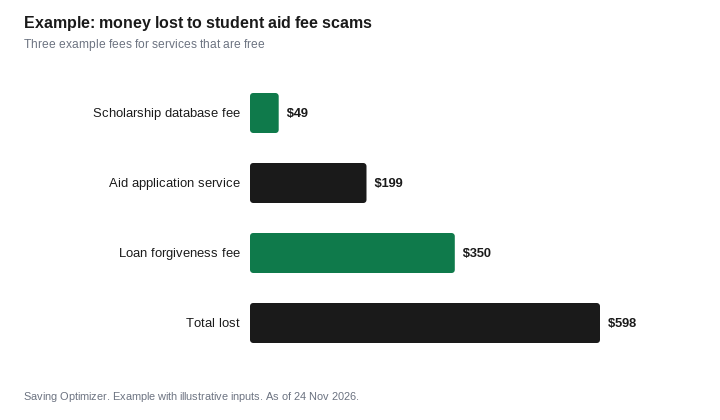
The direct loss here is $598. The bigger risk is identity theft from a shared SIN or banking login. Every one of these services has a free official version: your school's award listings, the provincial aid application, and the NSLSC's Repayment Assistance Plan. Use our scholarship deadlines calendar to find real awards.
Sources
- StudentAid BC, Student aid scams – How to protect yourself, 20 Jan 2026, checked 24 Nov 2026.
- Scotiabank Advice+, How scammers are targeting students and what to watch out for, 10 Aug 2026, checked 24 Nov 2026.
- Canadian Anti-Fraud Centre, report fraud and cybercrime (antifraudcentre-centreantifraude.ca), checked 24 Nov 2026.
- Government of Canada, Repayment Assistance Plan (free through the NSLSC), checked 24 Nov 2026.
Frequently asked questions
Do you have to pay to apply for OSAP?
No. Applying for OSAP is free, as are StudentAid BC and the other provincial aid programs. Your school's financial aid office will help you for free.
How can I tell if a scholarship is a scam?
Be suspicious if you didn't apply, if there's a fee, if the award is guaranteed, or if they want your SIN or banking details up front. Confirm with your school's financial aid office.
Is NSLSC loan forgiveness real?
There are real programs, like the Repayment Assistance Plan and forgiveness for some professions in rural communities, and they're free through the government. Messages offering fast forgiveness for a fee are scams.
Where do I report a student aid scam in Canada?
Report it to the Canadian Anti-Fraud Centre, contact your bank if you paid, and tell your school and the aid program. If your SIN was shared, contact Service Canada.
Are scholarship search websites legitimate?
Many free scholarship search sites are legitimate. Be wary of any that charge a fee for a list or promise guaranteed awards. Your school's award listings are free.
Researched and drafted with AI assistance and fact-checked against official Canadian sources. How we create content.
Note: If you think you've lost money or shared personal details, contact your bank and the Canadian Anti-Fraud Centre right away. Education only.