
Healthcare · Canada
Store-Brand Over-the-Counter Medicine in Canada: Same Active Ingredient, Lower Price
A lower price is a saving only when the label is the same drug in the ways that matter: the active ingredient, the strength, and the dosage form. In Canada that check starts with the drug identification number, not with a U.S. “generic” list and not with the banner on the box. This page uses Health Canada’s Drug Product Database, queried 27 Sep 2026. It does not use a shelf price. The unit-price row is illustrative so the division is visible. Offer types are disclosed below. This is not medical advice, and it is not a ranking of brands or stores.
Disclosure: Amazon.ca storefronts are an offer type. Saving Optimizer may earn a commission if a partner link is added later. No partnership is claimed with Amazon or any pharmacy banner. Education only. This page does not name a best pain reliever, allergy tablet, or store.
Key takeaways
- Health Canada’s Drug Product Database search tips say a DIN is an eight-digit number assigned to each drug product authorized for use in Canada. One DIN returns one product.
- Advil Tablets, DIN 01933558, are ibuprofen 200 mg tablets, marketed, active-ingredient group 0108883004. Ibuprofen Tablets 200 mg, DIN 02272849, are the same ingredient, strength, form, and group, and are also marketed.
- Advil Extra Strength Caplets, DIN 02244577, are ibuprofen 400 mg. Advil Cold and Sinus, DIN 02036312, is ibuprofen 200 mg plus pseudoephedrine hydrochloride 30 mg. Neither is the plain 200 mg tablet.
- A marketed store-brand tablet in the same group as Reactine 10 mg was not confirmed in this query. No shelf price for any of these products was opened.
- Price per dose is the package price divided by the number of doses you will take before the expiry date. Doses you discard are not a saving.
Reading the label: DIN, active ingredient, strength and dosage form
The search tips page says you look up a DIN on its own. The database should return one record, because the number is unique. On that record, read the brand name, the company, the status, the active ingredient, the strength, and the dosage form. Two products are the same comparison only when the ingredient, the strength, and the form match. The active-ingredient group number is a shortcut the database prints. Advil Tablets and the Vita Health ibuprofen 200 mg tablet share group 0108883004. Sharing a group is not a reason to ignore a second ingredient. A cold product can share part of a pain product and still be a different medicine.
Status matters. A record marked marketed is on the market in the database’s terms. A record marked cancelled, or approved but not marketed, is not a box you should expect on today’s shelf. Reactine tablets, DIN 02223554, are cetirizine hydrochloride 10 mg, group 0122686001, and the status returned was marketed. An older Reactine 10 mg DIN, 01900986, came back cancelled post-market. Do not shop from a cancelled DIN. If the package in your hand has no eight-digit DIN, this database method does not identify it. Do not guess that a different kind of number is the same medicinal ingredient. The generic and brand guide is the prescription version of interchangeability. Over-the-counter products are not swapped by a pharmacist under those public-plan rules unless the product is actually a prescription drug. Read the label yourself, and ask the pharmacist when the label is a combination.
Brand vs store-brand examples by category (pain, allergy, cold, antacid)
Pain is the pair this query could finish. Advil Tablets, DIN 01933558, company Haleon Canada ULC, are ibuprofen 200 mg in tablet form, status marketed, status history date 18 Jun 2026, database last update 24 Sep 2026. Ibuprofen Tablets 200 mg, DIN 02272849, company Vita Health Products Inc., are ibuprofen 200 mg tablets, the same group, status marketed. The database does not call the second product a house brand of a grocery banner. It is a second authorized 200 mg tablet. That is the comparison. It is not a claim that every store’s bottle is this DIN. Photograph the DIN on the bottle you buy and look that number up. Advil Extra Strength Caplets, DIN 02244577, are 400 mg. They are not a substitute in this comparison. Half a 400 mg tablet is a dosing decision for a pharmacist, not a price hack.
Allergy, cold, and antacid did not produce a clean marketed pair of the same form. Reactine, DIN 02223554, is a marketed 10 mg cetirizine hydrochloride tablet. A second marketed tablet in that group, under a store banner, was not in the results used here. A cetirizine liquid-gel record in the same group was a capsule, and its status was approved rather than marketed, so it is not held out as the store-brand match. Advil Cold and Sinus, DIN 02036312, is a marketed tablet with two ingredients, ibuprofen 200 mg and pseudoephedrine hydrochloride 30 mg. A pain-only ibuprofen tablet is not that product. Several other “cold and sinus” names in the database sit in different ingredient groups. Do not match them on the words “cold and sinus.” Antacid records were messier still: a Tums 500 mg tablet DIN that was checked had a cancelled post-market status, so it is not used as a current pair. The method is the same when you are in the aisle. Match ingredient, strength, and form. If you cannot, do not call them the same medicine.
Unit-price math: price per dose, not per box
The package price is not the price of a dose. Divide the price you pay by the number of doses in the package. A dose is what the label tells you to take, not what the box counts if the count is tablets and the dose is two tablets. Write that down before you divide. A 20-dose package at a higher shelf price can be cheaper per dose than a 10-dose package with a lower shelf price. It can also be the other way around. The only way to know is the division, on the day, in the store. No flyer price was opened for this draft.
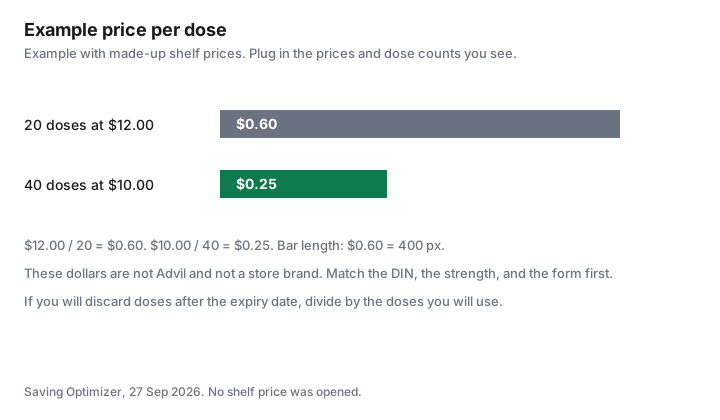
The illustrative row uses stand-in numbers so the chart has two bars. It is not a Shoppers, Walmart, or Amazon price. Illustrative brand package: 20 doses at $12.00, which is $0.60 a dose. Illustrative store-brand package: 40 doses at $10.00, which is $0.25 a dose. The gap is $0.35 a dose only inside that fiction. Your gap is your two divisions. The household store-brand guide uses the same unit-price habit for paper and detergent. Do not copy a paper-towel price into a medicine aisle. Loyalty points, if the banner awards them, are the PC Optimum guide. A point is not a reason to buy the wrong strength.
When to ask the pharmacist: interactions, children's dosing, combination products
The DIN match does not tell you whether the medicine is right for you. Ask the pharmacist before you treat a match as permission, especially in three cases. You already take other medicines, including prescriptions the dispensing-fee guide is about. The person who will swallow the dose is a child. The box is a combination, like the cold-and-sinus tablet that adds a decongestant to ibuprofen. A second ingredient is a second effect. A children’s DIN is not the adult DIN with a smaller price. Children’s Advil appears in the database as its own records. This page does not calculate a child dose from an adult tablet.
Ask even when the ingredients match and you are an adult who has used the brand before. The pharmacist can see the rest of the profile. This article cannot. Do not stack two combination products because each one was cheaper than the brand next to it. You can double an ingredient without noticing. If you are pregnant, buying for an infant, or treating a symptom that is new and severe, the person to ask is the pharmacist or your clinician, not a price table. Not medical advice.
Buying in bulk vs expiry dates
A larger count lowers the price per dose only for doses you will use. Read the expiry date on the package. Doses still in the bottle after that date are a cost, not a saving. If the illustrative 40-dose package is $10.00 and you will use 20 doses before expiry, the price per dose you actually take is $0.50, not $0.25. The other 20 doses were not cheap. They were discarded. A smaller package at a higher price per dose can win once you count waste.
Bulk is also a storage question. A bottle in a bathroom that gets wet, or a bottle opened long before the expiry date, is not the bottle the price assumed. This draft did not open a stability rule for an opened bottle, so it does not tell you a number of months. Follow the label. If the label is silent, ask the pharmacist before you buy the largest count. A household that uses a pain reliever twice a year does not need a year’s worth of tablets to capture a unit price.
A shopping checklist
Do these in order. Find the eight-digit DIN. Look it up, or look up the brand you are comparing, and write the ingredient, the strength, the form, and the status. Reject a cancelled record and a mismatched strength. Reject a combination if you meant a single ingredient. Divide price by doses you will use before expiry. Then ask the pharmacist if any of the three cautions above apply. The blank row is yours. The filled row is the illustrative division only.
| Row | Product | Doses in the package | Price | Price per dose |
|---|---|---|---|---|
| Illustrative brand | Not a named shelf product | 20 | $12.00 | $0.60 |
| Illustrative store brand | Not a named shelf product | 40 | $10.00 | $0.25 |
| Your brand | ||||
| Your store brand |
Sources & date stamps
- Health Canada, Drug Product Database search tips, retrieved 27 Sep 2026. A DIN is an eight-digit number for a drug product authorized for use in Canada, and a DIN search returns one record.
- Drug Product Database API, queried 27 Sep 2026. Advil Tablets DIN 01933558, ibuprofen 200 mg tablet, marketed, group 0108883004, last update 24 Sep 2026. Ibuprofen Tablets 200 mg DIN 02272849, Vita Health, same group, marketed. Advil Extra Strength Caplets DIN 02244577, ibuprofen 400 mg. Advil Cold and Sinus DIN 02036312, ibuprofen 200 mg plus pseudoephedrine hydrochloride 30 mg, marketed. Reactine DIN 02223554, cetirizine hydrochloride 10 mg tablet, marketed.
- A non-prescription labelling guidance page beyond the DIN definition was not retrieved. No shelf price was opened. The unit-price row is illustrative.
Frequently asked questions
Are store-brand medicines as good as name brands?
This page does not say they work the same, because no clinical comparison was opened. It does say two marketed products can share an ingredient, a strength, and a form: Advil Tablets, DIN 01933558, and Ibuprofen Tablets 200 mg, DIN 02272849, are both ibuprofen 200 mg tablets in one database group. A 400 mg caplet, or a cold tablet that adds pseudoephedrine, is not that pair. Ask the pharmacist before you treat a database match as the right product for you.
What does the DIN mean?
Health Canada’s search tips say a DIN is an eight-digit number assigned to each drug product authorized for use in Canada, and searching it returns one record. Use that record’s ingredient, strength, dosage form, and status, and do not treat a cancelled DIN as a current shelf match. A package with no eight-digit DIN is not identified by this method.
How do I compare prices per dose?
Divide the price you pay by the number of doses in the package, using the dose on the label. A larger package is not automatically cheaper. On the illustrative row, $12.00 for 20 doses is $0.60, and $10.00 for 40 doses is $0.25. Those dollars are not a shelf price, and if you will throw half the package out after the expiry date, divide by the doses you will actually use.
Is it safe to buy in bulk?
It is a price question and an expiry question, not a dare. A lower price per dose applies only to doses you use before the expiry date printed on the package. This draft did not open a rule for how long an opened bottle stays good, so follow the label or ask the pharmacist. A household that rarely uses the medicine should not buy the largest count to chase a unit price, and this is not medical advice.
When should I ask a pharmacist?
Ask when you take other medicines, when the dose is for a child, or when the box combines ingredients, such as ibuprofen plus a decongestant. A DIN match does not choose the medicine for you. Children’s products have their own DINs. Do not split an adult tablet into a child dose from this page, and treat this as education rather than medical advice.