
Education · Canada
Textbook Costs in Canada: Inclusive Access, Open Textbooks and Used Books
Before you buy anything, find out exactly what each course requires and whether you are already being billed for it. Many colleges and universities now use inclusive access, also called immediate or day-one access, which puts the digital textbook in your course page and charges your student account unless you opt out by a deadline. Keep it if the course needs the online homework platform or the price beats every alternative; opt out if a used copy, library copy or free open textbook will do. Open textbooks cost nothing: BCcampus reports more than $41.5 million in savings for B.C. students.
Key takeaways
- Inclusive access charges your student account unless you opt out by the deadline.
- At Sheridan, opting out credits the account immediately, but access ends after day 10.
- If a course uses an online homework platform, you may need the access code anyway.
- Open textbooks are free; eCampusOntario's Open Library lists more than 1,900 resources.
- Check the library, used copies and older editions before paying full price.
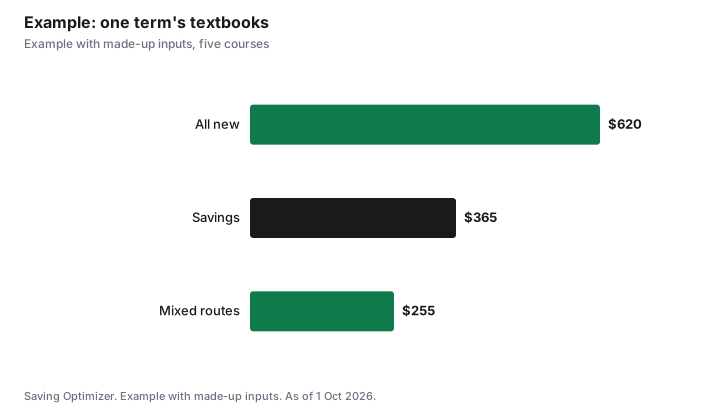
- Example with made-up inputs: a five-course term drops from $620 to $255.
How inclusive access works
Inclusive access is a deal between the school, its store or vendor, and publishers. Sheridan's campus store describes its Immediate Access pilot this way: required digital course materials are available in your course page on the first day of class, the vendor negotiates lower prices with publishers, and if you stay enrolled the cost is billed directly to your student account. Carleton lists Inclusive Access as coming soon and describes it as required digital course materials on or before the first day of class at a reduced cost, billed through tuition, with an option to opt out.
| Question | Sheridan's answer |
|---|---|
| When are you charged? | As soon as you are enrolled in the course |
| How does it appear? | A separate line, Course Materials Charges, on your account summary |
| How do you opt out? | An opt-out button on each item in your Bookshelf, reached from the course page |
| What happens after opting out? | Your account is credited immediately and you lose access after day 10, at the end of week two |
| Do you still need the book? | Yes, you must get it another way, potentially at a higher cost |
| Is it every course? | No, only courses in the pilot |
Two lessons follow. First, the opt-out deadline is short, and you keep access only until then, so decide in the first week or two. Second, inclusive access is per course: some courses will be billed, others will expect you to buy materials yourself. Read your welcome emails and the course outline for each one.
When to keep it and when to opt out
| Situation | Lean toward |
|---|---|
| Graded homework or quizzes run on the publisher platform | Keep; you may need the access code anyway |
| Reading only, and the library has a copy | Opt out |
| Older edition is acceptable to the instructor | Opt out and buy used |
| You prefer print and will sell it later | Compare print used price minus resale value |
| You are unsure whether you will stay in the course | Keep access until near the deadline, then decide |
| Instructor uses an open textbook | Nothing to pay |
Ask the instructor two questions in week one: is an older edition acceptable, and is the online platform required for marks? The answers decide most cases.
Free open textbooks
Open textbooks are openly licensed and free to read online, download or often print at cost. BCcampus, which runs B.C.'s open textbook collection, reports $41,549,899 in student savings from known open textbook adoptions in B.C. It calculates savings as the number of students multiplied by the cost of the textbook being replaced if bought new. eCampusOntario's Open Library says it gives access to more than 1,900 free and openly licensed educational resources, and that it launched in 2017 in partnership with BCcampus.
You cannot make an instructor switch, but you can use open textbooks to learn alongside a required book, and some instructors choose open texts precisely because students ask. If your course uses one, the cost is zero.
Other ways to pay less
| Route | Cost | Watch for |
|---|---|---|
| Open textbook used by the course | Free | Only if the instructor assigned it |
| Library or course reserve | Free | Short loan periods on reserve copies |
| Borrow from a student who took the course | Free or a favour | Edition must match |
| Used copy | Usually below new | Missing access codes; edition |
| Older edition | Often far cheaper | Page and problem numbers differ |
| Rental or digital rental | Below buying | Return dates; no resale |
| Inclusive access | Negotiated price | Opt-out deadline |
| New print at the store | Highest | Resale value may help |
Never buy a used book for a course that grades through an online platform until you know whether the access code is sold separately. A used book with an expired code can cost more in total than the inclusive access price.
Example with made-up inputs: one term
These numbers are an example with made-up inputs. They are not any school's real prices. A student has five courses. Buying everything new would cost $620. Course 1 uses an open textbook, so it is free. Course 2 has a reserve copy in the library, so it is free. Course 3 needs the publisher's homework platform, so the student keeps inclusive access at $95. Course 4 accepts an older edition, bought used for $40. Course 5 is a reading list available as a $120 new print book, bought used for $70 and resold at the end for $30, a net cost of $40. Adding the extra $80 for a used calculator the program requires, the term costs $255 instead of $620.
| Course | Route | Cost |
|---|---|---|
| 1 | Open textbook | $0 |
| 2 | Library reserve | $0 |
| 3 | Inclusive access (platform needed) | $95 |
| 4 | Older edition, used | $40 |
| 5 | Used print, resold | $40 net |
| Program calculator | Used | $80 |
| Total | $255 |
Student aid can help
Allowable costs in student aid assessments generally include books and supplies, so your aid application already accounts for some of them. Quebec's Aide financière aux études, for example, lists textbooks and school supplies among allowable expenses and offers an extra allowance for training support materials of $500 per term, paid as a loan you repay after your studies, to buy materials such as a computer. See Quebec AFE loans and bursaries and the Canada Student Grant.
Steps for each term
- List every course and its required materials from the outline.
- Note which courses bill inclusive access, and the opt-out deadline.
- Ask whether older editions are fine and whether the platform is graded.
- Check for an open textbook, a library copy or a reserve copy.
- Price used and rental copies; include resale value.
- Opt out of inclusive access only where you have a cheaper way, before the deadline.
For devices, see student education pricing on tech, and for the whole year see first-year university costs.
Sources
- Sheridan College Campus Store, Immediate Access, campusstore.sheridancollege.ca, as of 1 Oct 2026. Billing, opt-out and access rules.
- Carleton University, Inclusive Access, carleton.ca/textbooks, as of 1 Oct 2026. Description and opt-out.
- BCcampus, Open Textbook Stats, open.bccampus.ca, as of 1 Oct 2026. Student savings and how savings are calculated.
- eCampusOntario, About the Open Library, openlibrary.ecampusontario.ca, as of 1 Oct 2026. More than 1,900 resources; launched 2017 with BCcampus.
- Gouvernement du Québec, Allowable expenses, quebec.ca, as of 1 Oct 2026. Textbooks and supplies; $500 per term training materials allowance as a loan.
- Course prices and resale values in the example are an example with made-up inputs.
Frequently asked questions
What is inclusive access for textbooks?
A model where required digital course materials are delivered through your course page and billed to your student account, with an option to opt out. Sheridan calls its version Immediate Access; Carleton lists Inclusive Access as coming soon.
What happens if I opt out of inclusive access?
At Sheridan, your account is credited immediately and you lose access after day 10, at the end of week two. You then need to get the material another way.
Should I opt out of inclusive access?
Opt out if a free, library or used option works for the course. Keep it if the course grades homework through the publisher platform or the price is lower than the alternatives.
Where can I find free open textbooks?
BCcampus runs B.C.'s open textbook collection, and eCampusOntario's Open Library lists more than 1,900 free, openly licensed resources.
How much have open textbooks saved students?
BCcampus reports $41,549,899 in savings for B.C. students from known open textbook adoptions.
Does student aid cover textbooks?
Assessments generally count books and supplies as costs. Quebec's AFE lists textbooks among allowable expenses and offers a $500-per-term training materials allowance, paid as a loan.
Researched and drafted with AI assistance and fact-checked against official Canadian sources. How we create content.
Disclosure: Saving Optimizer may earn a commission if a partner link is added later, such as a textbook retailer offer type. No partnership is claimed on this page. Education only.