Internet · Canada
Universal Broadband Fund and Rural Fibre: How to Check If Better Internet Is Coming
Rural households hear “fibre is coming” for years while they renew another season of slow DSL. The Universal Broadband Fund (UBF) is one reason glass shows up on sideroads — but a funded project on a slide deck is not an order button. This guide is how a middle-aged Canadian household checks status: ISED’s National Broadband Map, builder notices, honest timelines, interim options, questions for the municipality or ISP, and a watchlist you can reuse every six months.
Disclosure: Education only. No partnership with ISED, the CRTC, or any ISP. Map layers and project lists change. Confirm live government and ISP sources. Not an application form for funding.
Key takeaways
- UBF funds builders and communities toward better broadband (policy target often discussed as 50/10 Mbps). Households check coverage — they do not submit a UBF retail form.
- Use ISED’s National Broadband Map: current services versus government-supported UBF-related layers. Then verify with the company digging.
- Ask for a calendar quarter. “Soon” and “leave your email” are marketing, not a date.
- While you wait: fixed wireless, LTE/5G home, or satellite as a bridge — see sibling rural guides.
- Connecting Families is a different program for low-cost plans where plant already exists.
What UBF projects mean for households (high level)
As framed on ISED program materials (desk read 22 Sep 2026), UBF contribution streams support projects that expand access in underserved areas. Related intakes and top-ups have appeared over time (including rapid-response style efforts in earlier rounds). For a household:
- You are waiting on construction and turn-up, not a rebate cheque in the mail.
- When service launches, you still buy a retail plan from the ISP or its partners at whatever rate they publish.
- Eligibility on a map hexagon can lag or lead what a truck can light at your driveway.
CRTC wholesale and retail policies shape prices later. They do not dig the trench. Keep UBF (build) separate from bill fights (winbacks, Internet Code).
How to check project maps and ISP build notices
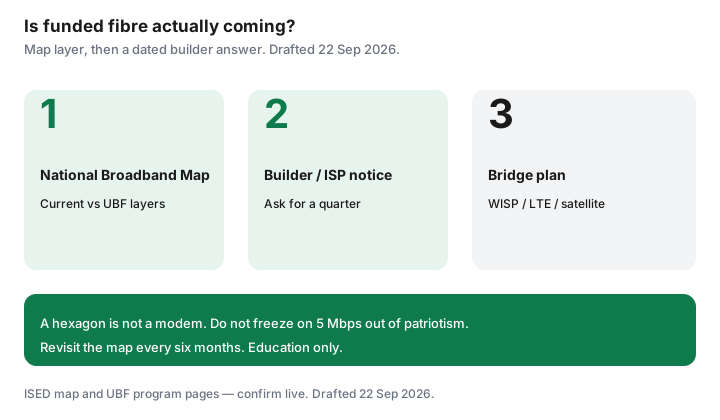
- Open ISED’s National Broadband Map. Locate your area. Note current available technologies and any government-supported / UBF-related project layers.
- Identify the named proponent if shown (regional ISP, Xplore, telco, municipal or Indigenous network).
- Check that builder’s fibre or coverage lookup with your exact address or road.
- Read township, county, or First Nation broadband updates — public meetings often admit slips before the ISP homepage does.
- Ask a neighbour on the same sideroad, not someone in town 15 km away on a different lateral.
Save screenshots with the date. Layers get revised.
Timelines vs marketing hype
| What they say | What you should ask |
|---|---|
| “Funded” or “announced” | Which intake? Which roads? Permitting done? |
| “Construction this year” | Which quarter for my road? Aerial or buried? |
| “Coming soon — join the waitlist” | Is there a target turn-up month? What happens if it slips? |
| “Available at your address” | Order link, install interval, upload speed in writing |
If nobody will date the drop, treat fibre as a hope and price a bridge. Do not freeze on 5 Mbps DSL for patriotism — see DSL upgrade paths.
What to do while you wait (fixed wireless, LTE, satellite)
- Fixed wireless / WISP — vet line of sight and contracts with the WISP checklist.
- LTE/5G home internet — allotments and fair use matter; 5G home guide.
- LEO satellite — map first, then live CAD; Starlink vs rural.
- Connecting Families — only if you qualify and a participating ISP already serves you; CFI walkthrough.
Prefer month-to-month or returnable hardware when fibre has a dated quarter within a horizon you can tolerate.
Questions to ask your municipality or ISP
- Which UBF or provincial project ID covers my road?
- What is the current construction phase and the next public milestone date?
- Will my civic address be aerial drop, buried lateral, or a fixed-wireless interim?
- Who do I email for pre-registration, and will that list get install priority?
- If the project is fibre to a nearby node only, what last-mile product do I actually get?
A rural upgrade watchlist
- Map screenshot dated ________
- Builder name and lookup result ________
- Dated quarter promised (or “none”) ________
- Bridge plan and monthly CAD ________
- Contract end / hardware return date on the bridge ________
- Next map re-check calendar date (six months) ________
- CFI eligibility checked? Y/N ________
Sources & date stamps
- ISED — Universal Broadband Fund program pages and National Broadband Map data notes; desk read 22 Sep 2026. Confirm live.
- CRTC — national broadband objective / 50/10 policy context as commonly cited in Canadian consumer materials; not a retail price control.
- Sibling Saving Optimizer rural guides — Starlink, WISP, DSL, CFI — for interim and pricing detail.
Frequently asked questions
What is the Universal Broadband Fund?
A federal contribution program administered with ISED support to expand broadband toward the national 50/10 Mbps policy target in underserved areas. Households do not apply for a UBF cheque; builders and communities do. You check whether a funded project covers your area.
Does a coloured hexagon on the map mean I can order fibre tomorrow?
No. Map layers show current services or government-supported projects. Construction slips. Pair the map with the builder’s fibre lookup and a dated answer from the ISP or municipality.
What should I use while I wait?
Fixed wireless, LTE/5G home internet where available, or satellite — priced for a bridge, not a ten-year identity. See the Starlink and WISP guides.
Is Connecting Families the same as UBF?
No. Connecting Families is a low-cost retail plan for eligible households where a participating ISP already has plant. UBF is about building infrastructure.
Is this an ISP or government partnership page?
No. Education only. Confirm live ISED maps and ISP notices.