
Education · Canada
University Meal Plan Costs in Canada for 2026-27: What You Actually Get
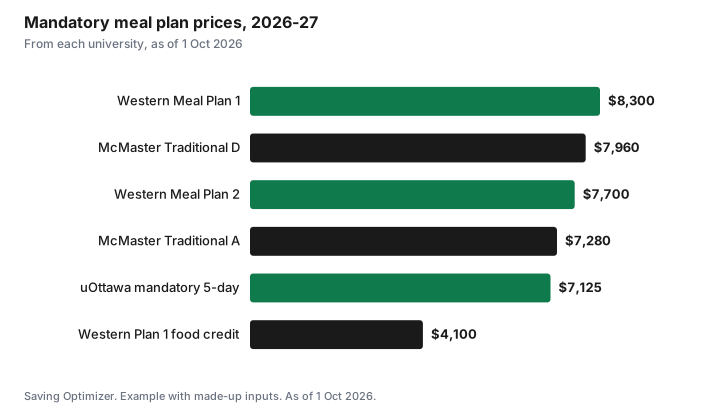
At McMaster, Western and the University of Ottawa, a traditional residence meal plan costs about $7,100 to $8,300 for 2026-27, but much of that price is not food you can spend. At Western, the $8,300 plan includes $4,100 of food credit and $4,050 of overhead; the $7,700 plan cuts food credit to $3,500 with the same overhead. McMaster charges $7,280 to $7,960 for its traditional plans and splits every purchase between your spending balance and an overhead balance. The University of Ottawa's mandatory five-day plan is $7,125, up from $6,825 last year. Plans are usually mandatory in traditional residences, so the real choice is which size to buy, and whether to live where a plan is optional.
Key takeaways
- Western 2026-27: $8,300 buys $4,100 of food credit; $7,700 buys $3,500.
- Western's overhead is $4,050 on either plan, so the bigger plan costs less per food dollar.
- McMaster's traditional plans run $7,280 to $7,960; apartment plans $4,590 to $5,310.
- uOttawa's mandatory five-day plan is $7,125, up from $6,825.
- Unused spending money can carry forward at McMaster; overhead cannot.
- Example with made-up inputs: choosing a plan size based on weekly spending.
What three universities charge
| University | Plan | Total cost for the year |
|---|---|---|
| McMaster | Traditional A to D | $7,280 / $7,510 / $7,740 / $7,960 |
| McMaster | Apartment A to D (select residences) | $4,590 / $4,830 / $5,070 / $5,310 |
| Western | Meal Plan 1 | $8,300 |
| Western | Meal Plan 2 | $7,700 |
| University of Ottawa | Mandatory 5-day plan (traditional residences and some suites) | $7,125 |
These are prices for the academic year. McMaster also lists four-month prices for co-op and exchange students, from $3,640 to $3,980 for the traditional plans. The University of Ottawa shows the 2025-26 plan at $6,825, so the 2026-27 plan costs $300 more, an increase of about 4.4%.
Overhead: why the sticker price overstates your food
Western spells out what is inside each plan. Meal Plan 1 has $4,100 of food credit, made up of $3,550 of residence dollars and $550 of flex dollars, plus a $4,050 overhead fee and a $150 capital improvement fee. Meal Plan 2 has $3,500 of food credit (residence dollars of $2,950 plus the same $550 of flex), with the same $4,050 overhead and $150 fee. Because the overhead is fixed, each extra dollar of plan buys a full dollar of food credit: going from Plan 2 to Plan 1 costs $600 more and adds $600 of food.
| Item | Meal Plan 1 | Meal Plan 2 |
|---|---|---|
| Residence dollars | $3,550 | $2,950 |
| Flex dollars | $550 | $550 |
| Food credit total | $4,100 | $3,500 |
| Overhead fee | $4,050 | $4,050 |
| Capital improvement fee | $150 | $150 |
| Plan total | $8,300 | $7,700 |
| Plan cost per dollar of food credit | About $2.02 | About $2.20 |
McMaster describes its plan as two buckets. The Basic bucket is the money you spend, and it carries forward if unused. An Overhead bucket covers dining hall operating costs: you never spend it directly, but for every purchase, 50% of the price comes from your Basic balance and 50% from Overhead. Unused Overhead does not carry forward and is non-refundable, which is why McMaster advises using your plan every day. Each McMaster plan total also includes a $50 administration charge and a $185 capital improvement charge.
Rules that affect the value
| Rule | McMaster |
|---|---|
| Mandatory? | Yes, for all residence students; no exemptions except rare cases |
| Exemption requests | Need a note from a physician or religious leader; dietary restrictions alone do not guarantee one |
| If you do not choose | You are given a C-level plan |
| Changing your plan | In writing to Mac Express by 4 August 2026 |
| Cancelling | Not while you live in residence |
| Unused Basic funds | Carry forward to the end of your enrolment |
| Unused Overhead | Does not carry forward; non-refundable |
| Tax | Basic portion is tax-exempt for residence students |
McMaster also notes that you need separately loaded funds to buy from off-campus restaurant partners, and that withdrawing from residence brings a prorated refund less a $50 fee. Other schools have their own rules, so read your residence's meal plan terms before choosing a size. Meal plan costs are board, not tuition: the CRA lists board and lodging among amounts that are not eligible tuition fees.
Choosing a plan size
If the plan is mandatory, the decision is about size. Overhead-heavy plans like Western's reward buying the size you will actually use, because the fixed overhead is the same either way and every extra dollar becomes food. At McMaster, unused Basic money carries forward to a later year, which lowers the risk of buying too large, but the Overhead bucket gives you more value the more you eat on campus. In both cases, estimate weekly spending from a typical week of meals before you choose and count the weeks you will actually be on campus each term.
Example with made-up inputs
These numbers are an example with made-up inputs, using Western's plan structure. Morgan expects to spend about $100 a week on campus food over a made-up 34-week stay, or $3,400. Plan 2's $3,500 of food credit covers that with $100 to spare. Plan 1 would add $600 of food credit Morgan probably would not use, so Morgan picks Plan 2 and plans to cook occasionally in a shared kitchen. A roommate who expects $120 a week, or $4,080, picks Plan 1, since Plan 2 would leave the roommate about $580 short.
| Student | Expected weekly spend | Expected year | Plan chosen | Food credit |
|---|---|---|---|---|
| Morgan | $100 | $3,400 | Plan 2 ($7,700) | $3,500 |
| Roommate | $120 | $4,080 | Plan 1 ($8,300) | $4,100 |
When a plan is worth it
For most first-year students in traditional residence, the plan is not optional, so worth it is the wrong question. It becomes a real choice in upper years or apartment-style residences. Compare the full plan price, not just the food credit, with what you would spend on groceries and occasional takeout, and add the value of time saved and a guaranteed hot meal during exams. If you cook, an apartment plan or no plan usually costs less; if you would rather not, a smaller plan plus a grocery budget can be a middle path.
- Find out whether your residence makes a plan mandatory.
- Read the breakdown of food credit, overhead and fees.
- Estimate weekly campus spending from a typical week.
- Choose the size closest to your estimate, before the change deadline.
- Track your balance against the weeks left in each term.
- Use carry-forward or top-up rules to adjust in winter term.
For more on student food and housing, see grocery strategy for residence and shared kitchens, student grocery discounts and residence vs living at home vs renting.
Sources
- McMaster University Hospitality Services, Residence Meal Plans 2026-2027, hospitality.mcmaster.ca, as of 1 Oct 2026.
- Western University Housing, Fees and Payment (Meal Plan Rates 2026-27), residence.uwo.ca, as of 1 Oct 2026.
- University of Ottawa, Residence fees and payment information, uottawa.ca, as of 1 Oct 2026.
- Canada Revenue Agency, Guide P105 Students and Income Tax 2025 (amounts that are not eligible tuition fees), canada.ca (Wayback copy), as of 1 Oct 2026.
- The students' weekly spending and stay length in the example are an example with made-up inputs.
Frequently asked questions
How much is a university meal plan in Canada?
For 2026-27, Western charges $8,300 or $7,700, McMaster $7,280 to $7,960 for traditional plans, and the University of Ottawa $7,125 for its mandatory five-day plan.
How much of a meal plan is actual food?
At Western, $4,100 of the $8,300 plan and $3,500 of the $7,700 plan is food credit; the rest is a $4,050 overhead fee and a $150 capital fee.
Are meal plans mandatory in residence?
Often. McMaster requires all residence students to buy one, with exemptions only in rare cases supported by a physician's or religious leader's note.
Does unused meal plan money carry over?
At McMaster, unused Basic funds carry forward to the end of your enrolment, but the Overhead portion does not.
Which meal plan size should I choose?
The one closest to your expected spending. Where overhead is fixed, as at Western, each extra plan dollar becomes food credit, so buying the size you will use matters most.
Can I claim a meal plan on my taxes?
No. The CRA lists board and lodging among amounts that are not eligible tuition fees.
Researched and drafted with AI assistance and fact-checked against official Canadian sources. How we create content.
Disclosure: Saving Optimizer may earn a commission if a partner link is added later, such as a grocery or meal kit offer type. No partnership is claimed on this page. Education only.