
Clothing · Canada
Buying a Winter Coat in Canada Without Overpaying: Warmth, Fit and Cost Per Wear
A winter coat is a tool for the days you actually spend outside, not a ranking. Brand names are not compared here. The decision is the winter you have, the words on the label, the features that change those days, and the price divided by the wears you will get. Marks and Costco homepages were checked 29 Sep 2026. No shelf price, fill-power chart, or warranty clause was taken from them. If a number is not in the worked example, it is not a market figure.
Disclosure: Cash-back portal offers, discounted retailer gift cards, and Amazon.ca storefronts are offer types. Saving Optimizer may earn a commission if a partner link is added later. No partnership is claimed with a portal, a card seller, or Amazon. None of those offers picks a coat. Education only.
Key takeaways
- Write down the winter you have: minutes outside, wind, and whether you are walking or sitting in a car. Buy for that day, not for a brand's coldest claim.
- Fill power, if printed, is a loft figure on that label. Fill weight is how much insulation is in the coat. A temperature rating varies by brand and is not treated as comparable here.
- Pay for the hood, the length, and a wind-resistant shell if those match your day. Skip features that do not.
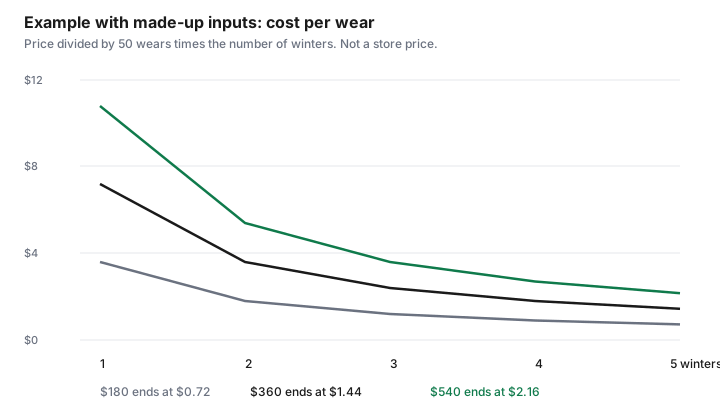
- Cost per wear is the price, plus repairs you pay, divided by wears you get. The chart uses made-up prices and 50 wears a winter.
- Fall has the sizes. Late winter has what is left. A warranty is whatever the terms say.
Match the coat to your winter: commute, car, dog walks, extreme cold
Start with a week, not a province. A Toronto sidewalk commute and a Winnipeg wait for a bus are both Canadian winters, and they are not the same coat problem. Write four lines: how many minutes you are outside, whether you are moving or standing, how much wind you get, and whether a car does most of the trip. A coat that lives on a car seat from the door to the office is doing less work than a coat on a 25-minute walk. Dog walks add standing still. Extreme cold, the days your city actually gets, is a different garment from a shoulder-season shell.
One household can own two layers instead of one hero coat: a shell for wet wind and a warmer coat for the coldest month. That is a cost-per-wear choice, because two garments you use can beat one you leave on the hook. Heat in the house is a different bill. The heating guide does not choose a parka. A coat you replace every few years belongs in a sinking fund, beside the other irregular bills, so November is not a credit-card surprise.
Down fill power, synthetic insulation and wool: what the labels mean
Read the fibre-content label and the insulation line separately. Down is a fill. The label may print a fill-power number and a fill weight. This guide does not cite a lab standard that converts fill power into degrees. Treat fill power as the loft claim on that label: more space for the same weight of down, on the test they used. Fill weight is how much of that down is actually in the coat. A high fill-power number with very little fill is not a warm coat. Two brands' numbers are not lined up here.
Synthetic insulation still works when it is wet, which is the reason it shows up in slush and freezing rain. It is often bulkier for the same warmth, and the label should say what it is. Wool, in a coating or a liner, handles damp differently again and follows its own care label. Do not wash down, synthetic fill, and wool on one habit. The cold-water laundry guide is about washer energy, not a coat recipe. If the care label is silent, ask the seller before you guess.
| Insulation | What the label can tell you | What it costs you in care | When it fits |
|---|---|---|---|
| Down | A fill-power number, if printed, and a fill weight if the brand shows it | Usually a specific wash and a long dry. Wet down loses loft until it is dry. | Dry cold, including a walking commute, if the shell blocks wind. A poor match for all-day slush unless the shell is doing the waterproof work. |
| Synthetic | The fibre name, not a fill-power scale | Often easier to wash. It can pack down over years. | Wet cold, car-to-door, and dog walks in freezing rain. |
| Wool | Fibre content, sometimes a blend percent on the textile label | Follow the care label. Wool, down, and synthetic fill do not share one wash. | Cool, damp days and a mid-layer under a shell. It is not automatically an extreme-cold coat. |
Temperature ratings are marketing: how to read them sceptically
A hangtag that says the coat is comfortable to a minus figure is the maker's claim. This guide does not cite a standard that makes those figures comparable across brands, so it does not call them a single national test, and it does not treat them as interchangeable. They vary by brand. Use them as a hint about which of that brand's coats is the warmer one, then test the hint against your week.
Read the claim next to the conditions. Standing at a bus stop in wind is colder than walking. A rating that assumes you are moving will feel optimistic on a platform. If the tag does not say what the person was doing, how long, or what they wore underneath, you do not have a temperature. You have a slogan. Try the coat over the layers you will actually wear, in the store, and use the return window if the week proves the tag wrong. That window is the return guide, not a warmth guarantee.
Features worth paying for (hood, length, wind layer) and ones that aren't
Pay for the feature that fails on your week. A hood matters in wind and snow if you will not wear a separate hat every day. A longer hem matters when you sit on a cold seat or stand in a wind that finds your waist. A shell that blocks wind matters more than a logo. Pockets you can use with gloves matter if you actually carry keys and a phone outside. A two-way zipper matters if you sit in a car and the coat bunches.
Skip what you will not use. A dozen pockets, a colourway, and a removable piece you will lose are not warmth. Fur trim is not insulation. A temperature rating printed in a larger font is not a feature. If two coats match your week and one is cheaper because it lacks a hood you need, the cheaper one is the expensive mistake. If the missing feature is one you do not use, take the simpler coat.
Cost per wear: a worked example across 5 winters
Example with made-up inputs. Cost per wear is the price divided by the number of wears. The chart uses three prices, $180, $360 and $540, and 50 wears each winter for five winters. Those prices are not Marks, Costco, or anyone else's ticket. At 50 wears a winter, five winters is 250 wears. $180 divided by 250 is $0.72. $360 divided by 250 is $1.44. $540 divided by 250 is $2.16. The expensive coat is still more per wear if you wear all three the same number of times. It wins only if you wear it more, or the cheap one dies sooner, or you add a repair to the cheap one.
The worksheet adds a repair so you can see the difference. Example with made-up inputs: a $360 coat, five winters, 50 wears a winter, and an $40 repair you actually pay, is $400 divided by 250 wears, or $1.60. If you only wear it 20 times a winter, five winters is 100 wears and the same $400 is $4.00 a wear. The blank row is yours. A coat you do not wear is the costly one, at any ticket.
| Row | Price | Winters | Wears per winter | Repair you pay | Cost per wear |
|---|---|---|---|---|---|
| Example | $360 | 5 | 50 | $40 | $1.60 |
| Same coat, worn less | $360 | 5 | 20 | $40 | $4.00 |
| Your coat |
When to buy (fall vs late winter) and how to handle warranties and repairs
Fall is when the size run is there and you can try the coat over a sweater. Late winter is when unsold stock is what remains. This page does not state a percent off for either moment. If you already need the coat, waiting for a clearance that may not include your size is the risk. The timing choice, including Black Friday and Boxing Day 2026, is on the sale-weekend guide and the month-by-month calendar. A price adjustment, if the banner offers one, is the adjustment guide. Read that banner's exclusions before you assume a January price comes back to you.
A warranty is the text on the hangtag or the receipt, not a vibe. Read who pays for a zipper, whether down leakage is included, how many years, and whether a store repair is required. This guide does not quote a warranty from Marks, Costco, or any other seller. Get a written repair price before you replace a coat that still fits. A repair you will not bother to book is not a saving. A repair that costs more than another five winters of wears is not a saving either. Use the worksheet.
Sources & date stamps
- Marks homepage, marks.com/en.html, checked 29 Sep 2026. No coat price, fill-power chart, or warranty term was quoted.
- Costco.ca homepage, checked 29 Sep 2026. No coat price or warranty term was quoted.
- Ratings are described as varying by brand.
- The cost-per-wear rows are example arithmetic on made-up inputs, labelled as such.
Frequently asked questions
How warm a coat do I need for a Canadian winter?
Match the coat to the winter you actually stand in. A walk to the bus, a car commute, a dog walk, and a day outside in extreme cold are different jobs, and one household can need two answers. A temperature number on a hangtag is not a national standard this page can convert into Celsius. If the label's number and your week do not describe the same day, the number is not the decision.
What does down fill power mean?
If the label prints a fill-power number, read it as that label's loft figure, not as a temperature. A higher number, on the test that brand used, means the down takes more space for its weight. It does not tell you the fill weight, which is how much down is in the coat. This guide does not cite a standard that turns fill power into a Canadian temperature, so two coats with the same number are not treated as equal here.
Are temperature ratings on coats reliable?
They vary by brand and they are not comparable on this page. Use the rating as the maker's claim about its own test, then judge the coat by the day you will wear it, the wind, and whether you stand still or walk. A rating is not a refund policy.
Is it cheaper to buy a coat in the fall or late winter?
Fall usually has the sizes. Late winter is when unsold coats are still on the floor, and your size may already be gone. Which one is cheaper in dollars depends on the ticket you see that year, and this page does not state a typical percent off. If you need the coat for the cold that is already here, a missing size is the expensive outcome. The sale calendar is the timing page.
Can a winter coat be repaired instead of replaced?
Often the useful question is a written repair quote against the price of a replacement, not a slogan. A zipper, a seam, or a patch can be cheaper than another coat, and a warranty can make the repair the maker's cost if the terms say so. Read the warranty before you rely on it. This guide does not cite a national repair price.