
Household Items and Supplies · Canada
Black Friday and Cyber Monday 2026 in Canada: How to Tell a Real Deal From a Fake Discount
This post contains Amazon.ca affiliate links. If you buy through them, Saving Optimizer may earn a commission at no extra cost to you.
A real Black Friday or Cyber Monday deal in Canada is one where the price you pay is lower than what the item has actually sold for over the past several months, not just lower than the crossed-out "regular" price on the tag. In 2026, Black Friday is Friday 27 November and Cyber Monday is Monday 30 November. Before either day, write down the items you actually need, record their current prices, and look at each one's price history. The Competition Bureau says a regular price used to claim a saving must pass a volume test or a time test, so a "was" price that the item rarely sold at is a red flag. Pay with a method you can dispute, keep the receipt, and note each store's price-adjustment and return windows.
Key takeaways
- Black Friday is 27 Nov 2026 and Cyber Monday is 30 Nov 2026; Boxing Day is Saturday 26 Dec.
- Compare the sale price with the item's price history, not with the crossed-out price.
- A genuine regular price must meet the Competition Bureau's volume test or time test.
- Resetting countdown timers and false low-stock claims can be misleading under the law.
- Mandatory non-government fees must be in the advertised price (drip pricing rules).
- Example with made-up inputs: a 40% off tag that saves 12% against the real recent price.
The 2026 dates and how the days differ
| Day | 2026 date | What it usually means |
|---|---|---|
| Black Friday | Friday 27 Nov | Store and online flyers, often starting earlier in the week |
| Cyber Monday | Monday 30 Nov | Mostly online offers; some extend Black Friday prices |
| Giving Tuesday | Tuesday 1 Dec | Charity giving day, not a sale |
| Boxing Day | Saturday 26 Dec | Clearance after the holidays, often running into the next week |
Many retailers now run "Black Friday" pricing for a week or longer, and some start in early November. That spread is useful: if you see the same price for days, there is no reason to rush at midnight. The days are also not interchangeable by product. Our product guides compare Black Friday with Boxing Day category by category, so you can decide whether to buy now or wait.
What the law says a regular price must be
When a store shows "Regular $100, now $50", the $100 has to be real. The Competition Bureau explains that a regular price used to claim savings must meet one of two tests. Under the volume test, more than 50% of sales of the product were at that price or higher within a reasonable period, usually within a year, before or after the promotion. Under the time test, the product was offered for sale in good faith at that price or higher for a substantial period, usually within a year, immediately before or after the promotion. If neither test is met, the discount claim can be considered misleading.
You cannot see a store's sales records, so you cannot apply these tests yourself. What you can do is look for the warning signs: a "was" price you never saw the item sell at, a "list price" from a manufacturer no one charges, or a savings claim such as "up to 70% off" with no reference price at all. The Bureau's page on fake sales lists past settlements over price claims, including Hudson's Bay ($4.5 million) and Amazon ($1.1 million), which shows the rules are enforced.
Fake urgency, bait and switch, and hidden fees
- Countdown timers: the Bureau describes timers that run out or reset while the offer stays available as a possible false urgency cue.
- Low-stock claims: "Only 2 left" or "5 other shoppers are looking" messages that never change can be misleading.
- Bait and switch: a heavily advertised price on an item that is out of stock, or only available at full price, when you try to buy it.
- Drip pricing: the Bureau says a price you cannot actually pay, because mandatory fixed fees are added later, is a false or misleading representation. Only amounts imposed by government, such as sales tax, are exempt.
If a deal relies on pressure, slow down. A real price will usually still be there tomorrow, or will come back on Boxing Day.
How to tell a real deal: a five-step routine
- Make a short list now. Write down the items you were going to buy anyway in the next few months, with the model number, not just the product type: for example, an Instant Pot Duo 7-in-1, 6 quart, not just "a pressure cooker."
- Record today's price. Note the price at two or three stores. Do this in October and early November, before the flyers arrive.
- Look at the price history. For Amazon.ca listings, free price-history sites such as Keepa or camelcamelcamel show past prices. For other stores, save screenshots or set price alerts. Our guides on tracking electronics prices and tracking Amazon.ca prices walk through the setup.
- Compare like with like. Black Friday TVs and laptops are sometimes special model numbers with lower specs. Match the exact model and the warranty before comparing.
- Decide your buy price in advance. If the sale price is at or below the lowest price you have seen in recent months, buy. If not, wait for Boxing Day or the next sale.
Black Friday or Boxing Day? Pick by product
There is no single best day. These guides compare the two by category:
| Category | Guide |
|---|---|
| Phones, laptops, headphones | Black Friday vs Boxing Day for tech |
| TVs | Buying a TV on Black Friday |
| Appliances | Black Friday vs Boxing Day for appliances |
| Clothing and winter gear | Black Friday vs Boxing Day for clothing |
| Beauty and gift sets | Beauty deals on both days |
| Phone plans | Black Friday phone plan deals |
| Video games and consoles | Video game deals |
Price adjustments, returns and delivery
Buying early is less risky when you know what happens if the price drops. Some retailers will refund the difference within a set window, and some exclude Black Friday, Cyber Monday and Boxing Day prices from their guarantees. Our price adjustment guide compares the published windows by retailer. Holiday return windows are often extended, but not always for electronics; see holiday electronics returns and holiday clothing returns.
For online orders, Ontario's Consumer Protection Act says goods must be delivered within 30 days of the promised delivery date or you can ask for a refund, although keeping a late item means giving up that refund right. Other provinces have their own consumer laws, so check your province's consumer protection office if an order goes wrong.
Pay in a way that protects you
- Use a credit card you pay in full, so a dispute is possible if an order never arrives. Do not carry a balance to chase a discount; card interest wipes out most savings.
- Watch for buy-now-pay-later offers that make a big purchase feel smaller. The total is the same, and missed payments can cost more.
- Stack savings only where the rules allow, such as discounted gift cards or cash-back portals. See stacking tech savings.
- Keep every receipt and order confirmation in one email folder until the return and adjustment windows close.
Example with made-up inputs
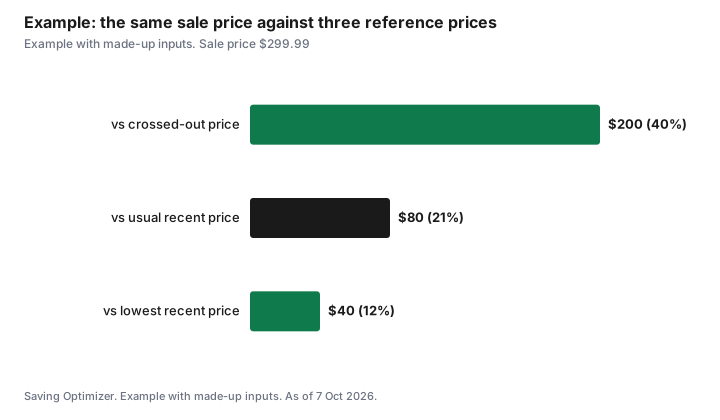
These numbers are an example with made-up inputs. A cordless vacuum shows "Was $499.99, now $299.99, save 40%". Over the previous four months the shopper saw it at $449.99 once, $379.99 for most weeks and $339.99 during a fall sale. Against the price it actually sold at most of the time, the real saving is $80, or about 21%. Against the lowest recent price, the saving is $40, or about 12%. It is still a reasonable buy if the vacuum was already on the list, but it is not the 40% the tag suggests.
| Reference price | Amount | Saving at $299.99 |
|---|---|---|
| Crossed-out "was" price | $499.99 | $200.00 (40%) |
| Usual recent price | $379.99 | $80.00 (21%) |
| Lowest recent price | $339.99 | $40.00 (12%) |
Common mistakes
- Buying something you did not need because the discount looked large.
- Comparing a Black Friday model with a different, better-equipped model at another store.
- Ignoring shipping, setup or restocking fees that change the total.
- Missing the return window because holiday shopping started in early November.
- Paying with a card balance you cannot clear by the statement due date.
If a discount looks fake
Take screenshots of the price, the "was" price, the date and the web address. Ask the retailer to explain the regular price. If you think the claim is misleading, you can file a complaint with the Competition Bureau using its online form. A complaint does not get you a refund, but it helps the Bureau spot patterns. For a refund or delivery problem, start with the retailer, then your card issuer, then your province's consumer protection office.
Sources
- Competition Bureau Canada, Ordinary selling price (volume test and time test), competition-bureau.canada.ca, as of 7 Oct 2026.
- Competition Bureau Canada, Fake sales and discounts (urgency cues, bait and switch, listed settlements), competition-bureau.canada.ca, page dated 13 Dec 2024, as of 7 Oct 2026.
- Competition Bureau Canada, Misleading representations and deceptive marketing practices (drip pricing), competition-bureau.canada.ca, as of 7 Oct 2026.
- Government of Ontario, Your rights under the Consumer Protection Act (delivery within 30 days of the promised date), ontario.ca, updated 1 Apr 2025, as of 7 Oct 2026.
- 2026 calendar dates for Black Friday, Cyber Monday, Giving Tuesday and Boxing Day, as of 7 Oct 2026.
- Prices, reference prices and savings in the worked example are made-up inputs.
Frequently asked questions
When is Black Friday 2026 in Canada?
Black Friday is Friday 27 November 2026 and Cyber Monday is Monday 30 November 2026. Many retailers start their sales earlier in the week or month.
How can I tell if a Black Friday deal is real?
Compare the sale price with the item's recent price history at more than one store. If the price is at or below the lowest price it has sold for in recent months, it is likely a real deal.
What does the law say about regular prices in Canada?
The Competition Bureau says a regular price used to claim savings must meet the volume test (more than 50% of sales at that price or higher within a reasonable period) or the time test (offered in good faith at that price or higher for a substantial period).
Is Black Friday or Boxing Day better in Canada?
It depends on the product. Use the category guides linked on this page for tech, TVs, appliances, clothing, beauty, phone plans and video games.
Are countdown timers on deals legal?
A timer is not illegal in itself, but the Competition Bureau says timers that reset while the offer stays available can be a misleading urgency cue.
What if my Black Friday order arrives late?
In Ontario, the Consumer Protection Act says goods must arrive within 30 days of the promised delivery date or you can ask for a refund. Contact the retailer first, then your card issuer.
Researched and drafted with AI assistance and fact-checked against official Canadian sources. How we create content.
Disclosure: This page contains Amazon.ca affiliate links. As an Amazon Associate, Saving Optimizer earns from qualifying purchases. Education only, not financial or legal advice.