Travel · Canada
Caribbean from Canada on a Budget: Packages, Shoulder Season, and Hidden Resort Fees
A Caribbean week from Canada is sold as a single number. The number is the charter, the room, and the buffet. It is not the premium drinks, the catamaran, the photo desk, the Wi-Fi tier, the tip envelope, or the transfer you assumed was inside. Households who compare islands by that headline pick a destination before they have a trip.
This page is the Canada-origin version of that decision: gateways Canadians actually fly, tour operators who bundle the week, and Canadian dollars. It is not a Florida drive-to-the-port guide. Cancun math stays on the Mexico package guide. Travel medical stays on the Insurance guide. Put the same policy beside every column so it does not pretend to be part of the resort.
Disclosure: Sun-destination package quotes are an offer type. Saving Optimizer may earn a commission if we later add partner links. We do not claim a partnership with any airline, tour operator, or resort. Dollar examples below are a labelled sketch, not a live package. Education only.
Key takeaways
- Compare Cuba, the Dominican Republic, and Jamaica on nonstops, passport rules, and how you pay on property. Do not crown a cheapest island from a headline.
- All-inclusive still leaves out premium drinks, excursions, photo packages, and sometimes Wi-Fi. Tips are extra unless the quote says gratuities are included.
- In a labelled seven-night sketch for two adults, the package all-in was about $3,310 and flight-plus-resort was about $3,370. A cheaper public room rate flipped it.
- Air Canada Vacations’ terms let eligible Caribbean packages booked 46 or more days out use a deposit shown at checkout, with the balance due at least 45 days before departure. Your operator’s PDF is the clock.
- A resort credit is worth the eligible spend you would have made before it expires, not the face value on the offer.
- 1 June through 30 November is Atlantic hurricane season. A September discount is also a disruption risk. Read cancellation wording before you deposit.
Compare Cuba, Dominican Republic, Jamaica, and other common Canadian gateways fairly
The fair comparison is not “which island is trending.” It is which airport you can reach without a self-connection, what the passport page actually requires, and whether the money in your pocket works at the front desk. Toronto, Montreal, and, on many winter weeks, Calgary and Vancouver have leisure nonstops into Cayo Coco, Varadero, Punta Cana, Puerto Plata, and Montego Bay. A city with one weekly flight is a different product from a city with a daily charter. If the only DIY itinerary connects in the United States on two tickets, you have bought a missed-connection problem. That risk is the passenger-rights guide, and it belongs in the destination choice.
| Question | Cuba | Dominican Republic | Jamaica | Other Canadian sun gateways |
|---|---|---|---|---|
| Why Canadians end up here | Winter leisure nonstops and a package market. Not a U.S. road trip. | Punta Cana and Puerto Plata are built for the same charter pattern. | Montego Bay is the usual leisure airport. Kingston is a different trip. | Bahamas, Aruba, Curaçao, St. Lucia. Nonstops are thinner from some cities. Cancun is the Mexico guide. |
| Passport, on travel.gc.ca | Valid for the expected stay. Canadian tourists need a visa, generally up to 90 days. An online customs form can be completed as early as 72 hours before entry. | The page says tourism entry through 31 Dec 2026 can use a passport valid for the stay, and also says a regular passport must be valid six months after arrival. Non-tourism travel is the six-month rule. Treat both lines as live and ask the airline. | Valid for the expected stay. Visitor status is generally 90 days. Officers may ask for a return ticket and proof of funds. | Open that country’s travel.gc.ca page. Do not copy Jamaica’s rule onto Aruba. |
| Money on property | Card and cash acceptance is a known friction. Read the Cuba page and ask the operator what the resort takes before you pack a stack of U.S. dollars “just in case.” | Resorts often quote and charge in U.S. dollars. Your CAD cost is the FX method, not the menu price. | U.S. dollars and Jamaican dollars both show up. Same FX habit. | Same question: which currency hits the card on the last night? |
| Storm calendar | Atlantic basin, 1 June–30 November. | Same season. A southern coast is not a promise. | Same season. | Aruba, Bonaire, and Curaçao sit south of the typical track. They are not storm-proof. Check the forecast anyway. |
Dual citizens have a separate Cuba rule on the same travel.gc.ca page: a person who is Canadian and Cuban presents a Cuban passport to enter Cuba and needs a valid Canadian passport to come home. Being born in Cuba can add steps even if you do not think of yourself as a dual citizen. That is a reason to read the page before a deposit, not after a denied boarding.
Ask one inclusion question that changes the island ranking: is the Cuban tourist card inside the operator’s total? A DIY fare that looks $80 cheaper and then sells you the card at the airport was not $80 cheaper. The Dominican Republic wants an e-ticket before you board. Jamaica accepts an online form or a landing card. None of those forms are the vacation. Forgetting one of them is how a cheap week starts at the airline desk.
What “all-inclusive” still excludes: premium drinks, excursions, photos, Wi-Fi
House wine, domestic beer, and the buffet are what the word usually means. The desk beside the lobby is the rest of the bill. Read the quote for four lines, and write an allowance for any line that says “extra,” “premium,” or “not included.”
- Premium drinks. Top-shelf brands, some imports, and mini-bar restocks are a second bar. If you will drink what is included, the allowance is zero. If you will not, write a number you believe. The sketch below uses $180 CAD for two adults for the week. That is not a resort rule.
- Excursions. A catamaran, a waterfall, a golf tee time. Operator add-ons and resort desks are different prices for the same hour on a boat. The sketch uses $240 CAD for one outing for two. Decline it and the line is zero on both the package column and the do-it-yourself column.
- Photos. The photo team is optional. There is no honest universal price. If you do not want the package, write zero and keep walking. If you know you will buy it, use the price on that resort’s sheet, not a guess from this page.
- Wi-Fi. Basic access is often included and a faster tier is not. If the quote is silent, ask. Silence is not “free and fast.”
- Tips. Same planning sketch as the Mexico guide: USD $10 per adult per day, only if gratuities are not included. Two adults, seven days, is USD $140. At a placeholder 1.36 CAD per USD (not a live rate; convert the day you travel) that is about $190 CAD. Do not add it twice if the PDF says gratuities are included.
A resort fee in the U.S. hotel sense, a nightly charge posted after the room rate, is less common on a true Canadian charter package because the room is inside the operator total. It reappears when you book a hotel rate that looks like a package and then adds a facility fee, a mandatory energy charge, or a “government fee” the first screen hid. Ask for the all-in resort total in one currency before you compare it with the charter.
Flight-only + resort vs tour-operator package after transfers
Hold the dates, the party, and the room category still. Then build two columns. The package column starts from the operator total. The flight-plus-resort column starts from a cash fare you can buy, a bag the fare actually includes, the resort’s public rate converted to CAD, and a transfer. Shared resort shuttles are not free because a blog said the airport is close.
Bags move the flight column by more than people expect. Air Canada’s Economy Basic fare, on tickets from 3 January 2025, is a personal item rather than a standard carry-on on many routes to the Caribbean. The bag-fee guide has the sizes. A fare that is $70 cheaper and then checks two bags at the airport is not the fare you compare with a package that already includes a suitcase.
| Line | Tour-operator package | Flight-only + resort |
|---|---|---|
| Flights, bags included as you will travel | Inside the $2,700 | $1,120 |
| Room and included food and drinks | Inside the $2,700 | $1,480 after tax and FX |
| Transfers, both ways | Included in this sketch. Confirm yours. | $160 shared shuttle for two |
| Premium-drink allowance | $180 | $180, same week, same habits |
| One excursion | $240 | $240 |
| Tips, if not included | about $190 | about $190 |
| Total before medical | about $3,310 | about $3,370 |
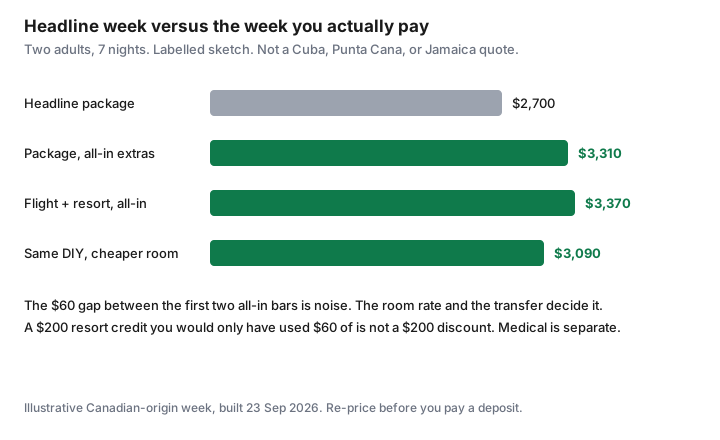
The two all-in totals are $60 apart. That is not a victory for packages. It is a sign the sketch is sensitive. Drop the resort line from $1,480 to $1,200, which is $280, and flight-plus-resort becomes 1,120 + 1,200 + 160 + 180 + 240 + 190 = $3,090, under the package. Raise the cash flights because the only nonstop is the charter, and the package wins by more than $60. Write your lines. The booking-window guide is how you test the cash fare. It is not a reason to buy a Basic ticket you cannot put a suitcase on.
Hurricane-season discounts vs travel disruption risk
The Atlantic hurricane season runs from 1 June through 30 November. Canadian sun demand does not follow that calendar. Christmas through March break is the expensive season because schools and the cold line up, not because storms are impossible. May and early June, and September through November, are when package and cash prices often fall. September is also the month Expedia’s 2026 Canada figures flag as cheaper for international flying. That signal is unpacked on the shoulder-season month guide. It is an average, not a promise that your Punta Cana week will be 26% off.
A discount in September or October is a trade. You are buying a week inside the season when storms form, and you are often buying it when teens are back in class, which is why the hotel will deal. The save is real if you can move, if the cancellation wording returns money you care about, and if you would still be glad you went in heavy rain. The save is fake if the deposit is forfeited when a storm watches the coast and you will not travel into that.
Read three lines on the quote before you call a shoulder week cheap: the date the balance is due, what “hurricane” or “travel advisory” means in that operator’s words, and whether a future-travel credit is the only remedy. Trip-cancellation cover and travel medical are not decided on this page. Provincial plans pay a thin daily amount abroad. The Insurance guide, why those caps are not a policy, is where that premium gets chosen. Put the premium beside the package and beside flight-plus-resort. Do not let the resort checkbox be the only time you see it.
If your only week off is March break, stop hunting a September rate. Compare package and flight-plus-resort inside March break. The shoulder method does not create a week your household does not have.
CAD budgeting: deposits, final payment FX, and resort credit maths
Canadian operators usually take a deposit in Canadian dollars and a balance later, also in Canadian dollars. That is the easy case: the FX is inside their price, and your job is the due date. Air Canada Vacations’ terms, as read for this page, say you can book eligible online packages, flight-and-hotel packages, and tours to the Caribbean (and to Mexico, Central America, the United States, Canada, and Europe) with a deposit when you book 46 or more days before departure. The deposit varies by package and is shown at checkout. The rest is due at least 45 days before departure. Miss that date and the operator can cancel. Do not inherit a dollar figure from a blog that says every deposit is $250. The checkout screen is the deposit.
Other operators use other clocks. Final payment at 45 days, 60 days, or on a cruise line’s own schedule are all normal. Write the date in the household calendar the day you deposit, and set the reminder before the email reminder. A balance that hits a card in the same week as a property-tax instalment is a cashflow problem, not a vacation problem.
FX shows up in three places:
- The operator invoice is in CAD. You are done on the package itself. On-property extras in USD still convert.
- The resort or a foreign OTA charges USD on the final-payment date. The CAD amount moves between deposit and balance. A planning buffer of a few percent of that foreign balance is a sketch, not a hedge. Convert with the method in the FX guide the week the charge will post.
- The deposit was quoted in CAD and the contract says the balance follows a USD package price. Read that sentence twice. It is how a “locked” week unlocks.
Resort credit maths is a cap, not a coupon. Value equals the smaller of the credit and the eligible spend you would have made before it expires.
Worked sketch: a $200 USD credit, good for spa and premium drinks, expires at checkout, cannot be applied to the room rate you already paid. You would have bought one massage at $80 USD and no premium drinks. The credit is worth $80, not $200. At the same placeholder 1.36, that is about $109 CAD. If the room that includes the credit costs $150 CAD more than the room without it, you paid $150 to receive $109 of spend you already wanted. Take the cheaper room. If you were going to spend the full $200 on a spa day you had already planned, the credit is worth $200 and the dearer room can win. Write the spend before you see the credit. The credit should not invent the massage.
Family vs couple templates with realistic daily spend
A couple and a family of four are different trips that get sold with the same adjective. Use the family per-day sheet for seats and a second room. Then keep the Caribbean extras honest: kids do not drink the premium bar, and a teen who will not stay on property does not make an all-inclusive cheaper.
| Line | Couple, package path | Four people, two adults and two teens |
|---|---|---|
| Headline package, flights and transfers in | $2,700 | $5,400 |
| Premium drinks | $180 | $180, adults only, if that is the habit |
| One paid outing | $240 | $360 for four. Zero if the beach is the outing. |
| Tips, USD $10 per adult per day at 1.36 | about $190 | about $190, unless you also tip for the teens. Add that only if you will. |
| Total before medical | about $3,310 | about $6,130 |
| Per person per night | about $236 | about $219 |
The family per-person figure is lower in this sketch because the flights and the room did not double when the party did, and because the teens are not on the premium-drink line. It rises fast if the resort sells a second room, if each person needs a paid seat with a bag, or if the “free” kids’ club starts at an age your children are not. Read the ages. A club that starts at four does nothing for a toddler. A 16-year-old who wants a town does not extract buffet value.
Daily spend on property, beyond the package, is those extra lines divided by nights, not a second grocery budget. Couple extras are $180 + $240 + $190 = $610 over seven nights, about $87 a night for the pair, on top of a package that already feeds them. If that $87 is the part you will not spend, delete the lines and the headline is closer to the truth. If you will spend it, the headline was the advertisement.
Deposit only when one column wins on the total and on a sentence about the day: everyone on the property, or breakfast and then out. A cheaper island you will not enjoy is not the save. A dearer nonstop that includes the meals you will actually eat can be. Passports that fail a six-month check belong to the renewal checklist before either column gets a card number.
Sources & date stamps
- Labelled sketch on this page — $2,700 and $5,400 headline packages, USD $10 per adult per day tips at a placeholder 1.36 CAD per USD, excursion and premium-drink allowances as shown. Not a live operator quote. Built 23 Sep 2026.
- Global Affairs Canada, travel.gc.ca pages for Cuba, the Dominican Republic, and Jamaica — passport validity, Cuban tourist visa, Dominican e-ticket, Jamaica visitor status. Used 23 Sep 2026. The Dominican page states both a tourism validity exception through 31 Dec 2026 and a six-month rule. Re-read it.
- Air Canada Vacations terms — deposit shown at checkout on eligible packages booked 46 or more days before departure; balance at least 45 days before departure. Used 23 Sep 2026. Other operators differ.
- Atlantic hurricane season, 1 June–30 November — the standard basin calendar used by the U.S. National Hurricane Center. A discount inside those dates is a weather decision as well as a price decision.
- Saving Optimizer Mexico, FX, bag-fee, booking-window, and family-budget guides — cross-used for method, not as a second set of island prices.
Frequently asked questions
Is a Caribbean package from Canada cheaper than booking the flight and resort yourself?
Sometimes, and often by less than the headline suggests. In the labelled seven-night sketch for two adults, the package all-in was about $3,310 and flight-plus-resort was about $3,370. A room $280 cheaper flipped flight-plus-resort to about $3,090. Price the same dates. The sketch is not a quote.
What does all-inclusive still leave off the bill?
Premium brands of alcohol, excursions, photo packages, and sometimes a faster Wi-Fi tier. Tips are extra unless the quote says gratuities are included. A resort credit is worth only the eligible spend you would have made before it expires.
Which Caribbean island is cheapest from Canada?
There is no standing winner among Cuba, the Dominican Republic, and Jamaica. Compare nonstop access from your airport, what the quote includes, passport rules on travel.gc.ca, and how you will pay on property. A connection plus a cheap room can lose to a dearer nonstop package.
Are September and October Caribbean deals worth the hurricane risk?
They can be the cheap weeks, and they sit inside the Atlantic hurricane season, which runs from 1 June through 30 November. Read the cancellation wording and travel.gc.ca before you treat a discount as found money. Travel medical and trip cancellation are Insurance decisions, not resort amenities.
When is the balance due on a Canadian sun package?
It is on your quote. Air Canada Vacations’ terms, read for this page, allow a deposit on eligible Caribbean packages booked at least 46 days out, with the remaining balance due at least 45 days before departure. The deposit amount is whatever checkout shows. If the final charge is in U.S. dollars, the Canadian-dollar total can move.