
Food & Groceries · Canada
Flashfood vs Too Good To Go vs FoodHero: which surplus app saves Canadians more?
Canadians install one surplus app, get a mediocre surprise bag of sad muffins, and conclude the category “doesn’t work.” That is a category error. Chooser apps (Flashfood, FoodHero) and surprise bags (Too Good To Go) do different jobs. Use the first to cheapen proteins and dairy you already cook. Use the second as an optional bakery or lunch. Do not evaluate a grocery system by a random restaurant bag.
Disclosure: These apps are not natural affiliate products. Meal-kit trials are a contrast option some households use when surplus meat is unreliable. Saving Optimizer may earn a commission if we later add kit or portal links. We do not currently claim partnerships with Flashfood, Too Good To Go, FoodHero, or meal-kit brands.
Key takeaways
- Flashfood ≈ Loblaw chooser. FoodHero ≈ Sobeys-family chooser (coverage varies). TGTG ≈ restaurants and bakeries, with some grocery bags.
- Pay attention to fees and to food you can freeze the same night.
- Loblaw reported that its Flashfood partnership saved customers more than $58 million in 2025 (news release 2 Mar 2026) — that is an aggregate, not your household.
- Skip pickups when the drive costs more than the discount.
- Stack with loyalty on the rest of the cart, not as a reason to tour three neighbourhoods.
Chooser vs surprise bag: different jobs
A chooser lets you tap specific SKUs: chicken thighs, yogurt, a bag of carrots. You can meal-plan around it. A surprise bag is a price for mystery contents, often near closing time. Mystery food is a poor input to a family dinner chart. It is a fine input to breakfast if you like day-old pastry.
Households that “tried surplus once” usually tried a surprise bag. Households that save on meat every week usually live near a Flashfood or FoodHero store and freeze on landing.
Store partners and city coverage patterns
Coverage is the whole game. Check the map before you download a personality.
- Flashfood: Canadian grocery identity is Loblaw banners. Urban and suburban density is highest where those banners are dense (southern Ontario, parts of the West and Quebec via Maxi/Provigo).
- FoodHero: Quebec-born; often discussed alongside Sobeys, IGA, and Foodland. Some cities have more FoodHero pins than Flashfood, some the reverse. Do not assume national parity.
- Too Good To Go: restaurants, cafés, grocery bakeries. Excellent downtown; thin in many suburbs after 8 p.m. if you are not already out.
Atlantic Canada, the territories, and smaller prairie cities can be sparse. If the map is empty, this article is not a reason to drive an hour.
Fees, value math, and waste risk
| Flashfood | FoodHero | Too Good To Go | |
|---|---|---|---|
| Job | Choose grocery SKUs | Choose grocery SKUs | Surprise bag |
| Typical discount claim | Up to ~50% off listed | Often ~30–50% off listed | Often ~50%+ vs stated retail value |
| Fee pattern | Service fee, historically a % capped near $2.99 | Per-order fee commonly reported (~$1.79) | Usually in the bag price |
| Waste risk | Produce on last day; meat if you delay freezing | Similar; some users report more frozen meat | Food you will not eat; duplicate bakery |
| Meal planning | Strong | Strong | Weak for dinners |
Worked example (labelled): Flashfood chicken listed at $9 versus $18 in-store, plus an assumed $2.99 fee cap on a larger order. If this is the only item, a percentage fee on $9 is small; if you add dairy you will finish, the fee is shared. If the produce is slime tomorrow, the “50% off” was compost.
Too Good To Go “retail value” is the merchant’s stated number. Treat it as marketing, not a Statistics Canada price. Pay the bag price, eat the food, or don’t buy it.
Best use cases for each app
- Flashfood: weekly protein top-up at a No Frills or Superstore you already visit. Freeze the night you pick up.
- FoodHero: same job where Sobeys-family stores are your discounter or your second stop.
- TGTG: bakery for weekend breakfast, or a lunch downtown after work. Not a family meal plan.
Stacking apps with loyalty programs
In-app surplus payments often will not earn or redeem PC Optimum or Scene+ the way a regular grocery till does. Shop surplus as a mini-cart, then walk the rest of the store with your list and scan loyalty there. Do not skip the loyalty load because you saved $6 on yogurt.
Card note: some users report Amex working in Flashfood, which can matter if you use a grocery-accelerated Amex elsewhere. Loblaw stores themselves often still will not take Amex at the main till. Confirm at checkout.
Travel-time calculator: when to skip a pickup
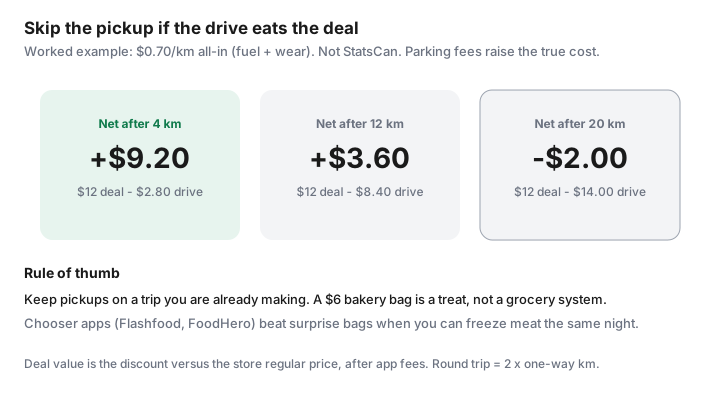
Rule: if you would not have made the trip for a $10 errand, do not make it for a $10 bag. Transit users should count extra fares and time, not kilometres.
Recommendation matrix by household type
| Household | First app | Skip when |
|---|---|---|
| Family near No Frills / Superstore | Flashfood, freeze meat | Only bakery bags left |
| Family near Sobeys / IGA / Foodland | FoodHero | Fee > discount on tiny orders |
| Couple downtown | TGTG lunches + one chooser | Bags you will not finish |
| Rural / small city | Whatever the map shows | Any dedicated drive over ~15 minutes |
| Meal-kit curious | Chooser apps first | Kits as a backup week, not a lifestyle |
Put the check on Sunday inside the weekly grocery system. Surplus is a side quest. The list is the main quest.
Sources & date stamps
- Loblaw news release, 2 Mar 2026: Flashfood partnership saved customers more than $58 million in 2025; more than 21 million pounds diverted that year (company figures).
- Flashfood and FoodHero public product pages (partner positioning; reviewed Sep 2026).
- Community reports (r/SavingsCanada and Canadian personal-finance blogs, 2025–2026) on fees and coverage — directional, not official fee schedules.
Frequently asked questions
Is Flashfood only for Loblaw stores?
In Canada, Flashfood’s grocery footprint is widely tied to Loblaw banners (No Frills, Superstore, Maxi, Zehrs, Provigo, Wholesale Club, and others). Coverage is store-by-store — check the map in the app.
Does Too Good To Go replace grocery shopping?
Usually no. In many Canadian cities TGTG is strongest for bakery and restaurant surprise bags. That can replace a treat or a lunch, not a week of dinners.
What fees should I expect?
Flashfood charges a service fee (publicly described as a percentage of the order, capped around $2.99 — the displayed rate has changed; check checkout). FoodHero users often report a per-order fee (around $1.79 in recent community reports). TGTG typically folds cost into the bag price. Fees change — read the live checkout.
Can I use loyalty points on surplus apps?
Often not on the in-app payment. You can still shop the rest of the store and scan PC Optimum or Scene+ for those items. Treat surplus as a separate small cart.
When should I skip a pickup?
When round-trip driving, parking, and the risk of unusable food exceed the discount after fees. Keep pickups on a trip you are already making.