
Kids · Canada
Halloween on a Budget in Canada: Costumes, Candy and Swaps
Halloween on a budget in Canada starts with one number for the whole night, split into three lines: costumes, candy, and decor. Halloween 2026 falls on Saturday 31 October, so trick-or-treating, parties and a weekend costume rush land on the same day. Decide the total before you walk into a seasonal aisle, reuse or swap costumes first, buy candy by the count you need rather than by the bag, and keep decorations to what you will store and reuse. Health Canada's costume safety points cost nothing and belong on the same list.
Key takeaways
- Halloween 2026 is Saturday 31 October. Set one total for the night, then split it into costumes, candy and decor.
- Costumes: reuse, swap or build from clothes you own before you buy. Health Canada suggests bright colours, reflective tape, and makeup instead of masks that block vision.
- Candy: estimate how many pieces you hand out, then compare cost per piece, not cost per bag.
- Decor: LED candles are on Health Canada's list for jack-o'-lanterns. Buy only what you will store for next year.
- Example with made-up inputs: a $120 plan for two kids comes in at $63 with a swap and a candy count.
Set one total for the night first
A seasonal aisle is laid out to sell the extras: the light-up prop, the second costume, the bag of novelty candy you did not plan for. A total written down before you shop gives each extra a place to go, which is usually off the list.
Write three lines under the total. Costumes covers every child and any adult who dresses up, including accessories and makeup. Candy covers what you hand out at the door plus anything for a class or a party. Decor covers pumpkins, lights and props. If one line runs over, another line gives up the difference. That is the whole system.
Because 31 October is a Saturday this year, check the calendar for school parades, daycare parties and community events in the week before. Each one can ask for a costume or a treat. Add them to the plan now, so a Thursday note home does not become a second costume purchase.
| Line | What goes in it | Cheapest first move |
|---|---|---|
| Costumes | Each child's costume, accessories, makeup, a warm layer underneath | Reuse, swap, or build from clothes you own |
| Candy | Door handout, class or party treats | Count the pieces you need, then compare cost per piece |
| Decor | Pumpkins, lights, props, candles | Reuse last year's, add one piece at most, choose LED over open flame |
Costumes: reuse, swap or build before you buy
The cheapest costume is the one already in the house. Last year's costume can fit a younger sibling. A dress-up bin often holds most of a new idea. Clothes the child already wears can carry a costume with one accessory: a plain black outfit becomes a cat, a ninja or a bat with ears or a mask drawn in face paint.
Swaps work well because children outgrow costumes long before they wear them out. Ask in a school or daycare parent group, a neighbourhood buy-nothing group, or a community centre that runs a swap. Bring one costume, take one costume. Thrift stores and consignment shops are the next stop. A store-bought costume is the last stop, not the first.
Health Canada's Halloween safety page has a short costume list, and none of it costs money. Avoid flowing skirts, capes, baggy sleeves and oversized pieces near candles. Nylon or heavyweight polyester are less likely to catch fire, and flame-resistant does not mean fire-proof. Pick bright colours and add reflective tape so drivers can see your child. Use makeup or face paint instead of a mask that can interfere with vision or breathing, and do a patch test first, because products labelled hypoallergenic can still cause reactions. Health Canada also says not to use contact lenses that change eye colour or create special effects. Choose a costume that fits over warm clothing, since late October can be cold and wet in much of Canada.
Before you buy a costume or a string of lights, Health Canada suggests checking its Recalls and Safety Alerts database. It takes a minute and it is free.
Candy: count the pieces, then compare cost per piece
Candy is the line that runs over most often, because a bag looks like a unit and it is not. The useful unit is a piece. Estimate how many pieces you will hand out: last year's leftovers, how busy your street was, and whether you plan to give one piece or two per child. Then divide each bag's price by the number of pieces printed on it.
Compare two bags on the shelf by cost per piece, not by the price tag. A bag that costs more can be cheaper per piece if it holds more. Store brands and multi-packs are worth checking, and a grocery store's flyer week can line up with the last weekend of October. Buy close to the date if you know the household will eat the candy early.
When the porch light goes off, the plan is over. Leftover candy is not a reason to buy more next year; it is a sign the count was high. Write down the number you started with and the number left, so next year's estimate is better.
| Step | What to do |
|---|---|
| 1 | Estimate pieces needed: expected visitors times pieces per visitor |
| 2 | Divide each bag's shelf price by the piece count printed on the bag |
| 3 | Buy the lowest cost per piece that meets your count and any allergy needs |
| 4 | After the night, write down pieces left so next year's count is closer |
Decor: buy only what you will store
Decorations are the line most likely to become clutter. Start with what you already have from last year. If you add something, add one piece you will store and use again, not a single-use prop.
Health Canada suggests LED candles or lights in jack-o'-lanterns and decorations instead of open flames, and keeping candles, matches and lighters out of children's reach. Battery candles are reusable, so they belong on the store-and-reuse list. Turning on outdoor lights helps visitors see your steps.
Pumpkins are food as well as decor. If you carve one, roast the seeds. If you buy a pie pumpkin for cooking and a carving pumpkin for the porch, put both on the decor line so the grocery budget does not absorb the second one.
Example with made-up inputs: a $120 plan for two kids
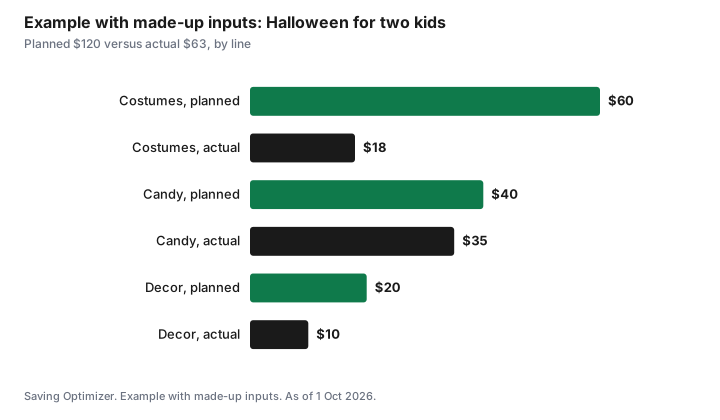
These numbers are an example with made-up inputs. They are not store prices. A household plans $120 for two kids: $60 for costumes, $40 for candy and $20 for decor.
Child one swaps last year's costume at a school swap: $0. Child two builds a costume from clothes at home plus a $12 accessory and $6 of face paint. Costumes come to $18. The household counts 120 pieces of candy and buys two made-up bags that cover the count at $35. Decor reuses last year's lights and adds a $10 set of battery candles. The total is $63, against a plan of $120.
| Line | Planned | Actual |
|---|---|---|
| Costumes | $60 | $18 |
| Candy | $40 | $35 |
| Decor | $20 | $10 |
| Total | $120 | $63 |
After the night
Wash and store costumes that can be reused or swapped next year. Put reusable decor in one labelled box. If your store marks down leftover Halloween stock after the date, buy only items that are on next year's list and that you will store, such as LED candles or makeup with a long shelf life. A markdown on something you did not plan to buy is still spending.
The rest of the season has its own budget. Use the kids' holiday gift budget for December, and keep Halloween separate so it does not quietly eat into it.
Sources
- Health Canada, Halloween safety, canada.ca, as of 1 Oct 2026. Costume fabric and fit, flame-resistant is not fire-proof, bright colours and reflective tape, makeup instead of masks, patch test, no special-effect contact lenses, LED or battery candles, keep matches and lighters out of reach.
- Health Canada, Staying safe on Halloween, Recalls and Safety Alerts, as of 1 Oct 2026. Check the recalls database for costumes, decorations and accessories.
- Health Canada, Use cosmetics safely, as of 1 Oct 2026. Patch test steps for cosmetics.
- Calendar: 31 October 2026 is a Saturday.
- The $120 plan, the $63 total, and every amount in the example table and chart are an example with made-up inputs.
Frequently asked questions
When is Halloween in 2026 in Canada?
Halloween 2026 is Saturday 31 October. Because it falls on a weekend, check the week before for school parades, daycare parties and community events that may ask for a costume or treats, and add them to your plan.
How can I get a cheap Halloween costume for my child in Canada?
Start with what you have: last year's costume, a dress-up bin, or everyday clothes plus one accessory and face paint. Then try a costume swap through a school, daycare, community centre or buy-nothing group, and thrift or consignment stores. Buy a new costume last.
What does Health Canada say about Halloween costume safety?
Health Canada suggests avoiding flowing or oversized pieces near candles, choosing nylon or heavyweight polyester, picking bright colours with reflective tape, and using makeup or face paint instead of masks that block vision or breathing. It recommends a patch test for makeup and says not to use special-effect contact lenses. Check its Recalls and Safety Alerts database before buying.
How much Halloween candy should I buy?
Estimate how many children usually come to your door and how many pieces you give each one, then buy that count. Compare bags by cost per piece, using the price and piece count printed on each bag. Write down how many pieces are left afterwards so next year's estimate is closer.
Are after-Halloween sales worth it?
Only for items on next year's list that you will store, such as LED candles or reusable decor. A markdown on something you did not plan to buy is still spending, and candy bought to save money often gets eaten instead.
Researched and drafted with AI assistance and fact-checked against official Canadian sources. How we create content.
Disclosure: Saving Optimizer may earn a commission if a partner link is added later. No partnership is claimed on this page, and no store, brand or product is ranked. Education only. This is not safety certification advice; follow Health Canada and product labels.