
Insurance · Canada
Shared Vehicle Insurance in Canada: Two Households, One Car, Fewer Surprises

When two households share one car, tell the insurer exactly how it is used. Insure it at the address where it is mostly kept, list every regular driver, and name the person who drives it most as the principal operator. Then agree in writing on how you split the premium, deductible and any surcharge after a claim.
Key takeaways
- Insurance generally follows the car, so the owner's policy usually pays first.
- List every regular driver and the true principal operator.
- Use the address where the car is mostly kept.
- Misstating a driver or address can void a claim.
- Write down how you split premiums, deductibles and surcharges.
Who pays in a claim
| Setup | What to tell the insurer | Risk if you don't |
|---|---|---|
| Co-owners, different addresses | Where the car is kept and both drivers | Claim denied for misrepresentation |
| One owner, regular second driver | List them as a driver | Claim denied or surcharged |
| Occasional borrower | Ask whether they need listing | Gaps in coverage |
| Peer-to-peer car share | Use the platform's coverage | Personal policy may exclude it |
Provincial differences
In BC, Manitoba and Saskatchewan, basic coverage comes from the government insurer; BC's Basic Autoplan includes $200,000 in third-party liability. In Ontario, Alberta and Atlantic Canada, you buy from private insurers and rates vary more.
Your sharing agreement
- Who pays the premium and how it is split.
- Who pays the deductible after an accident.
- How a surcharge is shared at renewal.
- Who covers a rental if the car is in the shop.
- What happens if one household moves.
Splitting the premium: an example
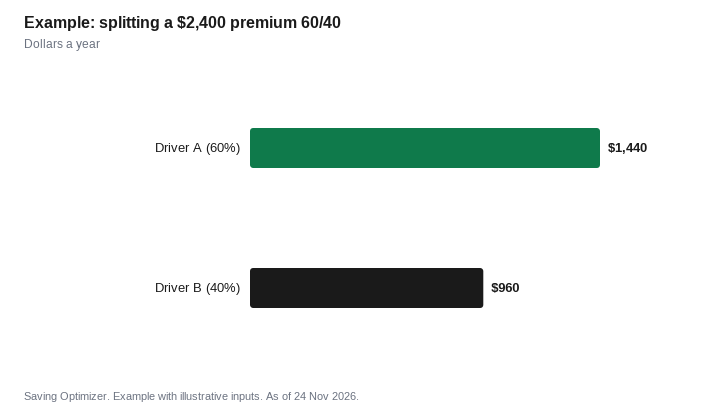
Example: a $2,400 yearly premium split by kilometres driven, 60/40, is $1,440 and $960. If the 40% driver causes a claim, they could also pay the deductible and any surcharge.
See cutting your premium, car rental vs car share and ICBC vs private coverage.
Sources
- Insurance Bureau of Canada, Mandatory auto insurance requirements, checked 24 Nov 2026.
- Financial Services Regulatory Authority of Ontario, Auto insurance, checked 24 Nov 2026.
Frequently asked questions
Can two households share one car insurance policy?
Yes, if the insurer knows where the car is kept and who drives it.
Whose insurance pays if a friend crashes my car?
Insurance generally follows the car, so the owner's policy usually responds first.
What happens if I don't list a regular driver?
The insurer could deny a claim or cancel the policy.
Does car sharing on an app use my insurance?
Peer-to-peer platforms usually provide their own coverage; check before you list.
How should we split the premium?
By usage, written down, with a plan for deductibles and surcharges.
Researched and drafted with AI assistance and fact-checked against official Canadian sources. How we create content.
Note: Not insurance or legal advice. Check your policy wording. Amounts are examples. Education only.