
Events · Canada
Special Occasion Permits in Ontario: When You Need One and the Cost
In Ontario you do not need a special occasion permit to serve alcohol to invited guests in your own home or another private place, but you usually do for a private party at a rented hall, park or other venue that is not already licensed. The Alcohol and Gaming Commission of Ontario (AGCO) charges $50 a day for a no-sale permit, used when drinks are free, and $150 a day for a sale permit, used when guests pay for drinks in any way, including a cash bar, drink tickets or an admission fee. Check first whether your venue has a liquor sales licence that covers your event; if it does, you need no permit. Apply online through iAGCO at least 10 days before the event.
Key takeaways
- No permit for invited guests at home or in a private place that is not rented out.
- No-sale permit: $50 a day. Sale permit: $150 a day.
- Any charge for alcohol, including tickets or admission, needs a sale permit.
- Liquor cannot be sold at a residence.
- Usually approved in one day, but allow 10 days; outdoor events need 30 to 60 days' notice to the municipality.
- Example with made-up inputs: a 60-guest anniversary party.
Do you need a permit?
| Situation | Permit? | Why |
|---|---|---|
| Free drinks for invited guests at your home | No | Your home is a private place |
| Free drinks at a rented community hall that has no liquor licence | Yes, no-sale ($50/day) | A rented hall is not a private place |
| Cash bar or drink tickets at a rented hall | Yes, sale ($150/day) | Guests pay for alcohol |
| Party at a restaurant or banquet hall with a liquor sales licence | No | The venue's licence covers it |
| Party in a park | Yes, plus a city booking | Parks need a permit and municipal notice |
| Fundraiser or advertised event | Public event permit | Private permits cannot be used to raise money |
The AGCO lists stag and does, bridal showers, wedding receptions, anniversary parties, birthday parties and funeral receptions as examples of private events, meaning the guest list is by invitation only, the event is not advertised, and you are not trying to make money from alcohol. A private place is an indoor place where the public would not normally be and that is not rented out to the public, such as a home or a company's private boardroom.
No-sale versus sale permits
A no-sale permit is for serving alcohol at no charge. You cannot charge for alcohol directly, or indirectly by selling tickets or charging an admission fee. A sale permit is for any event where you collect money for alcohol, such as a cash bar, drink tickets or money collected beforehand. The AGCO says any money from sales can only go toward the cost of the alcohol. If you want to advertise, raise money or make money, you need a public event permit instead, which has the same $50 and $150 daily fees.
What the application asks for
- The name of the person responsible for the event, and the event name and details.
- Dates and start and end times, which must fall between 9 a.m. and 2 a.m. the next day, or 3 a.m. on New Year's Eve.
- The location, expected attendance and the location's capacity. For outdoor areas, the AGCO says to divide the permit area by 12 square feet, or 1.11 square metres, per person.
- Whether liquor will be sold.
- For outdoor events: notification letters to municipal building, clerk, police, fire and health authorities, and a sketch of the boundaries.
Timing
The AGCO says most private event permits are issued in one day, but some take up to 10 days, and processing starts only once your application is complete. It asks applicants to apply at least 10 days before the event. If your event needs notice to municipal authorities, such as an outdoor party, that notice is due at least 30 days and up to 60 days before, depending on the municipality. Book the venue first, because the permit is tied to a location.
Buying the alcohol and running the event
Your permit has a number, which you give the cashier when you buy alcohol for the event. The AGCO points to the regulation for where you can buy it. As the permit holder you must follow the Registrar's standards and the Liquor Licence and Control Act, 2019. An AGCO inspector may visit, and for large events an inspector will contact you before the event to do a walkthrough. For events the AGCO considers higher risk, it may add conditions, such as limiting hours of service or restricting entry to people 19 and older. Breaking the rules can lead to a monetary penalty. Many halls also set their own conditions, such as requiring a licensed bartender or event insurance, so read the rental agreement.
Hall prices can change with alcohol
Some venues charge more when alcohol is served. Toronto's Ralph Thornton Community Centre, for example, lists its full auditorium at $104 an hour for private functions without alcohol and $157 an hour with alcohol, before HST, for 2026. Ask about this when you compare halls, because a higher room rate can cost more than the permit itself.
Example with made-up inputs
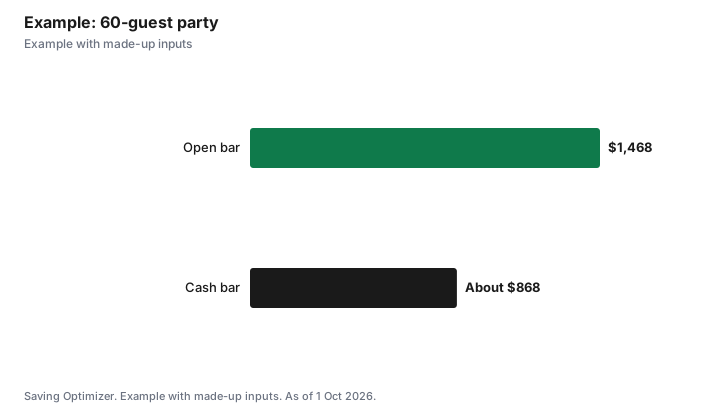
These numbers are an example with made-up inputs. The Patels host a 60-guest anniversary party for four hours at a community hall without a liquor licence. With an open bar, they need a $50 no-sale permit, and the hall charges its alcohol rate of $157 an hour, $628. Event insurance required by the hall is a made-up $90. Alcohol bought with the permit number is a made-up $700. Total: $1,468. With a cash bar priced to recover the alcohol cost, they would need a $150 sale permit, but guest payments could recover up to the $700 spent, for a net of about $868, before tax, if guests buy all of it.
| Item | Open bar | Cash bar |
|---|---|---|
| Permit | $50 | $150 |
| Hall, 4 hours at $157 | $628 | $628 |
| Insurance | $90 | $90 |
| Alcohol | $700 | $700 |
| Guest payments | $0 | Up to -$700 |
| Net cost | $1,468 | About $868 |
Steps
- Ask the venue whether its liquor licence covers your event.
- If not, decide whether drinks are free or paid.
- Book the venue and check its alcohol rules and rates.
- Notify municipal authorities 30 to 60 days ahead if the event is outdoors.
- Apply on iAGCO at least 10 days before the event.
- Buy alcohol using your permit number and keep receipts.
Common mistakes
- Charging admission at a no-sale event.
- Assuming a rented hall counts as a private place.
- Applying a few days before the event.
- Advertising a private event on social media.
- Ignoring the hall's own alcohol rules and insurance requirements.
Related: how much alcohol to buy and renting a hall.
Sources
- Alcohol and Gaming Commission of Ontario, Special occasion permits, agco.ca, as of 1 Oct 2026.
- Alcohol and Gaming Commission of Ontario, Apply to sell or serve alcohol at a private event, and at a general public event, agco.ca, as of 1 Oct 2026.
- Ralph Thornton Community Centre, Rates - Updated for 2026, ralphthornton.org, as of 1 Oct 2026.
- Insurance and alcohol amounts in the example are made-up inputs.
Frequently asked questions
Do I need a permit to serve alcohol at a party in Ontario?
Not at your own home or another private place. You usually need one at a rented venue unless the venue's liquor licence covers the event.
How much is a special occasion permit in Ontario?
$50 a day for a no-sale permit and $150 a day for a sale permit, for private and general public events.
Can I have a cash bar at a private party?
Yes, with a $150-a-day sale permit. Money collected can only go toward the cost of the alcohol.
How long does it take to get a special occasion permit?
Usually one day, but up to 10 days. The AGCO asks you to apply at least 10 days before the event.
What hours can alcohol be served under a permit?
Between 9 a.m. and 2 a.m. the next day, or 3 a.m. on New Year's Eve.
Can I sell alcohol at a party in my house?
No. The AGCO says liquor cannot be sold at a residence.
Researched and drafted with AI assistance and fact-checked against official Canadian sources. How we create content.
Disclosure: Saving Optimizer may earn a commission if a partner link is added later. No partnership is claimed on this page. Education only.