
Clothing · Canada
Stacking Clothing Savings in Canada: Cash-Back Portals, Discounted Gift Cards and Loyalty Points
A clothing cart can hold a sale price, a code, a gift card, a portal, points and a card reward at the same time. It can also hold a term that deletes the layer you cared about. The work is the order of the layers and the term that each one must pass, not a hunt for the largest percentage on a forum. This page is the clothing sequence. The Food guides own the portal walkthrough and the grocery gift-card shop. Rates change. Nothing here is a live rate, a ranking of portals, or a ranking of cards.
Disclosure: Cash-back portal offers and discounted retailer gift cards are offer types. Saving Optimizer may earn a commission if a partner link is added later. No partnership is claimed. A portal does not change a sale price, a code’s exclusions, or provincial gift-card rules. Education only.
Key takeaways
- Apply layers in this order: sale price, promo code, discounted gift card, cash-back portal, loyalty points, card rewards. Stop when the next term voids a larger layer.
- A code can void portal cash back. A gift card can be excluded from a tile, from a code, or from points. Read the tile on the day you buy. This page does not print a live cash-back rate.
- Points usually follow the amount you were charged, not the ticket before the sale. The Triangle and Scene+ household guide records how CT Money is calculated on eligible pre-tax spend. Confirm the clothing item on the offer.
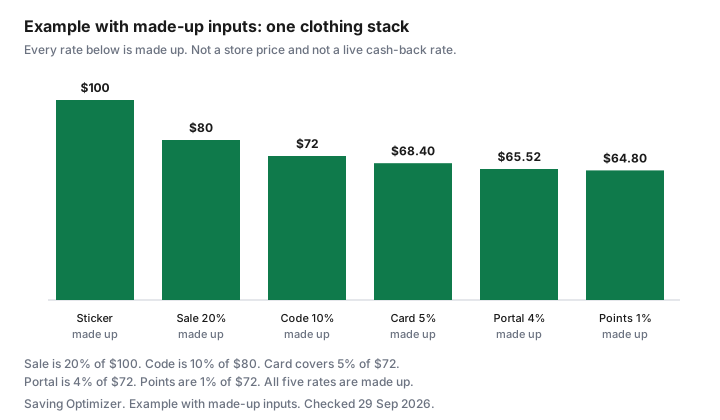
- The worked example is labelled made up. A $100 sticker becomes $64.80 only because every rate in that example is made up. It is not an average stack.
- Costco clothing has its own membership math on the Costco clothing guide. A portal does not replace it, and Costco.ca says gift cards are outside price adjustments and promotions.
The stacking order: sale, code, gift card, portal, points
Start with the price you would pay if you stopped. If the sale price is the item you want, in the size you want, the rest of the stack is optional. A code comes next because it changes the amount the store charges. A discounted gift card comes after the code, because you are buying the card for the amount the cart now shows, not for the original ticket. The portal is a click before you pay, on the merchant that will actually get the order. Points and a card reward are whatever the program calculates on the tender you used. They are not a reason to add a garment.
Each layer has a test. The sale price has to be the price of the same item, not a compare-at figure the tracking guide would fail. The code has to say it works with the sale, and it has to say whether it survives a portal. The gift card has to be accepted on that tender and has to be inside your province’s expiry rules, which the gifts guide lists for Ontario, Quebec and British Columbia. The portal tile has to name the merchant and the day. Points have to name the item as eligible. A card reward has to name clothing, or not exclude it, on the issuer’s terms. This page does not rank cards. The cash-back versus travel points guide is the household version of that choice.
| Layer | What it changes | Test before you count it |
|---|---|---|
| Sale price | The store’s price | Same item and size. A “was” price still has to meet the ordinary-price tests on the Competition Bureau page linked from the tracking guide. |
| Promo code | The store’s price again | The code’s own text: sale items, gift cards, and whether another offer voids it. The Old Navy and Gap Canada shipping-offer page keeps gift cards out of the merchandise total that qualifies for free shipping. |
| Discounted gift card | What you pay for the tender, not the store’s price | Face value covers the cart. Provincial expiry rules. The seller is identifiable. Check the portal tile if you also want cash back. |
| Cash-back portal | A later rebate, if the tile pays | Click through before you pay. A code or a gift card can be excluded. The Rakuten and Scene+ grocery guide shows how to read a tile. Use the clothing merchant’s tile, not a grocery one. |
| Loyalty points | Points on the eligible pre-tax amount | The offer lists the item. A lower pre-tax total means a lower base. See the Triangle guide for the household wording. Do not invent a clothing multiplier. |
| Card rewards | Whatever the issuer’s terms pay on that merchant | Read the certificate. No card is named or ranked here. Gift-card purchases are a common exclusion. Check the terms. |
Discounted gift card sources and their catches
The catch is not the discount. The catch is a card you cannot spend the way you planned. A mall card in Ontario or British Columbia can carry an activation fee up to $1.50 and, after 15 months, a dormancy fee up to $2.50 a month. A retail clothing card in Ontario generally cannot expire. Those rules are in the gifts guide, from the provincial pages checked 29 Sep 2026. A card sold at a discount can sit in a different bucket in British Columbia. Consumer Protection BC says gift cards that were sold at a discount, in the example of a business discounting its services or a certificate bought at an auction, are allowed to have an expiry date. Read that page against the card in your hand before you treat every discounted clothing card as expiry-proof.
The other catch is the portal. If the tile excludes gift cards, buying the card through the portal pays nothing, and buying the clothes with the card may also pay nothing if you did not click a clothing merchant. Pick one path and screenshot it. The grocery gift-card guide is the place for the gift-card shop as a product. This page does not reprint its rates.
Cash-back tracking failures and how to claim
Cash back fails for ordinary reasons: an ad blocker, a second tab, a code the tile did not list, a gift card, or an order placed on the phone after the click happened on a laptop. The fix is a record, not a second purchase. Before you pay, save the tile (merchant, rate, date, exclusions), the cart, and the confirmation number. If the purchase is missing, use the portal’s claim form inside the number of days that form prints. The grocery portal guide describes that habit for grocery-adjacent merchants. The same habit is the one to use for a clothing merchant. This page does not name a winning portal or a rate.
A return unwinds the stack. If you send the jacket back, expect the portal to reverse the cash back and the store to take any return fee. H&M Canada’s warehouse return is $3.99 on the page checked 29 Sep 2026. That fee is real. It is not part of the made-up chart below. Price adjustments are a third path: Costco’s 30-day rule is on the clothing price-adjustment guide. A portal does not extend it.
Loyalty programs worth joining (offer types only)
Join a program when you already shop that banner and the base earn is printed, not when a bonus email arrives. Triangle Rewards is the program attached to Canadian Tire, Sport Chek, Mark’s and the other banners named on the household guide. That guide, not this one, is where the base calculation is quoted. Scene+ and PC Optimum are offer types with their own terms. A clothing purchase earns only what the offer says. A one-time bonus that requires a category you will not buy is not a reason to join. No program is ranked here. No card is named.
Membership fees are a separate test. Costco’s membership is a fee with a satisfaction rule, described on the Costco clothing guide. Do not add a warehouse membership to collect a clothing portal rate you have not read. A free banner program is easier to leave. Read how to close it before you open it, and do not store a card number you do not need.
When stacking isn't worth the effort
Stop when the next layer is smaller than the chance it voids the previous one, or when it pushes you into a size you are unsure about. Bracketing two sizes to make a free-shipping threshold, then returning one, is the shipping and return-fee guide. Stacking does not fix a return fee. It can add a clawback on top.
Example with made-up inputs. The sticker is $100. None of the rates are a store’s rate or a portal’s rate. Sale, made up, 20 percent, leaves $80. Code, made up, 10 percent of $80, leaves $72. Gift card bought at a made-up 5 percent discount: you pay $68.40 for $72 of card value. Portal, made up, 4 percent of the $72 the store charged, is $2.88, so the net is $65.52. Points, made up, 1 percent of that $72, are $0.72, so the net is $64.80. If a real term deletes the portal because you used a code, you are back at $68.40 and the afternoon was wasted. If the points term pays on the pre-discount ticket, this example does not apply. Read the term.
| Layer | Made-up rate | Amount this step removes | What you have paid, net |
|---|---|---|---|
| Sticker | None | $0 | $100.00 |
| Sale | 20 percent | $20.00 | $80.00 |
| Code | 10 percent of $80 | $8.00 | $72.00 |
| Gift card discount | 5 percent of $72 | $3.60 | $68.40 |
| Portal | 4 percent of $72 | $2.88 | $65.52 |
| Points | 1 percent of $72 | $0.72 | $64.80 |
Sources & date stamps
- Old Navy / Gap Canada everyday free-shipping offer, checked 29 Sep 2026. Gift cards sit outside the merchandise total on that offer. The same page says no adjustments on previous purchases.
- Costco.ca price-adjustment answer, published 10 September 2025, checked 29 Sep 2026. All gift cards are not eligible for price adjustments or promotions.
- H&M Canada returns, checked 29 Sep 2026. Warehouse return $3.99. Cited only as a real fee that can undo a stack. It is not a bar on the chart.
- Ontario gift-card page, updated 14 August 2026, and Consumer Protection BC gift-card page, checked 29 Sep 2026. Mall-card fees and the B.C. note on cards sold at a discount. Full table is on the gifts guide.
- No cash-back portal rate and no card earn rate is cited on this page. Read the tile and the issuer’s terms on the day you pay.
Frequently asked questions
What is stacking and does it work on clothing?
Stacking is applying more than one saving to the same order, in an order the terms allow. A common sequence is the sale price, then a promo code, then a discounted gift card, then a cash-back portal, then loyalty points, then a card reward. It works on clothing only when each layer’s terms still apply to apparel and to the way you paid. A sale tag is not permission to add every other layer. This page does not quote a live portal rate and does not rank programs.
Do cash-back portals pay if I use a promo code?
Sometimes. Many tiles void the cash back when the code is not on the portal’s list. The grocery portal guide records that pattern for the tiles it reviewed. A clothing order needs the clothing tile, read the same day you buy. If the tile is silent, do not assume the code is safe. Screenshot the tile, the code, and the cart before you pay. If the cash back is missing, the portal’s missing-cash-back form is the claim path, and it has a deadline printed on that form.
Can I pay with a discounted gift card and still get cash back?
Only when both terms say yes. Some portal tiles exclude gift-card purchases. Some stores exclude gift cards from a code or from points. Costco’s Costco.ca price-adjustment answer, checked 29 September 2026, says all gift cards are not eligible for price adjustments or promotions. That is Costco’s rule, not a universal portal rule. Read the tile and the card. A discounted gift card is an offer type. No face-value discount is printed here.
Do points apply before or after discounts?
Read the program. Triangle Rewards, as the household guide records from the loyalty page it checked, calculates electronic Canadian Tire Money on the pre-tax amount of eligible merchandise. A code that lowers the pre-tax total lowers the base the points sit on. Do not assume points are calculated on the price before the sale. Mark’s and Sport Chek are in that family of banners. Whether a particular clothing item is eligible is on the offer, not on a category called clothing.
When does stacking stop being worth the effort?
When the next layer can void a larger one, when you would buy a size or a colour you do not need to make a code work, or when the time exceeds the gap. A made-up example later on this page shows a $100 order falling to $64.80 after made-up rates. If a real tile is 1 percent and the form takes an evening, the stack is a hobby. Pay the sale price and leave. Returns also unwind stacks. A portal clawback plus a return fee can erase the gap the chart looks so neat about.