
Weddings · Canada
Wedding Bands in Canada: Metals, Quality Marks, Prices and Matching Sets
Wedding band prices in Canada depend mostly on the metal, its purity, the band's weight and any stones. Under Canada's Precious Metals Marking Act, a quality mark such as 14K, 583 or PLAT is optional, but if a band carries one it must be truthful and paired with a Canadian trademark. Gold can be marked from 9K up, with 10K, 14K and 18K also shown as 417, 583 and 750 parts per thousand. Platinum and palladium marks need at least 95% of the metal, and sterling silver at least 925 parts per thousand. Plated bands are a different product: gold plated means a layer of at least 10K gold over another metal. Compare quotes by metal, purity and weight, not just price.
Key takeaways
- Quality marks are optional, but must be truthful and paired with a trademark.
- 10K, 14K, 18K = 417, 583, 750 parts gold per 1,000.
- Platinum and palladium: at least 95%. Sterling: at least 925 per 1,000.
- Plated and gold-filled bands are not solid gold.
- Get weight, metal and warranty terms in writing.
- Example with made-up inputs: a matching pair budget.
Metal choices and what the marks mean
| Metal | Mark examples | Minimum content |
|---|---|---|
| Gold | 9K and higher; 10K or 417; 14K or 583; 18K or 750 | As stated by karat |
| Sterling silver | Sterling, .925, 925 | 925 parts per 1,000 |
| Platinum | Platinum, PLAT | At least 95% platinum, or with iridium or ruthenium |
| Palladium | Palladium, Pall. | 95% palladium (90% in listed alloys) |
| Gold plated | Gold plated, G.E.P. | Plating of at least 10K gold |
| Gold filled | Gold filled, G.F. | At least 10K gold layer, at least 1/20 of total weight |
The Competition Bureau's guide also says the plating thickness may be marked in whole micrometres if at least 1 micrometre, and a dealer cannot mark a plated article with a guarantee that the plating will last for a period of time.
Tolerances
The guide sets tolerances for gold: a 14K band can be up to 3 parts per 1,000 below the stated quality where no solder is used, and 7 parts per 1,000 where solder is used. Platinum and palladium have no legal tolerance; the stated minimums apply. If a jeweller's description does not match the mark or the metal, you can complain to the Competition Bureau, and Ontario's Consumer Protection Act says misrepresentation, such as stating a product is a certain grade or quality when it isn't, lets you withdraw from the contract within one year.
How the metal choice affects price and wear
Higher karat gold contains more gold per gram, so an 18K band of the same weight contains more gold than a 14K band. A platinum mark requires at least 95% platinum. A wider or thicker band uses more metal. When comparing quotes, ask for the metal, the karat or purity, and the finished weight in grams; that lets you compare like with like. Ask about wear too: how the metal holds up to daily wear, whether a white gold band is plated for colour, and whether it will need re-plating or polishing over time. Get the jeweller's explanation in writing, since you can hold them to what they told you if it proves untrue.
Plain vs set bands
- Plain bands: simplest to resize and maintain.
- Half or full eternity bands with stones: the setting can limit or prevent resizing; ask before buying.
- Matching sets: a band shaped to sit beside an engagement ring; buy together or bring the engagement ring when ordering.
- Alternative metals such as tungsten, titanium or stainless steel are not precious metals under the Act; ask whether they can be resized or replaced if your size changes.
Resizing and warranties
Ask before you buy: whether resizing is free within a period, how many sizes up or down are possible, and whether it affects the warranty. Get the warranty terms in writing: what is covered (workmanship, stone loss, plating), for how long, and whether regular inspections are required. A warranty is not insurance; it does not cover loss or theft. Keep the original receipt, because warranty claims usually need proof of purchase.
Insuring the rings
Ask your home or tenant insurer whether jewellery is covered, the per-item limit, and whether a separate rider or appraisal is needed. Some wedding insurance policies include a short window of cover for bands: one Canadian policy wording covers wedding bands from seven days before the wedding until the end of the reception. For everyday cover after the wedding, ask about a home insurance rider or a separate jewellery policy; get an appraisal and keep receipts.
Tax note
The CRA's capital gains guide lists jewellery as listed personal property. Under the personal-use property rules, the CRA uses a minimum of $1,000 for both cost and proceeds of disposition. So if a band costs and sells for less than $1,000, there is generally no gain to report; above that, keep the receipt to show the cost.
Example with made-up inputs
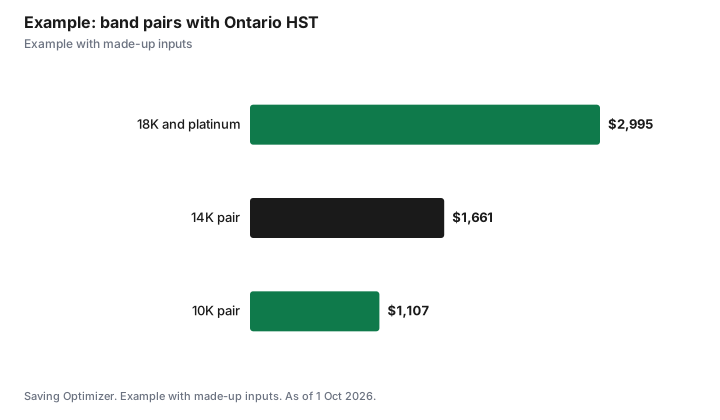
These numbers are an example with made-up inputs, apart from Ontario's 13% HST. Option A: two plain 14K bands at a made-up $650 and $820, $1,470 plus $191.10 HST = $1,661.10. Option B: an 18K band at $1,050 and a platinum band at $1,600, $2,650 plus $344.50 HST = $2,994.50. Option C: a 10K pair at $420 and $560, $980 plus $127.40 HST = $1,107.40. Engraving at a made-up $40 per ring would add $90.40 with HST.
| Option | Before tax | With HST |
|---|---|---|
| 10K pair | $980 | $1,107.40 |
| 14K pair | $1,470 | $1,661.10 |
| 18K and platinum | $2,650 | $2,994.50 |
Buying tips
- Shop for bands at least two to three months before the wedding to leave time for sizing and engraving.
- Try bands on more than once, at different times of day, before settling on a size.
- Bring the engagement ring if the band must sit beside it.
- Ask whether a matching pair is priced as a set.
- Keep the receipt, quality mark description and warranty together for insurance and resale.
Questions to ask the jeweller
- What is the metal, purity and finished weight?
- What quality mark and trademark will be stamped?
- Is the band solid, plated or filled?
- What does resizing cost, and is it possible with this design?
- What does the warranty cover and for how long?
- What is the return or exchange policy?
Common mistakes
- Comparing prices without the weight.
- Buying a plated band thinking it is solid gold.
- Choosing an eternity band that cannot be resized.
- Forgetting to insure the rings.
- Ordering too late for engraving.
Related: engagement ring budget and 2027 wedding budget.
Sources
- Competition Bureau Canada, Guide to the Precious Metals Marking Act and Regulations, as of 1 Oct 2026.
- Government of Ontario, Your rights under the Consumer Protection Act, ontario.ca, as of 1 Oct 2026.
- Canada Revenue Agency, Guide T4037 Capital Gains (personal-use and listed personal property); GST/HST rates, canada.ca, as of 1 Oct 2026.
- P.A.L. Insurance Brokers Canada, Weddinguard Wording, updated 1 Jun 2024, as of 1 Oct 2026.
- Ring prices and engraving amounts in the example are made-up inputs.
Frequently asked questions
What does 14K or 583 mean on a ring?
14K gold may be marked .583 (also 583) in Canada, meaning 583 parts gold per 1,000.
What is the minimum for a platinum mark in Canada?
At least 95% platinum, or platinum with iridium or ruthenium, with no legal tolerance.
Are quality marks required in Canada?
No, but if a quality mark is applied it must be truthful, in the prescribed form and accompanied by a Canadian trademark.
What does gold plated mean?
An article plated with gold of at least 10K over another metal. It is not solid gold.
Is there a tolerance for gold content?
Yes: 3 parts per 1,000 without solder and 7 parts per 1,000 with solder.
Do I pay tax when I sell my wedding ring?
Jewellery is listed personal property, and the CRA uses a $1,000 minimum for cost and proceeds.
Researched and drafted with AI assistance and fact-checked against official Canadian sources. How we create content.
Disclosure: Saving Optimizer may earn a commission if a partner link is added later. No partnership is claimed on this page. Education only.