
Housing · Canada
B.C. security deposits explained: caps, pet deposits, and getting your money back
Ontario habits follow people to Vancouver. They hand over first and last, skip the condition inspection, and then wonder why a half-month cap and a 15-day clock never entered the chat. The B.C. Residential Tenancy Branch is specific: a security deposit is no more than half of the first month’s rent, a pet damage deposit is a separate half-month maximum if pets are allowed, and a landlord cannot keep either on a vibe.
This is a cash-flow reading of the RTB deposits page (updated 4 Mar 2026; verified 20 Sep 2026). It is not legal advice and not a substitute for TRAC or the Branch.
Disclosure: There is no natural affiliate product in a B.C. deposit explainer. Saving Optimizer does not claim RTB, TRAC, or property-manager partnerships. Disputes need the Residential Tenancy Branch or a licensed advisor. This is not legal advice.
Key takeaways
- Security deposit ≤ half of first month’s rent. On $1,800 that is $900, not $1,800.
- Pet damage deposit ≤ another half month total, not per pet. No monthly pet fee. Guide/service dogs are not pets for this purpose.
- “First and last” is an Ontario import. Paying the deposit is treated as establishing the tenancy — do not e-transfer a stranger.
- Move-in and move-out RTB-27 inspections protect refunds. After a written forwarding address, the landlord has 15 days to return with interest, get written consent, or file.
- 2026 RTB deposit interest rate: 0%. Overpaid deposits can be withheld from next rent in writing — carefully.
Half-month security deposit cap and pet damage deposit basics
RTB example language: $1,500 rent → security deposit no more than $750. The cap is set by rent at the start of the tenancy; later increases do not automatically raise the deposit. If pets are allowed, the landlord can also collect a pet damage deposit up to half a month, regardless of how many pets. They cannot add a monthly pet fee. Certified guide and service dogs do not get a pet deposit.
If the landlord wants both deposits, the two halves can look like “a full month.” That is still not last month’s rent sitting in a jar. You cannot apply a deposit to rent without written permission.
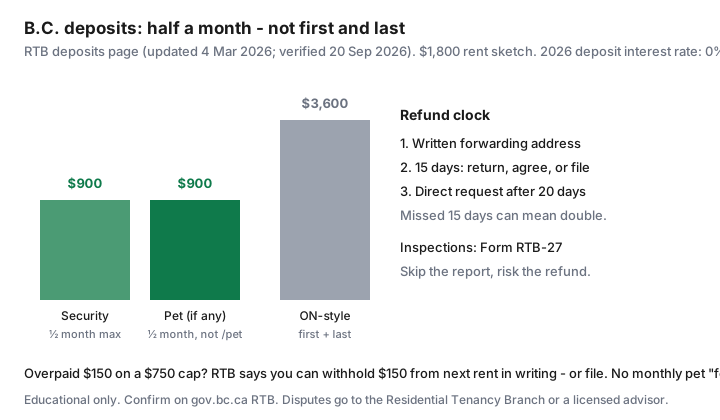
Why “first and last” is the wrong B.C. mental model
Last-month rent is an Ontario RTA category. In B.C., rent is rent, and the deposit is a capped trust-like hold. Paying it is how the Branch describes a tenancy as established — the landlord cannot then rent the unit to someone else and shrug. That is also why a Kijiji “send first and last to hold” message is both the wrong amount and a scam pattern. Use the three-province planner if you are moving between provinces.
Move-in/move-out inspection reports that protect refunds
Condition Inspection Report Form RTB-27 is the usual paper. Landlords must offer at least two chances to inspect, complete the report, sign, and give you a copy. Tenants who skip the inspection can lose deposit-claim rights; landlords who skip proper process can lose the right to claim against the deposit for damage. Photograph every room the same day, including the oven seal and the bathroom caulking. Wear-and-tear is not a redecorating invoice.
Timelines for deposit return and dispute pathways (high-level)
Give a written forwarding address (you generally have up to a year after the tenancy ends). From the later of move-out or receipt of that address, the landlord has 15 days to: return the deposit(s) plus interest; get your written agreement to deductions and return the rest; or apply to the RTB to keep some or all. They cannot just decide. If they do nothing, tenants can apply — a direct request is commonly available 20 days after the tenancy ends and the forwarding address is given, and an arbitrator may order double the deposit. Confirm current RTB direct-request rules before you file. This is not a filing kit.
Interest: RTB published 0% for 2026 (0.95% for 2025; 2.7% for 2024). Use their deposit interest calculator for mixed years. Interest is calculated on the full deposit before deductions.
Parking and storage fee increases vs rent increase limits
If parking or storage fees are in the tenancy agreement, RTB says those fees cannot exceed the annual allowable rent increase — 2.3% for 2026 (see the 2026 limit guide). Separate side agreements can be a different animal and a read-twice item. A $50 “parking hike” beside a 2.3% rent notice is how people pay an unofficial second increase. Late-rent fees, if used, cannot exceed $25 and must be in the agreement. Application fees are not allowed. Extra keys cannot exceed replacement cost and should be refunded on return.
How to deduct overcharged deposits carefully
RTB overpayment example: $1,500 rent, landlord takes $900 instead of $750. The tenant can withhold $150 from the next month’s rent after writing to the landlord, or file for dispute resolution if they do not want to self-help. Write the math. Keep the e-transfer. Do not withhold a random larger amount because you are angry. Hostile files belong at the Branch, not in a missing $400 that looks like unpaid rent.
Checklist for Vancouver and Victoria renters
| Before you pay | When you leave |
|---|---|
| See the unit; confirm legal suite / egress if it matters to you | Book RTB-27; take timestamped photos |
| Deposit ≤ ½ month (+ ½ pet if allowed) | Forwarding address in writing; keep proof of service |
| No application fee; no monthly pet fee | 15-day clock; do not wait six months to ask |
| Parking/storage: in the lease or a side letter? | Do not sign a deduction you do not agree with |
| Receipt or e-transfer screenshot | Direct request path if they ghost — confirm current RTB steps |
Victoria heritage walks-ups and Vancouver concrete both grow mould arguments. The inspection report is how you keep $900 that is yours. If you are still hunting, send a complete package instead of a larger deposit.
Sources & date stamps
- Government of B.C., Tenancy deposits and fees — half-month caps, pet rules, overpayment withholding, RTB-27, 15-day return, 20-day direct request, 2026 interest 0% (updated 4 Mar 2026; used 20 Sep 2026).
- Government of B.C., Rent increases — 2026 limit 2.3%; parking/storage in the agreement cannot outrun the annual limit (page updated 27 Aug 2026).
- RTB Policy Guideline 17 themes — return or retention of security deposits (read the current PDF for your facts).
- TRAC, Deposits — public tenant-education companion, not a ruling.
Frequently asked questions
How much can a B.C. landlord take as a security deposit?
No more than half of the first month’s rent. A pet damage deposit, if pets are allowed, can be up to another half month total. Guide and service dogs are not treated as pets for that deposit. Confirm on the RTB deposits page.
Is first and last month’s rent legal in B.C.?
That Ontario phrase is the wrong model. Rent is due as rent. The security deposit is capped at half a month. A landlord asking for a full extra month on a no-pet tenancy is asking above the usual cap.
How long does a landlord have to return my deposit?
After the tenancy ends and they have your forwarding address in writing, they generally have 15 days to return it with interest, get your written agreement to deductions, or apply to the RTB. Doing nothing can expose them to a double-deposit order. Confirm current direct-request timing (often 20 days).
The landlord charged more than half a month. Can I take it off rent?
RTB’s public page describes withholding the overpayment from the next month’s rent if you tell the landlord in writing, or applying for dispute resolution instead. Do not invent a larger set-off. This is not permission for your facts.
Is this legal advice?
No. It is a savings-oriented reading of RTB public pages. Use the Residential Tenancy Branch, TRAC, or a licensed lawyer for a dispute.