
Events · Canada
Lunar New Year 2027 Budget in Canada: Red Envelopes, Food and Visits
Lunar New Year 2027 falls on Saturday 6 February 2027, the start of the Year of the Goat, according to the Royal Observatory at Royal Museums Greenwich. Build the budget in this order: write your red envelope list by relationship and pick one amount per tier, then size the reunion dinner, visiting gifts and decorations around what is left. Red envelopes are usually the largest and least flexible line, so setting them first keeps the rest honest. Order new bills from your bank branch a few weeks ahead, and look for free public celebrations instead of paid outings.
Key takeaways
- Lunar New Year 2027: Saturday 6 February, the Year of the Goat.
- List red envelope recipients by tier and give the same amount within a tier.
- Ask your bank branch about new bills well before the week of the holiday.
- Reunion dinner at home usually costs far less per person than a set menu out.
- Reuse decorations; buy perishable flowers and fruit last.
- Example with made-up inputs: a $1,280 plan trimmed to $860 without dropping anyone.
The date and the season
The Royal Observatory notes that the date of Lunar New Year differs every year and gives Saturday 6 February 2027 for the Year of the Goat. Because it falls on a Saturday, many families will hold reunion dinner on the Friday evening and do visits over the weekend. Celebrations often continue for days afterwards, so budget for the whole period, not just one meal. If you plan to travel to see family, check your work schedule early and book before fares rise.
Red envelopes: set tiers first
Red envelopes, known by names such as lai see and hongbao, are given by many families, often to children and younger relatives. Customs and amounts vary between families and communities, so this guide does not prescribe numbers. What saves money is consistency: decide tiers and amounts once, write them down, and stick to them.
| Tier | Who | Count | Amount each | Subtotal |
|---|---|---|---|---|
| Close family children | Children, nieces, nephews | |||
| Wider family children | Cousins' children, friends' children | |||
| Elders | Parents, grandparents | |||
| Others | Staff, helpers, building workers | |||
| Spare envelopes | Unexpected visitors |
Keep a few spare envelopes for surprise visits. Many families prefer new, crisp bills; ask your bank branch what it can supply and when, because branches can run short close to the holiday. If you give by e-transfer to relatives far away, decide that in advance too, and include it in the total.
Reunion dinner
The reunion dinner is the main meal of the season. Hosting at home usually costs less per person than a restaurant set menu, but it takes time and a long shopping list. Shop in two trips: dry goods, frozen items and drinks a week or two ahead, and fresh fish, greens and fruit in the last two days. Ask relatives to bring a dish each to share costs.
| Line | Home | Restaurant set menu |
|---|---|---|
| Food | Groceries for the menu | Per-table price |
| Drinks | Bought retail | Restaurant prices or corkage |
| Tax and tip | Sales tax on some groceries only | Tax and tip on the bill |
| Leftovers | Several meals | Takeaway boxes |
| Time | Shopping, cooking, cleaning | Booking early |
For food safety with large meals, Health Canada advises keeping food out of the danger zone between 4°C and 60°C, refrigerating leftovers within two hours, eating them within two to three days and reheating to 74°C.
Visiting gifts, decorations and clothes
Visiting families often bring a gift such as fruit, sweets or a snack box. Decide on one standard gift and buy them together; buying ten of the same box is easier to price-compare than ten different gifts. Decorations such as banners, lanterns and couplets can be reused if you take them down carefully, so store them flat. Fresh flowers and plants are perishable; buy them last and only what you will display. New clothes are traditional for some families; set a cap per person or choose one new item rather than a full outfit.
Free public celebrations
Many cities hold public celebrations that cost nothing to attend. The City of Vancouver promoted the 52nd annual Chinatown Spring Festival Parade on Sunday 22 February 2026, starting at 11 am at the Millennium Gate and lasting about three hours, and encouraged people to walk, bike or take transit. Watch your city's events page and community associations for 2027 dates; organizers announce them closer to the season.
Example with made-up inputs: one household's plan
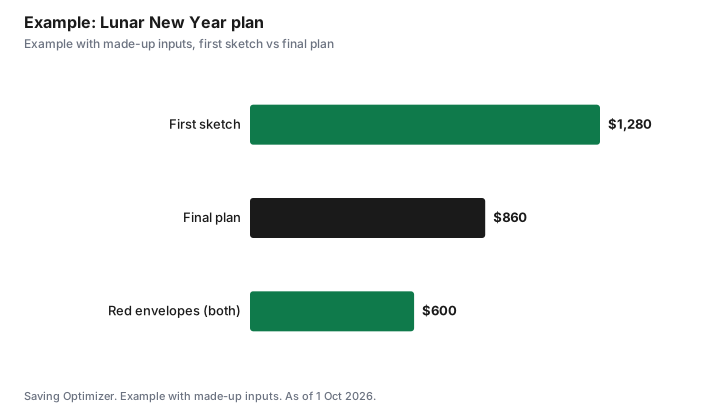
These numbers are an example with made-up inputs. They are not suggested red envelope amounts. A household first sketches $1,280: $600 in red envelopes, a $320 restaurant dinner for eight, $120 in visiting gifts, $60 in decorations, $80 in new clothes and $100 for a paid show. They keep the red envelope list exactly as planned at $600. They host dinner at home with relatives bringing dishes, for $140. They buy one standard fruit box for each visit, for $70, reuse last year's decorations and buy only fresh flowers for $20, limit new clothes to the children for $30, and go to a free parade instead of the show. The final plan is $860, a saving of $420, and nobody is dropped from the list.
| Line | First sketch | Final plan |
|---|---|---|
| Red envelopes | $600 | $600 |
| Reunion dinner | $320 (restaurant) | $140 (home, shared dishes) |
| Visiting gifts | $120 | $70 |
| Decorations and flowers | $60 | $20 |
| Clothes | $80 | $30 |
| Outing | $100 | $0 (free parade) |
| Total | $1,280 | $860 |
Notice where the saving came from: dinner and the outing account for $280 of the $420. Those are the lines with the most choice. Red envelopes stayed fixed because they matter most to the people receiving them, and cutting them would have saved money at the cost of the point of the holiday.
Keeping track
Use one note or spreadsheet for the season, with a column for planned and actual spending on each line. Put the red envelope list in the same file, with names, tiers and whether each envelope has been given. After the holiday, write down what you actually spent and what you would change; next year's budget then starts from real numbers instead of memory.
Steps
- Mark Saturday 6 February 2027 and decide which days you will host or visit.
- Write the red envelope list by tier with one amount per tier.
- Ask your bank branch about new bills a few weeks ahead.
- Choose home or restaurant for reunion dinner and book or shop early.
- Pick one standard visiting gift and buy in one trip.
- Reuse decorations and check your city's free events.
For other celebrations, see a Diwali budget and hosting a holiday party.
Sources
- Royal Museums Greenwich, Lunar New Year dates and animals of the zodiac, rmg.co.uk, as of 1 Oct 2026. Saturday 6 February 2027, Year of the Goat.
- City of Vancouver, 52nd annual Lunar New Year Parade, vancouver.ca, as of 1 Oct 2026. 22 February 2026 parade details.
- Health Canada, Safe food handling, canada.ca, as of 1 Oct 2026. Danger zone, two-hour rule, leftovers and reheating.
- All amounts in the example are an example with made-up inputs.
Frequently asked questions
When is Lunar New Year 2027?
Saturday 6 February 2027, the start of the Year of the Goat, according to the Royal Observatory at Royal Museums Greenwich.
How do I budget for red envelopes?
List recipients by tier, such as close family children, wider family children, elders and others, and set one amount per tier. Add a few spare envelopes for unexpected visitors.
Where can I get new bills for red envelopes?
Ask your bank branch what it can supply and when. Ask a few weeks ahead, because branches can run short close to the holiday.
Is a home reunion dinner cheaper than a restaurant?
Usually, especially if relatives each bring a dish. Compare groceries against the per-table price plus tax and tip.
Are there free Lunar New Year events in Canada?
Yes, many cities hold free public celebrations. The City of Vancouver promoted its 52nd Chinatown Spring Festival Parade on 22 February 2026; watch your city's events page for 2027 dates.
What is the biggest Lunar New Year expense?
For many households it is red envelopes, followed by the reunion dinner. Set the envelope list first, then size dinner, gifts and decorations around what is left.
Researched and drafted with AI assistance and fact-checked against official Canadian sources. How we create content.
Disclosure: Saving Optimizer may earn a commission if a partner link is added later, such as a grocery offer type. No partnership is claimed on this page. Education only.