
Subscriptions · Canada
Netflix Sharing in Canada: Extra Members, Household Rules, and Cheaper Alternatives
Netflix sharing in Canada is a household question with a price attached. The people who watch at the main home share the plan. A child who has moved out is a second household. Netflix will eventually say so on the TV. The legal path is an extra member you pay for, or their own account. The expensive path is keeping Premium all year so three ghost profiles stay logged in.
Plan prices used here are the Canadian figures reported with the January 2025 increase and still cited as unchanged for Canada on 23 Mar 2026: Standard with ads $7.99, Standard $18.99, Premium $23.99. They match the table in the rotation guide. Confirm the tier on your account the week you change it. Choosing Ignite TV versus a streaming stack is the Ignite guide, not this page.
Disclosure: This page has no natural affiliate offer. Education only. We do not claim a Netflix partnership. No card rankings.
Key takeaways
- A Netflix household is the devices at the main home where you watch. People outside that home need their own account or a paid extra member.
- Standard can buy one extra member. Premium can buy up to two. Standard with ads cannot buy one. The owner pays. The extra member gets their own login.
- January 2025 coverage of the Canada price change said extra-member fees stayed at $7.99. Read the live slot price on your account. A US help page is not your bill.
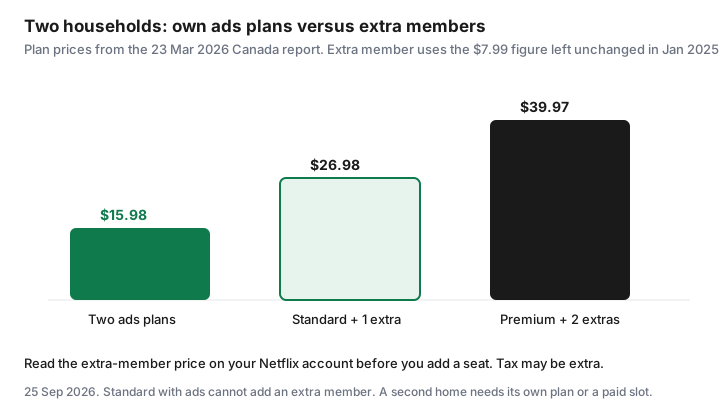
- Two homes on Standard with ads are $15.98. Standard plus one extra member at $7.99 is $26.98. Premium does not make the second home free.
- Remove the extra member the month they stop watching. Pair the seat with the streaming calendar so you are not paying for an empty profile and a second streamer.
Current Netflix household and Extra Member rules for Canada
Netflix’s help centre, read 25 Sep 2026, defines a household as the devices connected to the internet at the main place where you watch Netflix. You may not share the account outside that household. Someone who is not in the household creates their own account or is added as an extra member. The owner on Standard can add one extra member who does not live with them. The owner on Premium can add up to two. The extra member must be activated in the same country as the owner’s account. They get their own account and password. The owner pays and the owner adds or removes them.
Standard with ads cannot add an extra member. Some Netflix-included packages and third-party bills cannot either. Netflix tells you to open the help article for your package and read whether extra members are supported. Mobile-carrier billing is called out separately from other third-party billing on the extra-member page, so a phone-bill plan is not automatically the same as a TV-package plan. Open the membership page and see who the next charge belongs to before you promise a seat to anyone.
Travel with your own devices is not the same as a second living room that watches every week. Netflix’s rule is about the main home, not a ban on a hotel. A prompt that asks you to verify the household, or to buy an extra member, is the signal that a device is being treated as outside. Update the household from the home Wi-Fi when you are actually there. Do not ask the person in the other city to click through a code on your behalf every month. That is the sharing pattern the rule is aimed at.
Cost of Extra Member add-ons vs upgrading plan tiers
When Canadian prices moved in January 2025, Canadian Press reporting and iPhone in Canada said the extra-member fee did not change and remained $7.99 a month. On 26 Mar 2026, iPhone in Canada reported that a later US increase did not apply in Canada, leaving plan prices at $7.99, $18.99, and $23.99. The US Netflix help page, read 25 Sep 2026, now shows a with-ads extra member and a without-ads extra member in US dollars. Do not copy those US add-on prices onto a Canadian card. Open Manage extra members and use the CAD figure on that screen. The arithmetic below uses $7.99 so the comparison is visible, and it is labelled as that January 2025 unchanged fee.
| Setup | Monthly, before tax | What you are paying for |
|---|---|---|
| Standard with ads | $7.99 | One household. No extra-member slot. |
| Standard | $18.99 | One household, ad-free, room for one paid extra member. |
| Standard + 1 extra | $26.98 | Home plus one person elsewhere, if the add-on is still $7.99. |
| Premium | $23.99 | One household, more screens, room for two paid extra members. The slots are not included. |
| Premium + 2 extras | $39.97 | Home plus two away, at $7.99 each. |
| Two ads plans | $15.98 | Two independent households. No shared password. |
Upgrading to Premium to “let the kids keep using it” does not remove the household rule. Premium’s extra screens are for the home. The away seats are still add-ons. Premium at $23.99 is $5 more than Standard and buys a second slot plus the higher tier. It is the right upgrade when two people outside the home both watch, and you are willing to pay their slots, or when the home itself needs four simultaneous streams. It is the wrong upgrade when one person moved out and mostly does not watch. In that case the slot should not exist.
When a second household should buy their own ads plan instead
Use the ads plan for the second household when any of these are true. They watch a few hours a month and will tolerate ads. They want a login that survives if you cancel. The extra-member price on your screen is at or above $7.99, which is the price of their own Standard with ads. They live outside Canada, so they cannot activate an extra member on your Canadian account. Or your plan is Standard with ads, which cannot sell a slot at all.
Two ads plans at $15.98 cost less than one Standard plan at $18.99, and much less than Standard plus a slot. The trade is ads, and two bills instead of one. A parent who wants an ad-free living room stays on Standard at $18.99 and lets the other household buy ads at $7.99. That total, $26.98, matches Standard plus a $7.99 slot, with one difference: the other household owns the account. If the live extra-member price is higher than $7.99, the own ads plan wins on dollars as well as on ownership.
Keep a paid extra member when the other person wants the ad-free experience, watches most weeks, and you have already checked that your package allows the slot. Transfer their profile when Netflix offers it, so recommendations move with them. Then stop using the old profile on your plan. An old profile that still appears in your list is how the household keeps paying for someone who has already left.
Legal sharing vs risky password sharing that triggers prompts
Legal sharing, in Netflix’s own words, is the household plus extra members you purchased. Risky sharing is the password sent to another address, followed by a workaround when the prompt appears. The prompt is the enforcement. Treating it as a glitch and mailing a verification code every week does not change whose home the device is in. It also trains the account to look shared.
A practical test. Write down the addresses where Netflix is watched on a typical week. One address is the household. Any other address that is not a trip needs its own plan or a slot. Update the household only from the home network, while you are there. If a TV at the cottage is on every weekend, decide whether the cottage is the household or an extra member. You do not get two households on one plan.
Package billing adds a second failure. If a Rogers, Bell, or other partner bills Netflix, cancelling in the Netflix app may not remove the partner line, and dropping the package can start a card charge on the linked account. The audit guide maps that. Read both screens before you tell a family member the password is “handled.”
Coordinate with family rotation so paid seats stay full
An extra member is a paid seat, the same kind of seat as Disney+ or Crave on the rotation calendar. Name who uses it and which show they are finishing. If the answer is “they might watch something,” the seat is empty. Empty seats are how a household pays for Netflix, Disney+, and Crave in the same month and still feels like each one is only a few dollars.
One in, one out still applies. Do not add an extra member in the same week you start a second streamer unless the calendar shows a cancel. The rotation guide’s cap is three paid video streamers for no more than 60 days. An extra member counts toward the Netflix bill, not as a free profile. Put the extra member’s name on the same fridge line as the always-on service: “Netflix Standard, extra member: Alex, review 1 November.”
Cancel Extra Members the month they stop watching
The owner removes the extra member. The extra member cannot cancel a slot they do not pay for, and you should not wait for them to “get around to it.” The month their watching stops, open the extra-member controls, remove the person, and save the confirmation. Check whether the charge stops immediately or at the end of the period already paid. The screen you confirm is the record. A pause is not a removal.
Then look at the tier. If you moved to Premium only to hold two slots and both slots are gone, Standard or Standard with ads may be enough for the home. Downgrade at the next renewal after you have watched anything that needed the higher tier. If Netflix is the rotating slot rather than the always-on service, cancel the membership at period end the way the rotation guide describes. Signing out does not cancel. A partner-billed plan is cancelled with the partner.
Tell the person you removed, the same day, so they are not staring at an error on a Friday night and texting you a verification code. If they still want Netflix, Standard with ads at $7.99 is the number to hand them, checked against the signup page that week. Your card goes back to one household.
Sources & date stamps
- Netflix Help, “Sharing your Netflix account” and “Extra Members,” read 25 Sep 2026: household is the main residence; Standard one extra member; Premium up to two; not on ad-supported plans; not on some packages; same country; owner pays; own login for the extra member.
- Canadian plan prices $7.99, $18.99, and $23.99: January 2025 increase as reported by Canadian Press and iPhone in Canada; iPhone in Canada, 26 Mar 2026, reporting that a US increase did not apply in Canada. Same figures as the rotation guide’s 23 Mar 2026 Couch Potato citation.
- Extra member at $7.99: iPhone in Canada, 21 Jan 2025, reporting Netflix’s statement that extra-member fees were unchanged in that Canada increase. The US help page read 25 Sep 2026 shows different US add-on prices. Use the CAD price on your account.
- The $15.98, $26.98, and $39.97 totals are arithmetic on those figures, before tax. They are not a quote.
Frequently asked questions
Can I share my Netflix password with a child who moved out?
Not as a second household. Netflix says a household is the devices at the main home where you watch. Someone who does not live there needs their own account or an extra member slot that you pay for. Standard can add one extra member. Premium can add up to two. Standard with ads cannot add one.
How much is a Netflix extra member in Canada?
When Netflix raised Canadian plan prices in January 2025, coverage of that change said extra-member fees were unchanged at $7.99 a month. The US help centre later showed separate with-ads and without-ads add-on prices in US dollars. Read the Canadian account screen before you add a seat. The figure on that screen is the bill.
Is Premium cheaper than Standard plus an extra member?
Premium at $23.99 is $5 more than Standard at $18.99 and adds a second extra-member slot plus more screens in the home. It does not include the extra-member fees. Standard plus one extra member at $7.99 is $26.98. Premium alone does not cover a second address.
What if Netflix is on my TV package?
Extra members are not available on every package or third-party bill. Netflix says to check the help article for your provider. Cancelling only inside Netflix may leave a partner charge, and leaving the package can turn card billing back on. Read both places.
Does cancelling Netflix delete my list?
Netflix says it keeps viewing activity and account details for a long window after you cancel, so a rejoin still looks like your account. The rotation guide uses the 24-month figure from Netflix’s help. Change the password if someone else in the old household should not be able to restart it.